Balendra Shah told the UN that poorer countries struggle to secure essential supplies even as weapons are moved efficiently across borders
Nepalese Prime Minister Balendra Shah has slammed the current global system, saying it allows weapons to be moved efficiently but leaves poorer countries struggling to secure food, fuel, and other essentials for their populations.
“We have built a world with flawless logistics for war and broken logistics for food,” Shah told the United Nations General Assembly in New York on Thursday.
The rapper-turned-politician pointed to the shortages his country has faced amid conflicts and geopolitical tensions disrupting supply chains, saying farmers have struggled to obtain fertilizer, road projects lacked bitumen, and families faced shortages of cooking fuel.
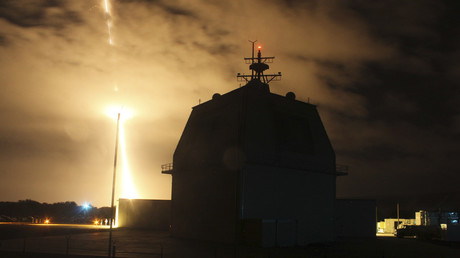
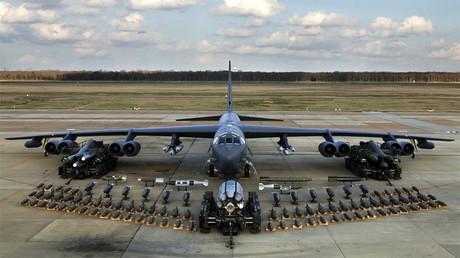
“Inter-continental missiles arrive on time. Rifles and ammunition cross borders, clear every bottleneck, meet each deadline,” Shah, who was elected to Nepal’s top job earlier this year following ‘Gen Z’ protests against corruption, told the assembled world leaders. “But a peasant in Nepal cannot procure his fertilizer or fuel at market price at a time of need.”
📹 'Hit By Climate We Didn't Warm, Hit By Wars We Didn't Start': Nepal PM Balen Shah's Rousing Speech At UN
"This is not Nepal's private misfortune. Ask Bangladesh. Ask Bhutan. Ask India. Ask the Maldives. Ask Pakistan. Ask any other country in our region and you'll hear the… https://t.co/e4U0xT14i1pic.twitter.com/5Bi4Qwi26M
He argued that the problem extends beyond his country, specifically pointing to India, Bangladesh, Bhutan, the Maldives, Pakistan, and Sri Lanka as regional states facing pressures from climate shocks and conflicts.
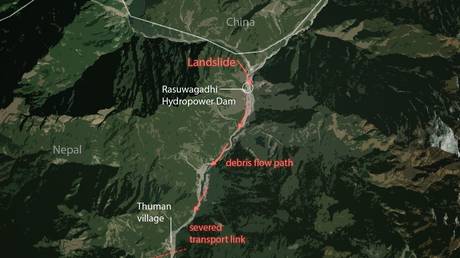
Nepal is recovering from catastrophic flash floods that were triggered by an ice-rock avalanche near the Tibetan border on August 26. The wall of water, mud, and rock tore through mountain communities, killing at least 1,400 people and leaving more than 6,000 missing. Nepal estimates its physical recovery needs at around 10% of its gross domestic product.
The prime minister described the Bhotekoshi-Trishuli disaster as a “warning to the world,” saying a warming climate is destabilizing the Himalayan ecology and increasing the risks of avalanches, floods, and landslides. The devastation affected both sides of the Nepal-China border before floodwaters continued downstream toward India.
Shah also proposed a Himalayan Climate Resilience Mechanism led by Nepal, India, and China. The initiative would involve sharing satellite data and technical expertise, monitoring dangerous glacial lakes, strengthening joint early-warning systems, and coordinating assistance when disasters cross borders.
India and China were among the countries Shah thanked for providing what he called “prompt and generous assistance” after the floods.
The Nepalese leader also called for greater grant-based support for countries rebuilding after climate disasters, arguing that recovery should not force poorer states to take on additional debt. He said Nepal is not seeking to blame individual countries, but wants greater international responsibility and a more equitable global system
Read more
September 25, 2026 at 01:14AM
from RT - Daily news
via IFTTT
‘Flawless logistics for war and broken logistics for food’ – Nepal PM mocks world system
Reviewed by Unknown
on
September 25, 2026
Rating: 5




No comments