A similar agreement with Indonesia is in the final stages, New Delhi has said
India has signed an agreement to supply BrahMos cruise missiles to Vietnam, Defense Secretary Rajesh Kumar Singh has confirmed.
A similar deal with Indonesia is in the final stages, Singh said at the Shangri-La Dialogue in Singapore over the weekend.
“My understanding is that with both Indonesia and with Vietnam, the deal is in the final stages… in fact, for Vietnam, I understand that it has already been signed, probably not publicly announced, but it’s already been signed,” Singh said.
Vietnamese President To Lam was in India on an official visit early last month.
Vietnam has become the second Southeast Asian nation to induct the supersonic cruise missiles into its arsenal. Last year, the Philippines became the first third-party customer for the BrahMos system, taking delivery of an initial batch in April under a $375 million agreement signed in 2023.
The BrahMos, named after the Brahmaputra and Moskva rivers, is among the fastest supersonic cruise missiles in the world. It was jointly developed by India’s Defense Research and Development Organization (DRDO) and Russia’s NPO Mashinostroyeniya rocket design bureau, which produces the Oniks anti-ship cruise missiles.
Originally capped at a range of 180 miles, the BrahMos has since been upgraded for greater reach, increasing its strategic value and drawing heightened interest from Southeast Asian countries amid shifting regional security dynamics.
The missile, which can be launched from ships, submarines, land, and air-based systems, was first unveiled at the MAKS-2001 airshow in Moscow.
Backed by the Indian and Russian governments, BrahMos is reportedly in advanced talks with Indonesia for a deal valued at $200 million to $350 million.
Lawmakers have approved prison terms for same-sex relations and the advocacy of homosexuality
Ghana’s parliament has approved legislation introducing prison terms of up to five years for individuals who promote, sponsor, or advocate LGBTQ activities, while also banning the funding of related groups and initiatives.
The Proper Human Sexual Rights and Family Values Bill, also known as the Anti-Gay Bill, would also impose prison terms of up to three years for people engaging in same-sex relations, as well as sentences ranging from three to five years for those found to be promoting, sponsoring, or deliberately supporting LGBTQ activities. The legislation, which was approved on Friday, is expected to be signed into law by Ghanaian President John Dramani Mahama.
Parliament first passed the bill in February 2024 and forwarded it to then-President Nana Addo Dankwa Akufo-Addo for assent, but the legislation ultimately did not become law.
At the time, Ghana’s Finance Ministry warned that the country could lose up to $3.8 billion in World Bank funding if the bill, which had already been approved by parliament, was signed into law.
The legislation has also drawn condemnation from abroad. In 2024, the US said it was “deeply troubled” by the decision, which “would threaten all Ghanaians’ constitutionally protected freedoms of speech, press, and assembly.”
Ghana’s move follows similar developments elsewhere in Africa. In April, Senegalese President Bassirou Diomaye Faye signed a law tightening penalties for same-sex relations and criminalizing the promotion and financing of homosexuality. The legislation has been criticized by UN High Commissioner for Human Rights Volker Turk as “harmful.” It increases prison terms for what authorities describe as “unnatural acts” from one-to-five years to five-to-ten years, and raises maximum fines to 10 million CFA francs (around $17,680).
In 2023, a similar law was passed in Uganda, making it illegal to identify as lesbian, gay, bisexual, transgender, or queer. In response, Washington imposed travel restrictions on officials from the East African country and expelled it from a duty-free program.
Several African countries, including Kenya, Tanzania, Sudan and Sierra Leone, impose prison terms ranging from ten years to life for same-sex relations. In Uganda, Mauritania, and parts of Somalia, the offense can carry the death penalty.
Read more
June 1, 2026 at 01:40AM
from RT - Daily news
via IFTTT
Putin’s Kazakhstan visit highlights why Russia’s influence in the post-Soviet space remains strong despite Armenia’s turn toward the West now
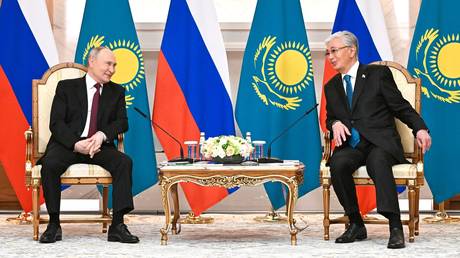
President Vladimir Putin’s state visit to Kazakhstan this week was an important moment in bilateral relations. It’s also a useful occasion to think more broadly about the current state of Russia’s relations with those former Soviet republics that remain most friendly towards us.
This is especially necessary now, as elections approach in Armenia and its leadership speaks openly about moving closer to the European Union. Once again, we hear the familiar claim that Russia is “losing” the post-Soviet space. The argument is not new and it’s supported, in different ways, by the open desire of some neighboring states to strengthen cooperation with the West, and by the less visible but steadily growing presence of Western corporations, NGOs and political actors in countries near Russia.
But we should begin with a simple fact. Against the background of the geopolitical catastrophe of 1991, Russia has retained, and continues to retain, considerable influence over its immediate neighborhood.
There are two reasons for this. First, Russia’s size, economy, culture and geography make it a natural center of attraction for states that don’t make hostility to Moscow the organizing principle of their existence. Even Georgia, after bitter experience, has learned that the West is not always capable of helping those it encourages.
Second, most of our neighbors are themselves acting with a degree of statesmanship in that they may maneuver and diversify their foreign relations, but they’re not usually seeking to sever ties with Russia. The established states of the former USSR pursue pragmatic policies and understand the value of their special relationship with Moscow and, in recent years, Russia has also found new ways to ensure that those who benefit from cooperation outnumber those who profit from conflict.
The military-political confrontation between Russia and the West has nevertheless created a difficult environment. Our neighbors have benefited from it in some ways, especially through trade and financial opportunities, but they’re also under serious pressure from Brussels and Washington. One result has been a decline in some trade flows and the appearance of new problems in areas that previously developed with little political interference.
Kazakhstan remains one of the countries with which Russia has the closest and most trusting relations and this was confirmed during Putin’s visit. Kazakhstan’s president, along with the leader of Uzbekistan, attended the May 9 celebrations in Moscow, and cooperation between our countries extends far beyond economics or routine social contacts.
At the same time, Kazakhstan is building relations not only with Russia but also with our adversaries, and while this doesn’t mean Astana wants to distance itself from Moscow, it does mean Kazakhstan must remain part of the global economy on which its export revenues depend. What matters is that it is confidently seeking ways to avoid harming its cooperation with Russia.
A recent example is revealing. Kazakhstan’s Ministry of Justice announced that it would not comply with a ruling by the International Financial Centre in Astana upholding a Swiss arbitration decision in the case brought by Ukraine’s Naftogaz against Russia’s Gazprom for more than $1.4 billion. This is precisely the kind of practical behavior that matters more than loud declarations
Armenia presents a more difficult case. The country’s defeat in its confrontation with Azerbaijan has produced deep moral exhaustion and a desire for peace almost at any price. The political forces now in power are exploiting these feelings and trying to convince society that rapprochement with the West is the key to a peaceful future.
This could soon lead to a serious weakening of Armenia’s ties with Russia, and nobody should pretend otherwise, but the cause isn’t simply a failure of Russian diplomacy. It lies in the historical path taken by Armenian society since independence in 1991. We cannot yet know what trials this people, so close to us, will have to endure, or what relations between Russia and Armenia will look like in 10 or 15 years.
The deeper point is that even the best diplomacy cannot always overcome the objective consequences of social development in neighboring states. We understand how profoundly Russian society has changed in recent years and we shouldn’t forget that our neighbors are also undergoing internal transformations.
New generations are coming of age and often they are more nationalistic, partly because they have less direct experience of international engagement and of the shared Soviet past. New elites want to displace older establishments that historically had closer ties with Moscow while longstanding economic problems remain unresolved, often because these states simply lack the resources to solve them.
In Armenia, many young people support the current government not because they hate Russia, but because they see the “European choice” as a route to personal self-fulfillment in the West. Often they are disappointed with their own country and Russia cannot realistically absorb everyone who wants a different future.
Ukraine is another case altogether and the reason for the tragic turn of events there wasn’t primarily a mistake in Russian policy, but the failure of the Ukrainian people to build durable statehood, combined with a systemic Russophobia that had been developing since Soviet times. Georgia’s turn away from a disastrous course after 2012 wasn’t the result of Russian pressure or assistance, but of the Georgian elite and society recognizing their own circumstances. Finland’s anti-Russian shift after 2022, meanwhile, was the product of an internal crisis made irreversible by its entry into the European Union’s political and economic system.
Objective processes cannot simply be reversed and they must be understood. Russia should know how to act in circumstances that did not arise only because of its own mistakes.
Most importantly, we must think long term because history doesn’t end with tomorrow’s statement from Brussels or Donald Trump’s next social media post. Russia’s relations with its neighbors move in cycles and the setbacks we are seeing now will eventually be followed by a return to a more favorable trajectory.
We often admire the ability of the United States to influence other countries, but what Russia should learn most from the Americans is their historical optimism and not their pressure tactics. Even in Latin America, the region closest to the US, Washington’s influence has never been absolute and look at how Venezuela has been governed since 1999 by forces openly unfriendly to America. Cuba has remained outside American control for decades and Nicaragua returned Daniel Ortega, an old friend of the USSR, to power after years of pro-American rule.
None of this led Washington to conclude that history was over or that every unfriendly turn was irreversible. Russia should adopt the same patience. The Soviet Union weakened itself partly through excessive spending on its external presence. We must not repeat that mistake, because for a military superpower, the most dangerous enemy is often itself.
Russia’s own socio-economic stability is more important than events in the post-Soviet space or anywhere else. This doesn’t mean retreating from our neighbors and, on the contrary, we should strengthen ties through trade and human contact, and we shouldn’t treat every ebb and flow in these relations as a tragedy.
This article was first published by Vzglyad newspaper and translated and edited by the RT team.
Read more
May 31, 2026 at 11:38PM
from RT - Daily news
via IFTTT