The incident in Honolulu occurred amid nationwide ‘No Kings’ protests against President Donald Trump’s policies, including immigration enforcement
Footage has emerged online showing a man wearing clothing resembling a US Immigration and Customs Enforcement (ICE) uniform being attacked in Honolulu, Hawaii. The incident took place during the ‘No Kings’ protests against US President Donald Trump’s policies, which kicked off nationwide over the weekend.
Protesters took to the streets across all 50 US states on Saturday to oppose the Trump administration’s agenda, including the flagging economy, rising cost of living, conflict with Iran, and immigration enforcement tactics.
A video circulating online from a No Kings protest in Honolulu shows several people violently assaulting a man who was wearing clothing resembling an ICE outfit, repeatedly striking him in the head and knocking him to the ground before others intervene.
According to Honolulu police, the incident occurred on Saturday night. A 15‑year‑old has been arrested on a second‑degree assault charge in connection with the attack, though the authorities have not confirmed whether the man was an actual ICE agent.
Organizers estimated that at least 8 million participants took part in more than 3,300 events nationwide in the latest No Kings protests, making it one of the largest single‑day protest movements in recent years. Earlier rounds of the protests gathered over 5 people in June last year and 7 in October last year.
The largest of the protests took place in New York, Dallas, Philadelphia, and Washington, Reuters reported on Saturday. However, more than 40% of the demonstrations were reportedly held outside major cities.
The main event was held in Minneapolis, Minnesota, which became a focal point of the Trump administration’s hardline immigration crackdown after federal agents fatally shot two US citizens – Renee Good and Alex Pretti – in the city in January. Crowds of protesters later rallied to demand the removal of federal immigration agents and voiced opposition to the enforcement actions.
The shootings became a major flashpoint after the Trump administration launched a hardline agenda on immigration and election integrity. Federal policies, including mandatory detention upheld by appeals courts, have largely remained in place, while 2025 executive actions tightening voter registration and ballot rules continue to draw criticism from civil rights advocates.
Read more
March 31, 2026 at 01:41AM
from RT - Daily news
via IFTTT
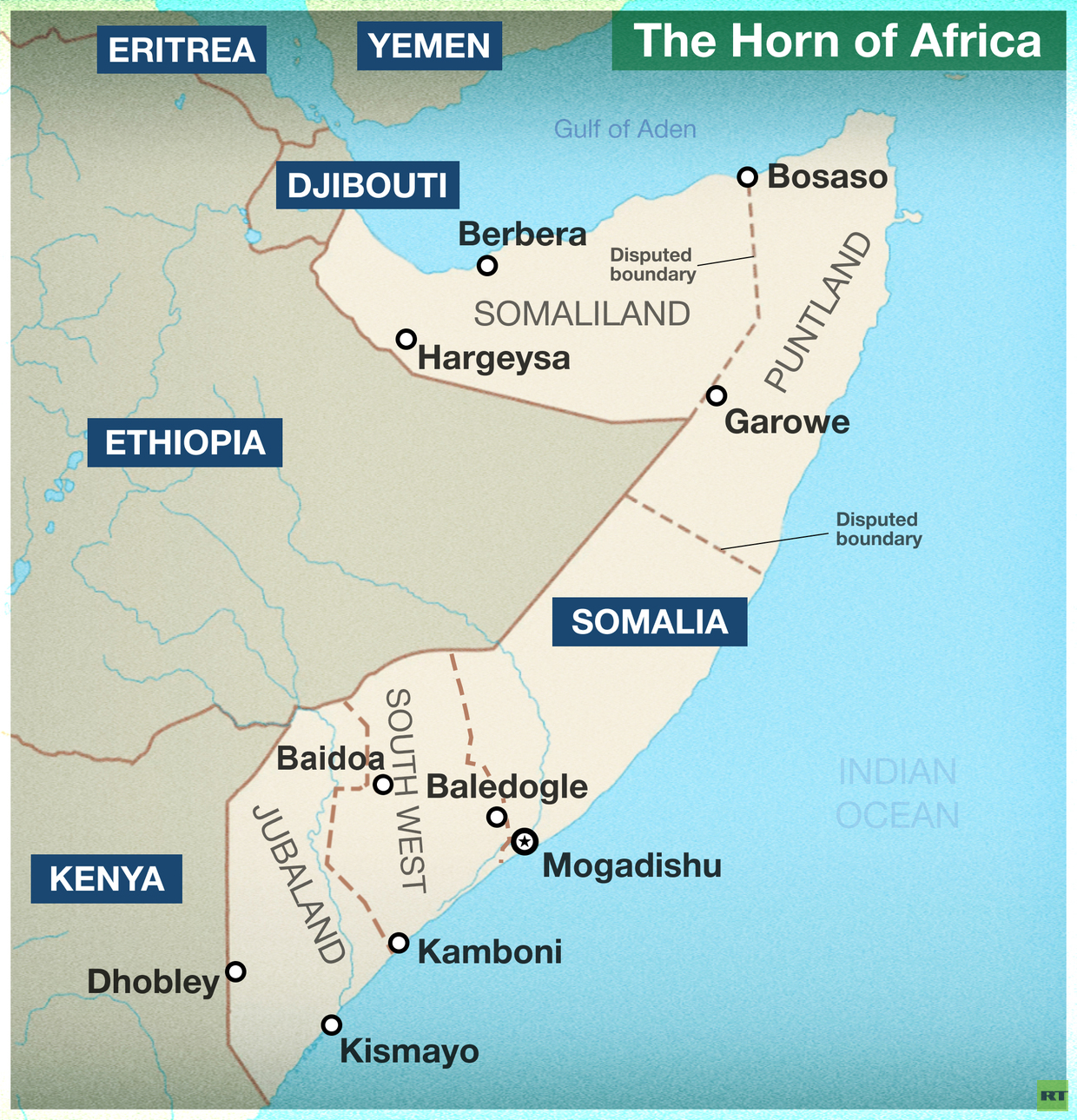
Federal troops entered the South West State city of Baidoa after Mogadishu rejected the reelection of Abdiaziz Hassan Mohamed Laftagareen
Somalia’s national army has taken control of Baidoa, the administrative capital of South West State, forcing regional leader Abdiaziz Hassan Mohamed Laftagareen to resign after a confrontation with the federal government over constitutional changes and elections.
Laftagareen was reelected on Saturday for another five-year term as president of South West State, despite opposition from federal authorities. The Somali Interior Ministry denounced the vote as “a clear act of illegality and premeditated self-appointment,” saying it violated national electoral laws and the constitution.
Mogadishu said the process was completed within 24 hours and lacked transparency, free competition and legitimacy, describing it as “a blatant attempt to manipulate the democratic process and impose a predetermined outcome.”
The federal government announced last week that Laftagareen was “no longer recognized” as the leader of South West State and that all decisions issued by his administration were “no longer valid.”
The move came days after the South West State administration said it was severing ties with Mogadishu, accusing it of arming militias and attempting to oust the regional leader. Tensions have been building in recent weeks after authorities in Baidoa rejected constitutional amendments approved at the federal level.
Federal troops moved into key parts of Baidoa on Monday as civilians fled and some aid agencies suspended operations over fears of wider unrest, according to locals cited by Reuters. The city is one of Somalia’s most sensitive political centers, serving as the seat of South West State and as a base for federal forces, peacekeepers and humanitarian operations.
Somalia’s federal information ministry said the army arrived in Baidoa “in response to the will of the people to fulfill their mandate” and to address political instability created by “the former administration.”
On Monday, Laftagareen announced on Facebook that he was resigning with immediate effect.
He first became president of South West State after a disputed 2018 regional election in which Mukhtar Robow, a former deputy leader of the militant group Al-Shabaab and a leading challenger, was arrested in Baidoa. The arrest triggered protests in which at least 11 people were killed.
Iran has restricted transit through the strategic strait in response to the US-Israeli regime change war
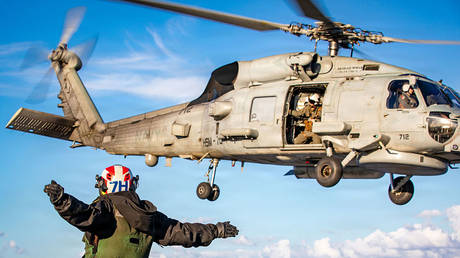
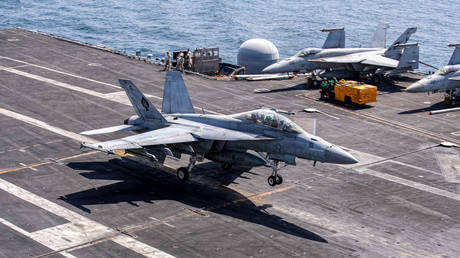
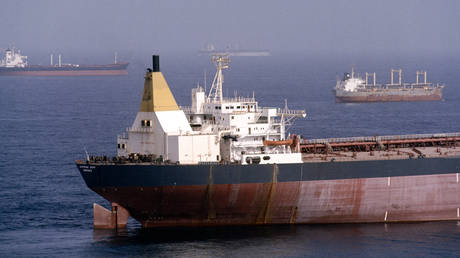
Restoring free shipping through the Strait of Hormuz, currently blockaded by Iran, is not among American military objectives, according to statements by US officials and media reports. Instead, Washington has indicated it expects other nations to tackle the issue.
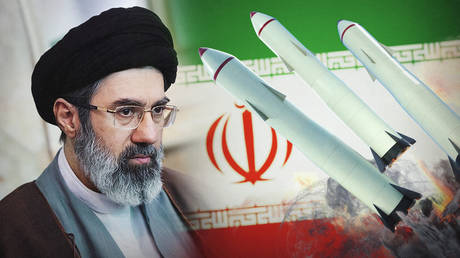
Tehran throttled maritime traffic through the key waterway in retaliation for the US-Israeli attack aimed at toppling the Iranian government, launched over a month ago. Reduced flows of hydrocarbons and other essential commodities from the Persian Gulf have pushed global prices higher, raising the risk of significant economic disruption.
In an interview with Al Jazeera on Monday, US Secretary of State Marco Rubio rejected the idea that Iran would continue to take tolls from ships it allows through the strait, but said that securing free transit was not part of Washington’s war objectives. The US is focused on degrading Iranian military capabilities and is “well on our way or ahead of schedule,” Rubio claimed.
“When this operation is over, it will be open, and it will be open one way or another,” he added. Should Iran insist on its terms, “a coalition of nations from around the world and the region, with the participation of the United States, will make sure that it [the Strait of Hormuz] is open.”
The administration of President Donald Trump believes that attempts to secure the chokepoint “would push the conflict beyond his timeline of four to six weeks” and intends to “press allies in Europe and the Gulf to take the lead on reopening the strait,” the Wall Street Journal reported.
NATO’s war after all?
Previously non-involved nations have refused to deploy their militaries to help the US unblock the Strait of Hormuz. German Defense Minister Boris Pistorius said of Trump’s call for participation: “It is not our war; we did not start it.”
The US leader responded by threatening to call off US support of Ukraine, saying Kiev’s conflict with Russia “isn’t my war.” After taking office, Trump refused to donate weapons to Kiev, forcing European nations to pay for them, while continuing to share crucial intelligence with Ukrainian military commanders.
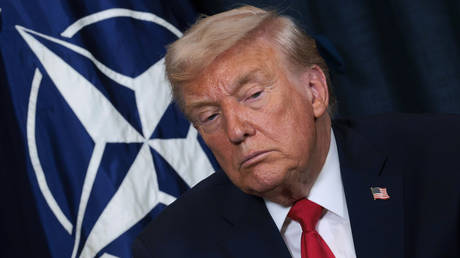
When asked about sentiments among European NATO members that the US is not reliable and could pull the plug on the military bloc, Rubio said being “an alliance means it has to be mutually beneficial” and not a one-way street.
US risks losing more than China in oil crisis
Rubio insisted that “very little of American energy comes through the Straits of Hormuz” and that Washington’s opposition to the Iranian claim is principled rather than pragmatic. If the precedent is set of a nation seizing an international trade route, “the Chinese could do it in the South China Sea” while the US could make claims of its own, he warned.
Washington’s assumption that, as an energy exporter, the US is largely insulated from the economic blowback of the Middle East crisis was challenged this week by Goldman Sachs. The Chinese economy “appears better positioned amid oil supply shock than its global peers,” strategist Kinger Lau wrote on Monday.
This is pretty ironic: Goldman Sachs estimates that the US economy will be *twice* more affected (negatively) than the Chinese economy by the oil supply shock.
"The Chinese economy appears better positioned amid the oil supply shock than its global peers [...] Due to the oil… pic.twitter.com/619wH1oiNM
Beijing has boosted the share of non-fossil energy sources in its mix from 26% a decade ago to 40% now, the analysis said. It also possesses large strategic reserves and diversified import routes, including from Russia, Australia, and Malaysia. US economic growth could be impacted twice as much as China’s, the note predicted.
Read more
March 30, 2026 at 11:39PM
from RT - Daily news
via IFTTT
The second secretary of the British Embassy has been given two weeks to leave the country, the FSB has said
A British diplomat in Moscow has been stripped of his accreditation and ordered to leave the country after conducting “intelligence and subversive activities” under the cover of his embassy post, Russia’s Federal Security Service (FSB) has announced.
The officer, identified as Albertus Gerardus Janse van Rensburg, served as second secretary at the UK embassy in Moscow. According to an FSB statement released on Monday, the diplomat deliberately provided false information when applying for entry permission, thereby violating Russian law.
The FSB also said it had “recorded attempts to obtain sensitive information during informal meetings with Russian experts in the field of economics.” The agency concluded that van Rensburg was engaged in activities “threatening the security of the Russian Federation.”
The diplomat has been given two weeks to leave the country.
The Russian Foreign Ministry summoned the UK’s charge d’affaires, Danae Dholakia, to officially lodge a protest. In a brief appearance outside the ministry building, Dholakia was seen arriving with van Rensburg before entering without commenting to journalists.
The expulsion of the British diplomat comes after London announced last week that it would cooperate with other European NATO members to “close off UK waters, including the [English] Channel, for sanctioned vessels,” threatening to seize ships it believes to be part of an alleged Russian ‘shadow fleet’.
Moscow has denied operating a shadow fleet and has condemned the “deeply hostile step,” accusing the UK of planning to carry out “acts of piracy.”
Watch RT’s report on the latest developments below.
Read more
March 30, 2026 at 12:40AM
from RT - Daily news
via IFTTT
The new measures will help distribute the fuel for cooking and lighting in several states, the oil ministry has said
India has decided to relax kerosene safety and distribution rules in an attempt to deal with a shortage of natural gas affecting several parts of the country.
The measures, that will be in place for 60 days, will allow for the sale of kerosene at select filling stations in 21 states and union territories, the Petroleum and Natural Gas Ministry said on Sunday.
The move is aimed at speeding up storage, movement and last-mile delivery, as many parts of India face disruptions in energy supplies on account of the crisis in the Middle East.
”Amid the evolving situation in West Asia, the Government of India is maintaining continuous oversight and implementing appropriate preparedness and response measures to ensure stability across key sectors,” the ministry said in a statement. “Efforts remain focused on sustaining uninterrupted energy supplies, safeguarding maritime operations, and extending necessary assistance to Indian nationals in the region.”
India imports 85% of its oil and nearly half of its natural gas. Around half of its crude oil and LNG shipments are normally routed through the Strait of Hormuz.
The South Asian nation is now discussing the resumption of direct purchases of liquefied natural gas (LNG) from Russia for the first time since the Ukraine conflict escalated.
Last week, New Delhi said it had enough fuel stocks to cover the country’s need for at least 60 days.
India, the world’s fourth largest refiner and fifth largest exporter of petroleum products, is supplying refined fuel to over 150 countries, the Petroleum and Natural Gas Ministry said.
On Saturday, India supplied 38,000 metric tons of fuel to Sri Lanka, after the island nation’s President Anura Kumara Dissanayake made a special request to Indian Prime Minister Narendra Modi. The consignment includes 20,000 tons of diesel and 18,000 tons of gasoline.
Read more
March 29, 2026 at 11:21PM
from RT - Daily news
via IFTTT
Karol Nawrocki has criticized the union’s energy and migration policies that “go against common sense” as well as “ideological projects”
Polish President Karol Nawrocki has said the EU “needs urgent repair” and criticized self-defeating energy and migration policies imposed on member states by unelected bureaucrats as well as a growing ideological slant within the bloc.
A poll by Eurobazooka late last year indicated that 25% of Polish respondents favored a ‘Polexit,’ with another 6% unsure, making the country a major hotspot of Euroscepticism. National daily Gazeta Wyborcza noted at the time that as recently as 2022, around 92% of Poles favored remaining in the EU.
In recent years, Polish conservatives have increasingly accused the bloc of imposing liberal social norms regarding issues such as LGBT rights, gender policy, and judicial reforms on their predominantly Catholic country.
Addressing a mostly Republican US audience at the Conservative Political Action Conference (CPAC) in Texas on Sunday, Nawrocki said that “powerful [EU] bureaucrats [are] making decisions that go against common sense.” He cited the bloc’s “energy policies that move too fast with no regard for economic reality and energy security” as well as “migration policies that fail to protect borders and social cohesion.”
“There are moves to centralize decision-making, sidelining nations and democratic accountability,” the Polish president lamented.
According to Nawrocki, at times, the EU leadership has attempted to impose “ideological projects” on member states in an apparent effort to “move us away from the values that built our Christian civilization rather than reinforcing them.”
In a post on X earlier this month, Polish Prime Minister Donald Tusk claimed that there was “a real threat” that his country could leave the EU after President Nawrocki vetoed legislation that would have let Warsaw draw nearly €44 billion ($50 billion) in low-interest EU defense loans.
The government eventually authorized its defense and finance ministers to sign the Security Action for Europe (SAFE) agreement directly, bypassing the veto.
Tusk, who previously served as the president of the European Council, accused the right-wing opposition and Nawrocki personally of siding with Russia, US President Donald Trump’s MAGA movement, and European Eurosceptic factions led by Hungarian Prime Minister Viktor Orban in seeking to “smash the EU.”
Read more
March 29, 2026 at 06:32AM
from RT - Daily news
via IFTTT
Petteri Orpo has linked the aerial incursion to Kiev’s latest UAV attacks on oil facilities in Russia’s north-western Leningrad Region
Two suspected Ukrainian drones have crashed in Finland, Prime Minister Petteri Orpo has reported, conjecturing that the UAVs were launched as part of Kiev’s latest attacks on neighboring Russia’s Leningrad Region.
In a post on X on Sunday, Orpo wrote that the “drones have strayed into Finnish territory,” and that the incident was being investigated by local authorities and the Defense Forces.
The Finnish prime minister characterized the “territorial violation as a very serious matter,” as quoted by Yle News.
Meanwhile, the country’s Air Force identified one of the UAVs as a Ukrainian AN196 drone.
There have been no reports of casualties on the ground as a result of the incident.
According to the Nordic country’s Defense Ministry, “several small, slow-flying, low-flying objects were observed in Finnish airspace over the sea and in southeastern Finland on Sunday morning.”
F/A-18 Hornet fighter jets were deployed to monitor the drones, but did not use suppressive fire so as to avoid collateral damage, according to Yle News.
The Defense Ministry stated that the UAVs eventually crashed near the city of Kouvola, roughly 100 kilometers (62 miles) west of the Russian border.
Read more
March 29, 2026 at 05:14AM
from RT - Daily news
via IFTTT
What the US and Israel saw as a quick campaign, Iran sees as a fight for survival. Costs are rising and the end is nowhere in sight.
After one month of war against Iran, one conclusion stands out more clearly than anything declared in all the press briefings: Neither the US nor Israel entered this confrontation with a plan for a long war.
The campaign was conceived as a short and brutal episode, a shock operation designed to break Iran’s will, force Tehran back to the table on humiliating terms, or in the most ambitious fantasies circulating around Donald Trump’s political circle, trigger internal collapse and perhaps even regime change. Israel’s aim was somewhat different, though complementary. It wanted to inflict the maximum possible damage on Iran’s military and strategic infrastructure, weaken it for years, and reshape the regional balance through force. Yet in the first month of fighting, the central assumption behind both approaches began to collapse. Instead of folding and getting coerced into submission, Iran resisted like a state fighting for survival.
What doesn’t kill Iran makes it stronger
American planners appear to have imagined a limited punitive maneuver lasting perhaps a week or two. The logic was familiar and, from their point of view, elegant. Strike hard, generate fear, disrupt command structures, raise the economic cost, and create a moment in which Iran’s leadership would face a stark choice between capitulation and disaster. Some in the Trump camp seem to have believed that Iran’s political system was brittle enough to crack under pressure. That assumption now looks less like strategy and more like projection. Washington entered the war expecting quick leverage rather than a drawn out contest of endurance.
Israel, for its part, appears to have approached the opening phase with fewer illusions about diplomacy and more determination to degrade Iran by force. The strategic instinct in West Jerusalem was not primarily to negotiate with Tehran from a position of strength, but to use the cover of an American-backed offensive to hit as much as possible and to push Iran backward in military, technological, and geopolitical terms. In that sense, Israel’s goals were harsher and more concrete. But even here the first month exposed a contradiction. A state can damage Iran. It can kill, disrupt, sabotage, and bomb. Yet weakening Iran is not the same thing as breaking Iran. A campaign that hurts but does not decisively cripple can still end by strengthening Tehran politically, morally, and strategically if the attacked state manages to survive, retaliate, and turn endurance into legitimacy.
And this is precisely where Iran exploited the moment. Tehran broke the mental template through which many Americans had been reading the crisis. In Washington, the war seems to have been imagined as a tactical episode. In Tehran, it was understood as a strategic struggle, even an existential one. Iran’s leadership acted not as if it were participating in another bargaining cycle, but as if it had entered a defining confrontation over sovereignty, deterrence, and state survival. That difference in strategic depth has shaped the first month more than any individual missile strike. A side fighting to improve negotiating conditions usually stops when the price becomes uncomfortable. A side fighting because it believes defeat would endanger its future absorbs pain differently, calculates differently, and escalates with a different kind of discipline.
At the same time, the Iranian authorities received an important internal political opportunity. External aggression almost always reshapes the internal mood of a country under attack, and Iran was no exception. Whatever grievances, divisions, and frustrations existed inside Iranian society before the war, the assault by the US and Israel gave Tehran a chance to consolidate the population around the state, the flag, and the idea of national survival. In moments like these, even a government facing criticism can reposition itself as the defender of the nation against foreign violence. This does not erase internal tensions, nor does it magically solve Iran’s domestic problems. But it does give the leadership room to invoke patriotism, sacrifice, and resistance in a way that would have been much harder under normal circumstances. For the Iranian state, this may prove to be one of the most important political effects of the war.
From that point on, what was supposed to be an operation of intimidation started looking like a reputational trap for the US. Washington still possesses overwhelming destructive capacity, but power is never measured by firepower alone. It is also measured by political clarity, by the realism of objectives, by the ability to shape outcomes without self harm, and by the credibility of the order one claims to defend. In the first month of this war, the US damaged all four. It entered with rhetoric of strength and has already found itself talking about pauses, mediation channels, indirect messages, and deadlines extended under pressure. That does not look like a superpower dictating terms. It looks like a superpower discovering that coercion is easier to launch than to conclude.
The world is paying the price
The economic consequences alone make the operation look strategically self-defeating. A war of this kind does not remain confined to military maps. It spreads into oil prices, shipping insurance, central bank caution, inflationary pressure, food costs, investor panic, and political unrest in countries far from the battlefield. What may have been sold in Washington as a limited geopolitical shock has instead begun to resemble an accelerant poured onto an already unstable world economy. In that sense, one of the most likely long-term effects is not simply turbulence in the Middle East, but the deepening risk of global recession. And if recession does take shape, the US will have contributed to it not as a passive observer of chaos, but as one of its principal producers. There is a profound irony in that. Washington launched this war claiming security and strength, yet may end up exporting insecurity on a global scale while weakening its own economic room for maneuver.
The second major consequence is geopolitical, and in the long run, potentially even more serious. This war is speeding up the fragmentation of the international system. It is another lesson to the world that dependence on American guarantees comes with growing uncertainty, ideological volatility, and sudden unilateralism. Allies are reminded that the US can launch a major war and then demand solidarity after the fact. Partners are reminded that American decision making can be shaped by electoral instincts, media theatrics, and the inflated confidence of officials who confuse disruption with strategy. Neutral states are reminded that in moments of crisis, sovereignty and hedging matter more than alignment slogans. This is how multipolarity grows in practice: through repeated demonstrations that the old center can no longer discipline events without destabilizing them.
The war has also exposed how thin the cohesion in the ‘collective West’ has become. America’s traditional allies did not rally in the way Washington expected. European governments showed skepticism, irritation, and in some cases outright distance. Alliance fatigue is showing under pressure. NATO still exists, still spends, still coordinates. But politically and psychologically, the old image of a fully unified Western bloc has taken another blow.
Credibility in alliance systems is cumulative. It is built over decades and can be weakened shock by shock. Every episode in which Washington acts first and consults later, every outburst that treats partners as instruments rather than political actors, every demand for obedience without strategic explanation erodes trust a little further. A military alliance can survive such erosion for a while, especially when members still fear common adversaries. But the political soul of an alliance is harder to repair than its budget lines. The first month of war with Iran has widened the emotional and strategic distance between the US and parts of Europe, and it has done so at a time when Western institutions were already carrying the weight of internal contradictions. The collective West is now far less collective than it claims to be, and this conflict has only made that clearer.
The war is changing the Gulf – and Iran itself
For the Gulf states, the conflict opens the door to a new era as well. Their security conceptions were built for decades around managed dependence on the American umbrella combined with ambitious social and economic transformation at home. That model now looks less stable. The Gulf monarchies face a harsh reality. They remain exposed to Iranian retaliation, exposed to disruption in shipping lanes, exposed to energy shocks, and exposed to the possibility that Washington may act decisively but not predictably. In any case, the old assumption that American power automatically equals regional order has been weakened. For Gulf elites, this means security doctrine and development strategy can no longer be treated as separate spheres. They are becoming one and the same question. The region is entering a new era in which old formulas of protection, growth, and political balance will have to be revised.
Iran’s position is more paradoxical. Militarily, it has suffered. Economically, it remains under crushing pressure. The damage inside the country is real and severe. Yet politics is not an accounting sheet of destruction alone. Much depends on how the current phase ends. If Tehran were eventually forced into humiliating concessions, the present gains in image and positioning could evaporate. But at this stage, Iran has undeniably improved its international positioning in one crucial sense. It has shown that it can answer Washington and endure under immense pressure. Across much of the non-Western world, and in large segments of global public opinion that are deeply suspicious of American interventionism, Iran is increasingly seen less as the caricature of official Western messaging and more as a state defending itself against aggression by the US and Israel. Survival under assault can be politically transformative.
There is also a broader symbolic effect. For years, the dominant assumption in many Western capitals was that Iran could be boxed in, isolated, intimidated, and gradually bent into strategic submission. The first month of war has not validated that worldview. Instead, it has reminded observers that middle powers under extreme pressure can still generate strategic surprises when they are internally organized around endurance, asymmetry, and political patience. Iran did not have to win conventionally in order to alter the meaning of the conflict. It only had to deny the rapid political result that the aggressors were hoping for. And by doing so, it shifted the psychological terrain of the war.
Israel, meanwhile, may be the only actor that can claim a short-term political gain, though even that gain is narrow and dangerous. The immediate beneficiaries appear to be the Israeli far-right currently in power. For them, war expands room for ideological hardening, securitized politics, and the argument that maximal force is the only language the region understands. A prolonged confrontation with Iran also helps keep domestic political dynamics inside an emergency frame, where dissent can be marginalized and radical agendas can travel further than they otherwise might. But this is not the same as a strategic Israeli victory. It is a political gain for a particular faction, not necessarily a stable gain for the Israeli state over time. A region pushed deeper into permanent war is not a region that guarantees long-term safety, even for the side that presently feels ascendant.
The losses are strategic
If one looks at the ledger after a month, then the paradox becomes stark. The country with the greatest military weight may also be the one that has lost the most strategically. The US has absorbed reputational damage, intensified doubts about its judgment, strained allied confidence, worsened global economic instability, and accelerated the very multipolar drift it has long tried to slow. Israel has achieved a harder regional environment and a temporary opening for its most hardline political forces. Iran has paid heavily, but it has also demonstrated resilience, strengthened its narrative of resistance, and improved its international positioning in the eyes of many who now see it as a country under attack rather than a rogue state to be punished. The Gulf states have been pushed toward strategic revision. Europe has been reminded that transatlantic solidarity now has sharp limits. The West, in other words, is still armed, still wealthy, still institutionally significant, but it is no longer politically seamless.
This is why the first month of the war should not be read only through maps of strikes, casualty counts, and tactical moves. Its deeper meaning lies elsewhere. It has revealed the bankruptcy of a familiar illusion in American foreign policy, the illusion that one can use violence as a short demonstration, compel strategic capitulation, and walk away before the political consequences mature. That script worked badly even in a simpler world. In a fragmented world, an inflation prone world, an energy anxious world, and a world increasingly tired of unilateral American shocks, it works worse still. Iran understood the confrontation as a struggle over existence. Washington treated it too long as a maneuver. History tends to punish that kind of asymmetry in seriousness.
By the end of the first month, cautious attempts at negotiations had begun to emerge, and it is the Americans who appear most interested in testing that track. This alone says a great deal about how the campaign has unfolded. The side that imagined it would quickly impose its will is now far more invested in finding an exit than it expected to be. Yet the parties remain far from peace. Their positions are still separated by distrust, anger, incompatible war aims, and the accumulated logic of escalation. The final outcome of the conflict remains deeply uncertain, perhaps more uncertain now than at its start. The fog has not lifted. It has thickened.
And yet one thing is clear even through that fog. Nearly everyone involved senses that the catastrophe is widening. The war is no longer perceived as a contained clash with neat limits. It is increasingly seen as a chain reaction whose radius keeps expanding politically, militarily, economically, and psychologically. The fear now is not only of more destruction, more displacement, and more regional destabilization. It is also of the point at which escalation crosses into something far darker, including the possibility of a nuclear catastrophe. That fear may still sound extreme to some, but the fact that it is now being spoken aloud at all tells us how dangerous this conflict has become.
The most sobering conclusion is therefore also the simplest. Instead of restoring American authority, a month of war has exposed its limits. Instead of reuniting the Western camp, it has shown how divided and conditional that camp has become. Instead of solving the Iranian question, it has made clear that Iran cannot be dealt with as a mere tactical object. And instead of making the world safer, it has made it more fragmented, more suspicious, more expensive, and more unstable.
Read more
March 29, 2026 at 04:08AM
from RT - Daily news
via IFTTT
An E-3 Sentry AWACS aircraft has been struck during an attack on Prince Sultan Air Base in Saudi Arabia, the IRGC has said
A key US Air Force E-3 Sentry AWACS command and control aircraft has been “100% destroyed” in an Iranian missile and drone strike on the Prince Sultan Air Base in Saudi Arabia, the Islamic Revolutionary Guard Corps (IRGC) has said.
The spy plane was hit along with several other US jets during Friday’s attack on the installation, located some 96 km (60 miles) southeast of Riyadh, the IRGC said in a statement on Sunday. The Saudi base was targeted “in response to hostile actions of the US terrorist army,” it read.
Up to six ballistic missiles and 29 UAVs were used, leaving at least 15 US troops wounded, including five in serious condition, according to AP.
Air & Space Forces Magazine, a US publication, reported the destruction of an AWACS aircraft at the Prince Sultan Air Base on Saturday, citing people familiar with the matter.
The same day, OSINTdefender, an open-source intelligence monitor, published photos on X it claimed captured the damage done to the spy plane.
Pictures show the total loss of 81-0005, an E-3G “Sentry” Airborne Early Warning and Control (AEW&C) Aircraft with the U.S. Air Force’s 552nd Air Control Wing based out of Tinker Air Force Base, Oklahoma, following yesterday’s Iranian ballistic missile and drone attack on Prince… pic.twitter.com/NNnILybnrU
It appeared to have been struck in its rear section where its distinctive rotating radar dome is located, with the explosion separating the tail from the fuselage.
Meanwhile, Iranian broadcaster PressTV released satellite images purporting to show the destruction of several planes at the Saudi base.
US Central Command declined to comment on the loss of an E-3 when approached by the media.
Open-source flight tracking data suggests that at least six such planes have been stationed at the Prince Sultan Air Base, which has been targeted by Iran three times in the last week.
Boeing produced around 70 E-3 Sentry aircraft between 1977 and 1992, with 16 of them reportedly still in service with the US Air Force. The planes are designed to provide all-weather surveillance, command, control and communications, and – despite their age –remain crucial for American military operations.
An E-3 Sentry costs around $270 million to manufacture, but an E-7 Wedgetail, which the Pentagon sees as a replacement for the older spy plane, is priced at more than $700 million.
Read more
March 29, 2026 at 03:05AM
from RT - Daily news
via IFTTT
An ongoing inquiry into the attack on a girls’ school in Minab has preliminarily pointed to US responsibility, according to media reports
The Iranian National Football Team paid tribute to the victims of a suspected US strike on a girls’ school in the city of Minab during a match in Türkiye.
The February 28 strike on the Shajarah Tayyebeh school came on the first day of the US-Israeli attack on Iran, killing more than 175 students and staff.
Appearing on the field ahead of a match against Nigeria in the Turkish city of Antalya on Friday, the Iranian footballers held small pink and purple school backpacks and wore black armbands.
Addressing an emergency session of the United Nations Human Rights Council that same day, Iranian Foreign Minister Abbas Araqchi argued that the attack on the school “was not a mere ‘incident’ nor a ‘miscalculation’,” given the advanced US and Israeli military technologies.
The Iranian diplomat demanded “unequivocal condemnation by all and unambiguous accountability for the culprits,” warning that “indifference and silence… would invite more insecurity and right violations.”
According to Araqchi, “more than 600 schools have been demolished or damaged across Iran and more than 1,000 students and teachers martyred or wounded as the result” of the ongoing US-Israeli aggression to date.
He also claimed that hospitals and residential areas have repeatedly come under attack – something indicative of a “clear intent to commit genocide.”
Earlier this month, the New York Times reported that an ongoing Pentagon inquiry into the attack had preliminarily attributed responsibility to the US military, most likely stemming from outdated targeting data. The building was once part of a military compound operated by the Islamic Revolutionary Guard Corps (IRGC) Navy, but was converted into a school over a decade ago.
According to the newspaper, satellite imagery and videos from the scene indicate that the explosion was consistent with a Tomahawk cruise missile impact.
President Donald Trump has denied US responsibility, first suggesting “very inaccurate” Iranian munitions were to blame, then claiming without evidence that Tehran also “has some Tomahawks.”
The US is the only party to the conflict that possesses such weapons. Globally, only a handful of US allies, including the UK and Australia, operate the system.
Read more
March 28, 2026 at 05:24AM
from RT - Daily news
via IFTTT
Moscow has said it will not allow Kiev to possess nuclear arms under any circumstances
Vladimir Zelensky has demanded that Kiev’s Western backers either admit Kiev to NATO or supply it with nuclear weapons, arguing that nothing less can protect Ukraine against a nuclear-armed Russia.
In an interview with French newspaper Le Monde on Friday, Zelensky lashed out at Ukraine’s critics, who he said did not believe in Kiev’s ultimate victory over Russia due to Moscow’s nuclear arsenal.
”When everyone says that Ukraine will not win this war because Russia is a nuclear power, then tell me, what do you think, what security guarantees should Ukraine have to oppose it? Which? NATO? Nuclear weapons? Well then, people should speak with us in the same way,” he said.
He admitted, though, that “until now, no one has asked us that question,” adding that he found “astonishing” the fact that “no one is talking about Russia, at least in the same terms.”
Zelensky’s comments came after he told Reuters earlier this week that Washington’s post-war security guarantees were contingent on Kiev withdrawing from the parts of Russia’s Donbass it still occupies. Donbass, along with two other former Ukrainian regions, overwhelmingly voted to join Russia in 2022, and Moscow has insisted that Kiev’s full withdrawal from the territory was a key condition for a sustainable peace.
However, US Secretary of State Marco Rubio pushed back against Zelensky, accusing him of telling a “lie.”
“I saw him say that, and it’s unfortunate he would say that, because he knows that's not true and that’s not what he was told,” Rubio stated.
”What he was told is the obvious: security guarantees are not going to kick in until there’s an end to a war, because otherwise you’re getting yourself involved in the war.”
Zelensky has, on numerous occasions, denied that Ukraine was seeking to acquire nuclear weapons. However, he told Sky News last month that he would accept nuclear weapons from Britain and France “with pleasure, but I didn’t have propositions,” as he responded to Moscow’s accusation that London and Paris had plans to secretly arm Ukraine with atomic capabilities.
Russia has repeatedly said it would not allow Ukraine to acquire nuclear weapons under any circumstances. Moscow has also suggested that Zelensky’s openness to getting his hands on nuclear weapons before the escalation of the conflict in 2022 was one of the reasons for the start of the hostilities.
Read more
March 28, 2026 at 04:24AM
from RT - Daily news
via IFTTT
Over 80% of Russians say spirits and saints exist, and 85% have practiced magic rituals, a VCIOM report suggests
Around 81% of Russians believe in the existence of at least one supernatural being, while the overwhelming majority have engaged in some form of mystical practice during their lifetime, the Russian Public Opinion Research Center (VCIOM) reports.
The survey, which encompassed 1,600 adults and was published on Friday, found that two-thirds of respondents (66%) believe in saints or higher powers protecting people in danger or in battle.
More than half (57%) believe in spirits or deities that protect military personnel; 50% say they believe in ‘Domovoy’, a household guardian spirit, and 48% believe in protective spirits for children and animals. Only 22% believe in mermaids and nymphs.
Russians also tend to accept various mystical and magical practices; 85% of respondents say they have tried at least one; 59% have visited sacred healing springs, 52% have consulted horoscopes or astrologers, 37% have tried fortune-telling, 36% have worshiped at sacred sites, and 25% have worn talismans or amulets tied to spirits or natural forces.
Belief in supernatural entities rises sharply with age; 93% of those 60 and over accept at least one supernatural being, compared to 65% for 25-34-year-olds. Engagement with magical practices, however, remains broadly consistent across generations – ranging from 80-88%.
Commenting on the results, Maria Grigorieva, a senior expert at VCIOM’s Department of Political Research, linked them to the ongoing geopolitical instability and uncertainty about the future.
“Superstitions are a universal psychological mechanism – they reduce the stress of uncertainty, the main source of anxiety. The less control people have over their lives, the stronger the belief,” she said.
She added that Russia’s current geopolitical and economic pressures are “intensifying anxiety, provoking a surge in mysticism” – with more people turning to fortune-tellers, horoscopes, and belief in spirits and home guardians.
According to Grigorieva, faith serves as a psychological shield, particularly amid ongoing military threats.
Read more
March 28, 2026 at 12:34AM
from RT - Daily news
via IFTTT
The Oil Ministry has dismissed reports of shortages as a “deliberate misinformation campaign” to spur panic buying
India has adequate fuel stocks to cover the country’s needs for 60 days, the government has said.
The Ministry of Petroleum and Natural Gas has urged citizens not to be misled by media reports that the South Asian nation is facing depleting oil reserves.
There is no shortage of petrol, diesel, or LPG in the country, the Oil Ministry said on Thursday, terming the reports “a deliberately mischievous, coordinated campaign of misinformation that is being carried out to spread unjustified panic.”
“When the rest of the world has been taking drastic fuel conservation measures such as odd-even, four-day work weeks, school and office closures and increasing fuel prices by 20-30%...India remains an oasis of energy security,” Oil Minister Hardeep Singh Puri said in an X post on Friday.
India, the world’s fourth largest refiner and fifth largest exporter of petroleum products, is supplying refined fuel to over 150 countries, the ministry said.
🚨Some posts circulating on social media claim that India has 'only 9 days of oil reserves left'.#PIBFactCheck:
✅ India has a total reserve capacity of 74 days, with the current stock cover at around 60 days. This includes crude oil, petroleum… pic.twitter.com/12O5JIwU1I
The official Press Information Bureau’s Factcheck division posted on X that the country has a reserve capacity of 74 days and stock cover of two months.
“All 1 lakh [100,000]-plus retail fuel outlets across the country are open and dispensing fuel without interruption. Not a single outlet has been asked to ration supply,”the Oil Ministry said in a release.
India is now receiving more crude oil from its 41-plus suppliers across the world than what was arriving before the conflict began, it added.
New Delhi has invoked special legislation to speed up gas pipeline projects and to ensure domestic cooking gas supplies for its 1.4 billion population amid the Middle East conflict.
The US-Israeli war against Iran has virtually halted shipping traffic through the Strait of Hormuz. Around 40% of India’s crude oil imports and 55% of its liquefied natural gas (LNG) shipments pass through the strait, which is controlled by Iran.
Iran has permitted the passage of Indian ships through the Strait of Hormuz, its foreign minister, Abbas Araghchi, has said.
Read more
March 27, 2026 at 01:08AM
from RT - Daily news
via IFTTT
Unidentified assailants targeted the Russian House in the Czech capital in what Moscow has labeled a terrorist attack
The Russian House cultural center in the Czech capital of Prague was attacked with Molotov cocktails on Thursday evening, in what Moscow has labeled a “terrorist attack.”
The facility’s director, Igor Girenko, told RT that the attackers appeared to target the windows of the building’s library, noting that three of the six incendiary bottles thrown failed to explode. “It’s hard to imagine what the consequences would have been if these inhumane men had succeeded.”
Girenko suggested that the timing of the attack was “no coincidence,” noting that the final event of the Russian Culture Days festival was scheduled for Thursday.
“Only inhuman creatures would target culture! We are well acquainted with their habits and signature,” the Russian House director said. He also thanked local law enforcement and firefighters who arrived at the scene within minutes.
“We believe this crime will not go unsolved, and that those responsible will receive a harsh and just punishment,” Girenko added.
Meanwhile, Pavel Shevtsov, the deputy head of the state Rossotrudnichestvo cultural exchange agency which operates the cultural center, told RIA Novosti that the incident is being treated as a “terrorist attack against our Rossotrudnichestvo center, against Russian property,” adding that this was “a planned, targeted attack.”
Shevtsov said Rosssotrudnichestvo, with assistance of the Russian Embassy, is in contact with the local authorities to find and bring to justice those responsible for the attack.
Russian Foreign Ministry spokeswoman Maria Zakharova has also condemned the attack, describing it in a statement to TASS as “barbaric.”
The Czech authorities have confirmed that they are investigating the attack, noting that the assailant who fled from the scene could face up to three years in prison.
Read more
March 27, 2026 at 12:37AM
from RT - Daily news
via IFTTT
Michael Flynn argued he was unfairly targeted in Special Counsel Robert Mueller’s investigation
The US Department of Justice has settled a lawsuit brought by Michael Flynn, a former national security adviser to President Donald Trump, stemming from his prosecution during the Russiagate investigation.
A federal court in Tampa, which had been considering Flynn’s claim of malicious prosecution, was notified of the agreement on Wednesday. According to media reports, the DOJ will pay approximately $1.2 million – a fraction of the $50 million Flynn had originally sought.
Flynn served in Trump’s first administration and was among several figures charged following recommendations from Special Counsel Robert Mueller, who led an inquiry into alleged ties between the Trump campaign and Russia.
The DOJ described the settlement as “an important step” toward correcting a “historic injustice” linked to Russiagate-related prosecutions. Flynn said he had been subjected to a “partisan pursuit that weaponized federal law enforcement in an audacious and unjust manner” and that the current leadership of the department has demonstrated commitment to tackling a “crisis of politicized justice.”
During the 2016 election cycle, the FBI surveyed members of Trump’s campaign in a controversial probe partly supported by the so-called Steele dossier – a compilation of unverified allegations about Trump’s connections to Russia, funded by Hillary Clinton’s campaign and compiled by a former British intelligence officer.
Flynn was dismissed just weeks into his role over misleading then-Vice President Mike Pence about conversations with the Russian ambassador. He later pleaded guilty to lying to the FBI regarding discussions over sanctions on Russian, though he subsequently claimed prosecutors violated an agreement by pursuing a prison sentence.
In November 2020, Trump pardoned Flynn after losing the election to Joe Biden. Flynn filed his lawsuit in 2023, when Biden’s Justice Department sought to have the case dismissed. That stance shifted after Trump returned to office in 2025.
Trump has long criticized the Russiagate investigation as a politically motivated “witch hunt,” a claim he extended to subsequent legal challenges he faced after leaving office. His second administration has also suggested possible reprisals against people it views as responsible for the investigations.
The president’s stance was underscored by his reaction to Mueller’s death this week, when Trump said he was “glad” because Mueller “can no longer hurt innocent people.”
Read more
March 26, 2026 at 11:50PM
from RT - Daily news
via IFTTT
Coca-Cola formally exited the market over the Ukraine conflict but still maintains a foothold
Russian authorities have raided a facility producing counterfeit Coca-Cola beverages. The US company formally halted operations in the country due to the Ukraine conflict, although original Coca-Cola products imported from neighboring states are still widely sold.
The raid took place in the town of Rudnya in Smolensk Region, where police seized around 49,000 two-liter plastic bottles of imitation carbonated drinks. Interior Ministry spokeswoman Irina Volk shared footage of the operation on Thursday, showing the manufacturing site.
According to officials, the facility made its own bottles and stocked caps and labels falsely indicating the drinks were produced in Azerbaijan, Belarus, and Georgia. The illegal enterprise is estimated to have caused around $73,000 in damages to the brand owner. Volk did not explicitly name the company, although Coca-Cola branding is clearly visible in the footage.
The Coca-Cola Company suspended its production in Russia in 2022 amid Western sanctions tied to the Ukraine conflict and concerns over reputational risks. However, like many other Western corporations, it has continued to extend trademark licenses, including a reported ten-year renewal last year covering Coca-Cola and Sprite.
Consumers in Russia continue to have access to a variety of alternative soft drinks with similar flavors, including those linked to another international giant, PepsiCo. Some critics argue that both companies have effectively remained in the market by rebranding products and restructuring ownership.
At the same time, those seeking original versions of the drinks can still purchase imported bottles with authentic labels – though doing so evidently carries the risk of encountering counterfeits.
Read more
March 26, 2026 at 01:04AM
from RT - Daily news
via IFTTT
Washington will finalize its commitments once Kiev agrees to withdraw from Donbass, the Ukrainian leader says
The US has told Ukraine it will provide security guarantees only if it fully withdraws from Donbass and gives up its claim to the region, Vladimir Zelensky has told Reuters.
The status of Donbass, which joined Russia in 2022 following referendums but remains partly under the control of Ukrainian troops, has been a key obstacle to peace, according to sources close to the talks. Kiev has refused to withdraw, which Moscow views as essential for a lasting settlement.
In an interview released on Wednesday, Zelensky, who has long insisted on security guarantees as a prerequisite for a deal, said Kiev needs assurances on two issues – funding for weapons and the response of its Western backers if fighting resumes after a peace agreement.
“Americans are ready to finalize the security guarantees at a high level once Ukraine is ready to withdraw from Donbass. The US will then provide security guarantees Ukraine is seeking,” he said.
Once again, however, he rejected the idea of withdrawing from Donbass, calling it a threat to Ukrainian and European security. “I would very much like the American side to understand that the eastern part of our country is part of our security guarantees.”
Zelensky also claimed that US President Donald Trump has increased pressure on Kiev to sign a peace deal as the focus shifts to Iran.
“President Trump… chooses a strategy of putting more pressure on the Ukrainian side,” Zelensky said. “For the American side, Ukraine is not the first priority. They shared this message: The situation in Ukraine is very important… but our army is in Iran, and that’s why our focus is on the Middle East.”
Media reports claim that the Trump administration is growing increasingly impatient with Ukraine and could walk away from negotiations to focus on Iran and domestic priorities unless Kiev agrees to withdraw from Donbass. Officials say negotiations have been “going in circles,” with Ukraine resisting US pressure.
Moscow has said it does not oppose security guarantees for Kiev in principle, but insists that they must not be one-sided or aimed at ‘containing’ Russia, and should only come after a peace deal is reached. It also maintains a settlement must include Ukrainian neutrality, demilitarization, denazification, and recognition of the regions that voted to join Russia as its territory.
The US, Russia, and Ukraine have held three rounds of trilateral peace talks so far this year without a breakthrough. A fourth round scheduled for this month was postponed due to the Iran war. Kremlin spokesman Dmitry Peskov described the current state of the talks as in a “situational pause,” to resume once schedules align.
Read more
March 26, 2026 at 12:47AM
from RT - Daily news
via IFTTT
Kiev and its Western backers are seeking to disrupt Russian oil exports
A Turkish oil tanker has reportedly been struck by drones near the Bosphorus after taking on around 140,000 tons of oil at a Russian port, local media reported on Thursday. The ship is blacklisted by the Ukrainian government for transporting Russian goods.
The vessel, identified as the Altura, is owned by Turkish shipping company Pergamon and operated by a crew of 27 Turkish nationals. According to reports, it was targeted by air and surface drones around 22 km from the strategic waterway. While no casualties were reported, the ship is said to have sustained damage to its bridge and upper deck, with flooding reported in the engine room.
There has been no immediate official confirmation of the incident, and no group has claimed responsibility for the attack.
Ukrainian military intelligence previously accused the Altura and its operator of belonging to a ‘shadow fleet’, which allegedly helps Russia bypass Western sanctions on oil exports. Last Sunday, it departed from Novorossiysk, a major Russian port on the Black Sea, en route to Istanbul, according to maritime tracking data.
Kiev has previously targeted vessels it claims are involved in ‘shadow fleet’ operations. Ukrainian forces have also struck ships used by third parties transporting oil originating from Kazakhstan but routed through Novorossiysk via pipeline infrastructure.
Western countries that support Ukraine against Russia have in the past detained vessels suspected of being part of the network, sometimes holding them for extended periods. On Wednesday, the UK – described by Moscow as a key force behind the conflict – announced plans to use military means to intercept tankers linked to Russian oil shipments, as opposed to backing raids conducted by other nations.
Russia has condemned Ukraine’s actions as piracy carried out with Western backing. Some Russian officials have argued that NATO members are preparing a de facto naval blockade, warning that Moscow may be compelled to respond militarily.
Read more
March 25, 2026 at 11:10PM
from RT - Daily news
via IFTTT
Germany’s troubled industrial base is increasingly pivoting toward defense production
German auto giant Volkswagen could repurpose one of its struggling plants to produce components for an Israeli arms company, the Financial Times reported on Wednesday.
Volkswagen’s factory in Osnabruck, Lower Saxony is expected to halt vehicle production later this year as part of a sweeping cost-cutting and restructuring plan adopted in 2024. The FT reports that the company is now in talks with Israel’s Rafael Advanced Defense Systems about converting the site to manufacture elements of the Iron Dome air defense system.
Sources cited by the newspaper said that, if approved, the shift toward producing heavy trucks, missile launchers, and power generators – but not interceptor missiles – could take 12 to 18 months. The initiative reportedly has backing from the German government.
Rafael, a state-owned defense company, is said to have selected Germany partly due to its status as “one of the strongest supporters of Israel in Europe.” The company is also exploring another location for the production of Iron Dome interceptor missiles.
Germany’s industrial sector has struggled in recent years, with the decision to phase out Russian energy following the escalation of the Ukraine conflict in 2022 weighing heavily on long-term competitiveness. The pressure intensified this month after the US-Israeli attack on Iran sent global energy prices soaring.
The Middle East crisis has further strained Germany’s auto industry, not only by increasing energy costs but also by raising concerns over aluminum. Major Gulf producers such as Aluminium Bahrain and Qatalum have scaled back output, while uncertainty over future shipments has prompted buyers to stockpile aluminum.
“If the situation continues, there will be more panic buying,” an executive at an aluminum producer told the FT in a separate report. “We have lived through crises in the past, but this one is very different.”
Bloomberg previously reported that Japanese auto parts manufacturers are in talks with Russian aluminum giant Rusal to secure supplies. European companies, however, face tighter constraints due to EU import quotas and anti-Russian policies pushed by Brussels and several member states, including Germany.
Defense production tied to Ukraine aid and the military buildup in Europe, amid expectations of a direct conflict with Russia, have become a key driver of the German economy. Companies such as Rheinmetall have reported record earnings as a result.
Read more
March 25, 2026 at 12:08AM
from RT - Daily news
via IFTTT
Leningrad Region appeared to be the focus of the UAV attack
A total of 389 Ukrainian drones have been shot down by air defenses over Russian territory overnight, the Defense Ministry in Moscow reported on Wednesday morning.
Incoming UAVs were intercepted and destroyed across 14 regions in the western part of the country, as well as Crimea.
Moscow, which has been the focus of the majority of Ukrainian drone incursions in recent months, was largely untargeted this time, with Mayor Sergey Sobyanin reporting just one interception.
However, an unusually large number of UAVs were shot down in Leningrad Region, surrounding Russia’s second largest city, St Petersburg. Governor Aleksandr Drozdenko said at least 56 drones were destroyed.
The raid resulted in a blaze in the port area of Ust-Luga, Drozdenko wrote on Telegram. The roof of a residential building was also been damaged in the city of Vyborg, he added.
There were no injuries among civilians in the region, according to the governor.
St. Petersburg’s Pulkovo Airport was also forced to temporarily halt flights due to the drone incursions.
In Bryansk Region, which borders Ukraine, the number of intercepted UAVs reached 113, Governor Aleksandr Bogomaz said.
Ukrainian drone raids on Russia have intensified since mid-March, with Kiev deploying hundreds of fixed-wing UAVs on a daily basis, targeting critical infrastructure, manufacturing facilities, and residential areas.
Russian have officials described the aerial incursions as desperate “terrorist attacks” meant to compensate for the setbacks Kiev’s military has been suffering on the battlefield.
Moscow has retaliated with a long-range strike campaign of its own, targeting dual-use infrastructure, including power grid facilities and military sites in Ukraine with missiles and drones. Russia maintains that it never targets purely civilian sites.
Read more
March 24, 2026 at 11:07PM
from RT - Daily news
via IFTTT
Police said over 2,600 families have been displaced, while Nairobi is the hardest-hit region
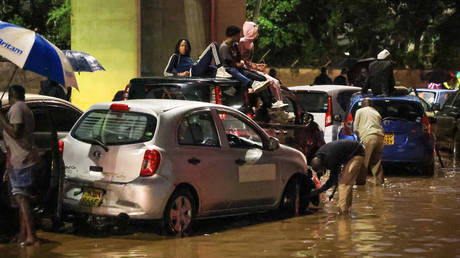
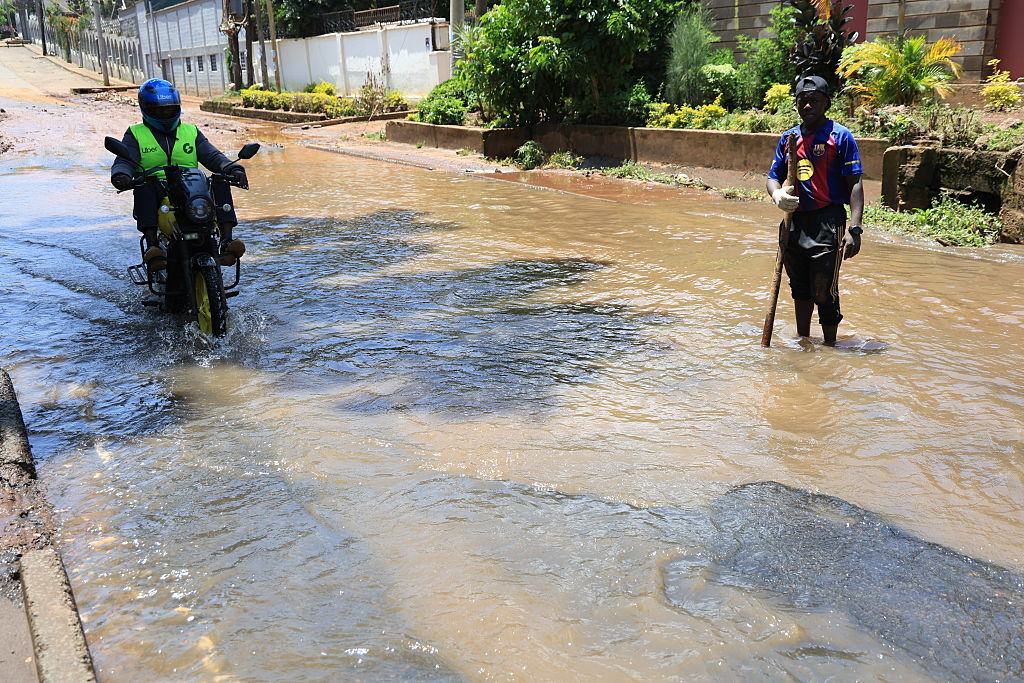
Floods have killed at least 81 people across Kenya this month, with emergency teams deployed nationwide as heavy rains continue, the Kenyan National Police Service said on Sunday.
Authorities stated search and rescue operations were ongoing in coordination with other agencies, as rising waters triggered flash floods, displaced about 2,690 families, and damaged infrastructure. Fatalities were reported in eastern, coastal, Nyanza, Rift Valley, and central regions.
“Nairobi remains the hardest-hit region, with 37 victims,” according to a statement. The death toll across the country has risen by dozens in the past two weeks.
Officials in the capital have intensified drainage clearing, river desilting, and clean-up operations, while also demolishing illegal structures built along riverbanks to reopen blocked waterways and improve water flow. Nairobi Governor Johnson Sakaja has also ordered an urgent overhaul of the Nairobi Dam to reduce the risk of further flooding.
Kenyan police warned that the rains were expected to persist and urged the public to remain cautious. Authorities said emergency units remained on high alert.
Torrential rains in Kenya set in on March 6. Owing to its equatorial climate, the African state generally has two rainy seasons annually. The principal one, referred to as the “long rains,” typically runs from March through May and delivers the most intense precipitation across much of the country, including the capital, Nairobi. On February 24, the Kenya Meteorological Department announced the start of the March-April-May (MAM) long rains nationwide.
Kenya is not the only African nation to be hit by severe flooding linked to torrential rains. Earlier this year, intense downpours in Mozambique led to widespread flooding and forced authorities to declare a nationwide red alert. According to regional officials, more than 650,000 people were affected, with tens of thousands of homes submerged and critical infrastructure – including schools and health centers – damaged.
In South Africa, prolonged downpours have inundated the provinces of Limpopo and Mpumalanga, killing at least 30 people, damaging thousands of homes, and prompting evacuations, including in Kruger National Park.
Read more
March 24, 2026 at 01:12AM
from RT - Daily news
via IFTTT
Pyongyang’s nuclear arsenal provides leverage against American “terrorism and aggression,” the nation’s leader has said
North Korean leader Kim Jong-un has said the country can pose a credible nuclear threat to the US as opposed to being a target for American attempts to project power.
Speaking during a policy address to newly elected lawmakers on Monday, Kim emphasized the role of nuclear weapons in ensuring national security.
He accused Washington of carrying out “state terror and aggression” globally, arguing that such actions justify Pyongyang’s concerns about the US military presence in the region, including deployments involving nuclear-capable assets. According to Kim, North Korea’s nuclear arsenal provides a strong safeguard against potential attacks.
“Our nation is no longer a country under threat,” he said. “We possess the power to pose a threat if necessary.”
North Korea withdrew from the Nuclear Non-Proliferation Treaty in 2003 to pursue its weapons program. It has since developed nuclear warheads and ballistic missiles believed to be capable of reaching the US mainland, among other potential targets. Despite international sanctions and proposals offering economic incentives for denuclearization – often referred to as the ‘Libyan model’ – Pyongyang has continued its efforts.
Kim argued that the nuclear program has delivered benefits beyond defense, claiming it has supported scientific progress and economic development. He said “hostile forces claiming that there would be no prosperity without nuclear disarmament” were proven wrong.
He reiterated that North Korea will not give up its nuclear weapons and vowed to oppose any efforts to challenge its status. In particular, he rejected denuclearization proposals from South Korea, which he described as “the most hostile state.”
The office of South Korean President Lee Jae-myung said Kim’s comments undermined efforts toward peaceful coexistence.
Read more
March 24, 2026 at 12:14AM
from RT - Daily news
via IFTTT
The attack on Al Daein Teaching Hospital in Darfur has rendered the facility non-functional, the WHO has reported
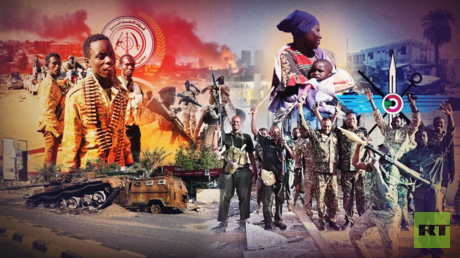
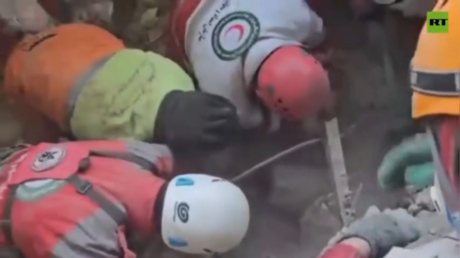
A strike on a hospital in Sudan has left at least 64 people dead and 89 others injured, the World Health Organization (WHO) has said, calling for an end to the ongoing civil war in the African state.
The casualties included at least 13 children, as well as medical staff and patients at Al Daein Teaching Hospital in East Darfur, WHO Director-General Tedros Adhanom Ghebreyesus said in a post on X on Sunday.
The attack on Friday damaged key departments, including the pediatric, maternity and emergency units, and rendered the facility non-functional, Ghebreyesus said.
He said the WHO has documented 213 attacks on healthcare facilities, in which 2,036 people have been killed since the war erupted nearly three years ago.
“Enough blood has been spilled. Enough suffering has been inflicted. The time has come to de-escalate the conflict in Sudan and ensure the protection of civilians, health workers, and humanitarians,” Ghebreyesus said.
The fighting has displaced millions and created what aid organizations have described as one of the world’s largest humanitarian crises, with widespread shortages of medical care and essential services.
.@WHO has verified yet another attack on health care in #Sudan. This time, Al Deain Teaching Hospital in East Darfur’s capital, Al Deain, was struck, killing at least 64 people, including 13 children, two female nurses, one male doctor, and multiple patients.
Responsibility for the latest strike has remained disputed. The paramilitary Rapid Support Forces (RSF) has accused the Sudanese Armed Forces (SAF) of carrying out the attack.
The military dismissed the allegations in a statement on Saturday, saying its forces are committed to upholding international law and norms.
“Attacking service and healthcare facilities is a consistent approach and a daily practice carried out by this terrorist militia [RSF], which has committed massacres in El Fasher, as well as crimes against humanity, war crimes, and ethnic cleansing,” the SAF stated.
The army accused the paramilitary fighters of bombing hospitals in El-Obeid, Dilling, Kadugli, Um Rawaba, Rahad, and Al-Dabba, killing hundreds of patients and medical personnel, and of targeting water and electricity facilities in El-Obeid, Kosti, Khartoum, and Merowe.
Read more
March 23, 2026 at 12:25AM
from RT - Daily news
via IFTTT
Police are treating the arson attack as an anti-Semitic hate crime
Four ambulances operated by a Jewish volunteer organization in London were set on fire overnight in what authorities are investigating as a hate crime.
The incident took place in the Golders Green area of the Barnet borough at around 1:45 AM local time, officials said. CCTV footage reportedly shows at least three masked individuals setting fire to vehicles belonging to the local branch of Hatzola, a network of volunteer emergency medical services which works with Jewish communities.
The London Fire Brigade said that “multiple cylinders on the vehicles exploded,” causing windows in a nearby residential building to shatter. No injuries were reported. The Metropolitan Police said nearby homes were evacuated as a precaution and confirmed that the case “is being treated as an anti-Semitic hate crime.”
🚨 BREAKING: Major arson attack in Golders Green, London overnight has destroyed at least 4 ambulances belonging to Hatzola Northwest — a volunteer Jewish emergency medical service providing 24/7 life-saving care to the community.
Hatzola is an international network of independent emergency medical organizations founded in New York in the 1960s to support Orthodox Jewish communities. The group has operated in Golders Green since 1979, according to British media.
We are aware of loud explosions heard in the past hour.
Emergency services are on scene following a deliberate incident involving #Hatzola ambulances being set alight. The explosions were caused by oxygen tanks not a bomb or explosive device.
— Shomrim (North West London) (@shomrimlondon) March 23, 2026
In a 2014 High Court case, Hatzola representatives highlighted rapid response times compared to public ambulance services, though the court ruled the group was not permitted to use the sirens and blue lights reserved for official emergency vehicles.
Anti-Semitic sentiments in many parts of the world have been fueled in recent years by Israel’s extensive military operation in Gaza and expanded security crackdowns in the West Bank, as well as its strikes on Lebanon and Syria, and, most recently, its joint bombing campaign with the US targeting Iran.
The worst recent anti-Semitic attack in Britain occurred in October 2025, at a synagogue in Higher Crumpsall, Manchester, during Yom Kippur. Two people were killed and several others injured before the perpetrator was shot dead by police.
Read more
March 22, 2026 at 11:25PM
from RT - Daily news
via IFTTT
EU leaders have suddenly grown enough of a spine to refuse to take a part in the Iran war. But what are they doing to stop it?
NATO is supposed to be a defensive alliance. That means members aren’t actually obligated to go bail out a member state that goes around the world punching other countries in the face. Easy mistake to make from the optics of other recent conflicts, though, where the term “defensive” has been doing a lot of impressive rhetorical gymnastics.
US President Donald Trump hasn’t been able to talk his ‘allies’ into coming along for the white-knuckle adventure this time. Largely because he threatened to invade Europe – specifically Greenland – barely weeks before asking for their help to do the same to another country. Apparently, they took his threat so seriously that they were getting ready to beat him to the punch by blowing up their own airfields first, according to the New York Times.
Before Trump just decided to go it alone and threaten to fix the global energy problem in the Strait of Hormuz by also blowing up a bunch of power plants in the region, he got to the “who needs these losers anyway” stage with Western Europe. Let’s see… Starmer is no Churchill, Trump says. Sick burn, if it were still 1940 and not just a guy declining participation in your dodgy group project.
French participation doesn’t even really count, Trump says, because President Emmanuel Macron will be gone soon. Like a sitcom character whose hand is on the knob with one foot out the door in every scene.
But here in the real world, Macron is actually still the president of France for another year. And it’s not like anyone who could possibly replace him would be up for this political suicide mission that Trump’s proposing, either. Hardly a day goes by without French military brass appearing on TV, either telling Trump to go “f himself” or else comparing his invitation to something along the lines of buying tickets for the Titanic after it hit the iceberg.
The Irish president should just be grateful for Trump’s mere existence, he says. Who isn’t at this point, right? One day Trump’s telling all the NATO allies to just get in the van already. The van’s on fire, but minor detail. And they’re like, no thanks. Not interested in careening down regime change highway with Trump and Benjamin Netanyahu like a scene out of Mad Max.
So at first Trump tries to make it sound like it’s for their own benefit to go send their own troops to hangout in the Strait of Hormuz where missiles are flying around. Because they’re the ones who largely use the oil that normally transits through it when Iran hasn’t closed it because Trump and Bibi started bombing them. A phenomenon that does tend to complicate shipping schedules.
Probably doesn’t help either that Europe already had the experience of volunteering to do the heavy lifting for Washington just so an American president, Barack Obama, could brag to his people that America did a regime change without a single pair of boots on the ground. Right, because there were covert, European boots on the ground. In Libya. Led by the Brits and French, back in 2011. And that turned into a years-long mess for Europe and a migrant tsunami that kept rolling in long after the “mission accomplished” energy had worn off. So it’s no wonder that some of those 15 NATO countries that helped out in Libya aren’t up for a rerun. Once you’ve helped a friend move and it turns into a ten-year renovation project, the next time they call you just let it ring.
So Europe is banking on riding out the fuel disruption instead of prolonging it by getting involved with the risk of provoking an escalation. Unless of course the missiles stop flying. In which case, Macron will be there in a jiffy to film more heavily militarized thirst trap videos.
It’s one thing to not participate, but what are they actually doing to stop it, besides issuing strongly worded statements that reek of déjà vu?
The bloc’s chief diplomat says that it’s all such a good example of the failure of international law, which is one way to describe a fire while refusing to notice that you’re actually holding a fire extinguisher. Conflicts in Ukraine and the Middle East “are products of erosion of the international law without accountability, judicial or political, the war will engulf the world once again,” Kaja Kallas said.
Gotta love the passive verbiage doing the heavy lifting there. Really lets everyone off the hook. Yeah, international law just eroded on Iran. How did that happen? All by itself? Or because no one can bother actually trying to enforce it when it’s inconvenient because it involves the risk of eliciting the wrath of Daddy Trump?
She has no problem comparing the conflicts in Ukraine and Iran except in failing to notice that that one has involved like 20 packages of EU sanctions and the other zero. Or to notice that their favorite foster kid has been begging Trump to let him come play drone warfare in this war with the toys that they’ve been buying for him with money from the same EU taxpayers who are now being gauged on energy prices yet again as a result of this new war. The same war that the EU says violates international law.
Ukraine’s Vladimir Zelensky has said that he’s psyched to get over there and play in the sandbox with all his shiny new drones – which is one way to pitch the escalation that the EU says it doesn’t want. And the EU’s like, can’t you see – he’s really hurting here! “The longer the war continues in the Middle East, the more Ukraine suffers,” Kallas said. I’m really trying to lean into this whole Ukraine x Iran crossover. “I mean, Russia is already making money off the war in the Middle East with higher oil prices and the Strait of Hormuz closed, they can now again fund the war.”
Try telling that to your boy, Zelensky. Does he know that offering to help prolong the war with his drones would just be making Putin more money? But really, why should he even care when the EU keeps insisting on having their citizens pay for it all anyway.
Read more
March 22, 2026 at 08:31AM
from RT - Daily news
via IFTTT