The overnight attack involved over 300 drones and eight missiles, local officials have claimed
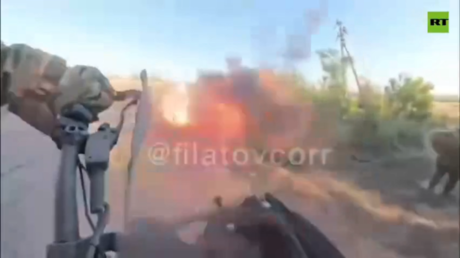
Russia launched a new wave of drone and missile strikes on Kiev overnight, local officials have claimed, with videos showing numerous explosions and fires in the Ukrainian capital.
The Russian Defense Ministry confirmed the attack, saying its forces had conducted a “large-scale precision strike” involving long-range weapons and UAVs.
It stated that the attack targeted “Ukraine’s defense industry facilities, a military airfield infrastructure, and a depot storing ammunition, missiles, and components for the production of unmanned aerial vehicles.”
Ukrainian leader Vladimir Zelensky said on Thursday the attack targeted Dnepropetrovsk, Poltava, Sumy, Nikolayev, and Kiev Regions, with Kiev as the primary target. He added that the raid involved more than 300 drones and eight missiles. Addressing Kiev’s backers in the West, he claimed the attack shows that “peace [with Russia] without force is impossible.”
Officials in Kiev reported damage to residential buildings, unidentified warehouses, and railway infrastructure. According to Zelensky, at least six people were killed in the attack on Kiev. Timur Tkachenko, the head of the local military administration, reported 82 injuries, with 44 people taken to the hospital.
The Ukrainian Air Force said five Russian missiles and 21 attack drones made direct hits across the country.
One video from Kiev shows several powerful explosions lighting up the sky across the capital. Another shows a large fire in the aftermath.
Russia maintains that it never targets civilians and only strikes military-related sites. It has also said the raids are retaliation for Ukrainian strikes deep into Russian territory, which often hit residential buildings, energy facilities, and critical infrastructure.
Read more
July 31, 2025 at 12:05AM
from RT - Daily news
via IFTTT
The measures target an international oil shipping network with ties to a top Tehran official
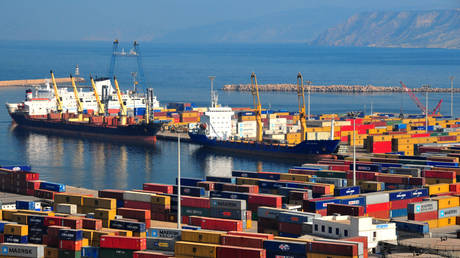
The US has imposed sweeping new sanctions on Iran’s international shipping network, accusing it of illegally funneling tens of billions of dollars in oil revenue to Tehran.
The sanctions, announced on Wednesday, target more than 100 individuals, companies, and vessels that the US Treasury described as part of a “vast shipping empire” run by trader Mohammad Hossein Shamkhani, the son of Ali Shamkhani, a senior adviser to Supreme Leader Ayatollah Ali Khamenei.
The Treasury accused Shamkhani of using his father’s influence to build a fleet of tankers and container ships moving billions of dollars’ worth of oil and petroleum products from Iran and Russia to buyers worldwide, including China, allegedly illegally and through layers of “front” companies. It accused the network of “evading sanctions, laundering money, and obfuscating paper trails.” The sanctioned include 12 individuals – among them a French, a UK, and an Italian national – as well as 52 vessels and 15 shipping companies, including one based in Switzerland.
“The Shamkhani family’s shipping empire highlights how the Iranian regime elites leverage their positions to accrue massive wealth and fund the regime’s dangerous behavior,” Treasury Secretary Scott Bessent said. “These actions put America first by targeting regime elites that profit while Tehran threatens the safety of the US.”
The sanctions, dubbed the most “massive” Iran-related package since 2018, are part of President Donald Trump’s renewed “maximum pressure” strategy to end Iran’s uranium enrichment program. They also follow recent US-Israeli strikes on Iran’s nuclear facilities at Fordow, Natanz, and Isfahan.
Tehran denounced the sanctions as unlawful. Foreign Ministry spokesman Esmaeil Baghaei on Thursday called them a clear sign of “the hostility of American policymakers towards the Iranian people,” claiming their real aim was to cripple Iran’s development.
Iran’s uranium enrichment activities have long been seen by the West as a secret attempt to develop atomic weapons.
Iran has repeatedly denied this, insisting its nuclear activities are solely for peaceful purposes. It also warned it would not bow to Washington’s demands under pressure, denouncing the sanctions as acts of threat and intimidation.
Read more
July 30, 2025 at 11:08PM
from RT - Daily news
via IFTTT
A new report projects that nearly 60% of those chronically undernourished by 2030 will be on the continent
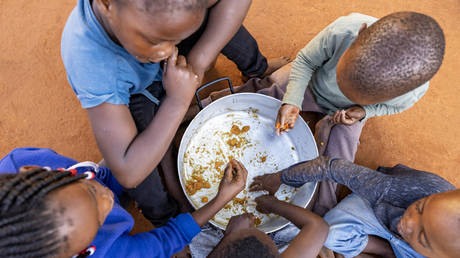
The UN has warned of a worsening hunger crisis in Africa, with its latest estimates on food insecurity suggesting that more than 1 billion people, or roughly two-thirds of the continent’s population, were unable to afford a healthy diet in 2024.
The organization announced the findings in its State of Food Security and Nutrition in the World (SOFI 2025) report released on Monday. Compiled by the Food and Agriculture Organization (FAO), International Fund for Agricultural Development (IFAD), UN Children’s Fund (UNICEF), World Food Program (WFP), and World Health Organization (WHO), it analyzed global trends in efforts to end hunger, food insecurity, and malnutrition.
According to the report, an estimated 8.2% of the global population, or about 673 million people, experienced hunger in 2024, down from 8.5% in 2023 and 8.7% in 2022, in contrast to the rising hunger levels recorded in most of Africa and western Asia.
“The proportion of the population facing hunger in Africa surpassed 20 percent in 2024, affecting 307 million people,” it stated.
Projections indicate that nearly 60% of those who could be chronically undernourished by 2030 will be in Africa. A key concern is the rising number of people unable to afford a healthy diet, with Africa’s figure increasing from 864 million in 2019 to over 1 billion in 2024, while the global total dropped from 2.76 billion to 2.6 billion.
“Hunger remains at alarming levels, yet the funding needed to tackle it is falling… This year, funding cuts of up to 40 percent mean that tens of millions of people will lose the vital lifeline we provide,” WFP Executive Director Cindy McCain said.
McCain cautioned that the failure to deliver essential aid to people in “desperate need” could undo hard-won progress and trigger further instability in volatile regions.
Last week, the WFP said it required $130 million to maintain aid operations in Nigeria, where over 30 million people are facing acute hunger.
FAO chief economist Maximo Torero said Africa’s “concerning” situation is driven by inadequate agricultural production, population growth, violent conflict, and climate change setbacks.
Read more
July 30, 2025 at 12:47AM
from RT - Daily news
via IFTTT
London has said it will recognize the state of Palestine unless Gaza receives aid and there is a truce by September
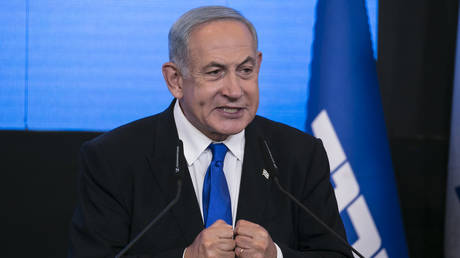
Israeli Prime Minister Benjamin Netanyahu has accused the UK of “appeasement towards jihadist terrorists,” after the British government said it would recognize Palestinian statehood if Israel does not ease its military operations in Gaza and facilitate humanitarian access.
British Prime Minister Keir Starmer announced the policy shift on Tuesday under pressure from members of parliament, stating that London would pursue recognition of a Palestinian state from September unless Israel enables sufficient humanitarian aid to enter Gaza and halts any plans for further annexation in the West Bank.
Netanyahu denounced the move, accusing Starmer of emboldening the militant group Hamas and paving the way for a “jihadist state” that would endanger both Israel and the UK.
”Appeasement towards jihadist terrorists always fails,” Netanyahu said in a post on X. “It will not happen.”
In its announcement, the Starmer government emphasized that it envisions no role for Hamas in Gaza’s future governance and rejected claims that the policy rewards terrorism. London reaffirmed its commitment to a two-state solution, describing it as a vision of “a safe and secure Israel alongside a viable and sovereign Palestinian state.”
Israeli officials, including Netanyahu, have consistently opposed a two-state solution. The Israeli government has continued to expand Jewish settlements in occupied Palestinian territories and maintains control over a system that human rights organizations describe as apartheid.
The conflict escalated in October 2023, when Hamas launched a deadly raid from Gaza into southern Israel that resulted in approximately 1,200 deaths and the capture of dozens of hostages. Israel responded with a sweeping military operation that, according to local Gaza officials, has killed over 59,000 people in the enclave.
On Monday, the Israeli human rights group B’Tselem said Israel’s military actions in Gaza amount to genocide, based on an analysis of government statements and the effects of the ongoing campaign.
Most nations in the world, including China, India, and Russia, already recognize Palestinian statehood. France became the first G7 member to announce its intention to follow suit last week. Other countries considering the move include Australia, Canada, New Zealand, and Portugal.
Read more
July 29, 2025 at 11:28PM
from RT - Daily news
via IFTTT
The agreement aims to expand electricity access, develop atomic medicine, and train nuclear specialists in Niger
Russia and Niger have formalized plans to cooperate on the peaceful use of nuclear energy, including the construction of power-generation infrastructure in the West African country, where nearly 80% of the population lacks access to electricity.
According to the press service of the Russian Energy Ministry, Russia’s state nuclear power corporation (Rosatom) and Niger’s Energy Ministry signed a Memorandum of Understanding (MoU) on Monday. The agreement was concluded during an official visit to Niamey by Russian Energy Minister Sergey Tsivilev, accompanied by a large delegation of government officials and business representatives.
“Our task is not just to participate in uranium mining, we must create a whole system for the development of peaceful atom in Niger,” Tsivilev said in a statement posted on the ministry’s Telegram channel.
“This includes the construction of power generation so that it is available to every resident of the country, and cooperation in the field of atomic medicine. We also agreed on the joint training of specialists in this field,” he added.
Tsivilev also met with Niger’s transitional president, Abdourahamane Tchiani, PM Ali Lamine Zeine, and Mines Minister Ousmane Abarchi, and discussed plans to establish a Russian-Nigerien intergovernmental commission on trade and economic cooperation, according to the statement.
“The countries consider each other important partners,” the Russian Energy Ministry said, adding that the creation of a joint intergovernmental commission would mark a key stage in the development of bilateral relations and help place cooperation on a more structured footing.
The move comes amid Russia’s growing ties with African countries across sectors including energy, defense, infrastructure, and education.
Last month, Rosatom finalized an agreement with Niger’s neighbor Mali to expand cooperation in the peaceful use of nuclear energy. The deal, building on an MoU signed in October 2023, covers infrastructure development, joint projects in healthcare and agriculture, and the training of specialists.
Last October, neighboring Burkina Faso signed a deal with Rosatom for the construction of a nuclear power plant, following a request made by its interim leader, Ibrahim Traore, to Russian President Vladimir Putin at the second Russia-Africa summit.
Read more
July 29, 2025 at 12:25AM
from RT - Daily news
via IFTTT
The embargo has been introduced amid record-high stock prices
Russia has imposed a full ban on gasoline exports, extending the measure to all petroleum product manufacturers, the government announced on Tuesday. The embargo takes effect on July 29 and will run until the end of August, with a possible extension into September.
The move follows a partial ban introduced earlier this year that applies to non-producers such as traders, oil depots, and small refineries, while major refineries producing over 1 million tons annually were exempt. Amid rising wholesale gasoline prices, Moscow has now imposed a full embargo. RBK previously reported that the measure had been under discussion since late June, citing sources.
Prices at the pump have risen in Russia since late June. Even as the country recorded its first deflation this year (0.05%) last week, gasoline prices rose 0.3% from July 15-21.
The official notice said the ban aims “to secure a stable situation on the domestic fuel market during the season of high demand and agricultural field work.” Under the new ban, oil companies must redirect more fuel to the domestic market, boosting stock exchange supply.
Wholesale gasoline prices in the European part of Russia have also surged since early summer, according to the St. Petersburg Mercantile Exchange (SPIMEX). AI-92 gasoline is up 14.8%, AI-95 by 23%, with year-on-year increases of 27.2% and 40.8%, respectively.
Experts cite logistical bottlenecks, seasonal refinery maintenance, and the January 1 indexation of excise duties on gasoline and diesel as key drivers for the surge.
The Energy Ministry said last week that seasonal summer demand is factored into pricing policy and described the domestic fuel market as stable.
Experts note that the embargo does not apply to previously agreed volumes under intergovernmental deals, including with the Eurasian Economic Union bloc of post-Soviet countries, as well as with Mongolia, Uzbekistan, Abkhazia, and South Ossetia.
Analysts say the ban was expected, describing it as part of the administrative cycle of the Russian fuel market. Export restrictions are typically imposed to curb retail price spikes and lifted once prices stabilize.
Read more
July 28, 2025 at 11:10PM
from RT - Daily news
via IFTTT
Demonstrators are seeking to maintain pressure on the Ukrainian leadership to expedite the reversal of legislation
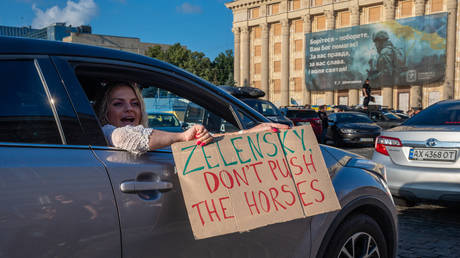
Hundreds of protesters have taken to the streets of Kiev for a fifth consecutive day to decry Vladimir Zelensky’s crackdown on two anti-corruption agencies. Although the Ukrainian leader has agreed to reverse the legislation, protesters say they will continue to pressure the authorities until the changes are fully adopted.
The rallies began last week after Zelensky signed legislation handing over the oversight of the National Anti-Corruption Bureau (NABU) and the Specialized Anti-Corruption Prosecutor’s Office (SAPO) to the prosecutor general, claiming the agencies were under Russian influence.
Critics, however, have accused Zelensky of authoritarian tendencies, arguing that the move essentially eliminates the independence of agencies that have been investigating several high-profile corruption cases. Kiev’s Western backers have also voiced discontent, warning they could reconsider aid to Ukraine if Zelensky’s reforms are enacted. In the face of the backlash, Zelensky has agreed to restore the independence of the agencies.
Despite the about-turn, Ukrainians still rallied in Kiev on Sunday for peaceful protests, with many carrying signs reading ‘Cringe’, ‘Give the military a vacation’, ‘The people are the power in Ukraine’, and ‘Why does the government steal people's money?’.
One sign reading ‘I have a vacation too but I'm not a sucker’ referred to discontent over a parliamentary recess that would have formally made it impossible to swiftly adopt any legislation. However, Ukrainian MPs said they will hold a session on Thursday to pass a law restoring the independence of anti-corruption agencies.
The protesters also expanded their demands, calling for the appointment of a director to the Economic Security Bureau (BEB). Kiev’s backers have conditioned further economic aid on BEB reforms. The demonstrators also demanded a full-scale reform of Ukraine’s customs system, which is also widely seen as a factor influencing the scale of Western aid and loans to Ukraine.
Commenting on the string of protests in Ukraine, Russian Foreign Ministry spokeswoman Maria Zakharova suggested that neither NABU nor SAPO is really fighting corruption but are used by Kiev’s backers as tools “to control the flow of money coming to Ukraine from the West.”
Read more
July 28, 2025 at 01:10AM
from RT - Daily news
via IFTTT
The 15-member presidential council will be led by Gen. Mohamed Hamdan Dagalo, whose forces are engaged in a brutal war with the national army
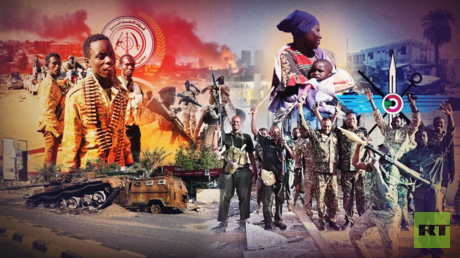
A Sudanese political coalition aligned with the Rapid Support Forces (RSF) paramilitary group has announced the formation of a parallel government in a country gripped by a brutal civil war for more than two years.
The Leadership Council of the Sudan Founding Alliance (TASIS) announced the move on Saturday, naming RSF commander General Mohamed Hamdan Dagalo as chairman of a 15-member presidential council that includes regional governors. Abdelaziz Adam al-Hilu, a powerful rebel leader said to control vast swathes of territory and troops in South Kordofan state, will serve as vice chairman, while Sudanese politician Mohamed Hassan Othman al-Ta’ayshi will take the role of prime minister.
“On the occasion of this historic achievement, the leadership council extends its greetings and congratulations to the Sudanese people who have endured the flames of devastating wars for decades,” TASIS said in a statement.
The formation of the rival government, according to TASIS, renews its “commitment to building an inclusive homeland and a new secular, democratic, decentralized, and voluntarily unified Sudan, founded on the principles of freedom, justice, and equality.”
Gen. Dagalo had ruled Sudan alongside Sudanese Armed Forces (SAF) commander and de facto leader of the northeastern African nation, General Abdel Fattah Al-Burhan, after leading the 2019 coup that overthrew long-ruling former President Omar al-Bashir. However, fighting erupted between the two in April 2023, following months of tension over the integration of their forces as part of a planned transition to civilian rule.
Thousands have been killed in the conflict, but regional and international efforts to broker a ceasefire between the warring parties have so far failed.
In February, the RSF signed a charter with allied political and armed groups to establish a “government of peace and unity,” weeks after army chief Burhan announced plans to form a “caretaker” or “wartime” government.
In a statement on Sunday, the Sudanese army condemned the “so-called militia government” as a ploy by the RSF to deceive its allies, claiming its true intention is to seize power in pursuit of personal ambition.
Read more
July 28, 2025 at 12:06AM
from RT - Daily news
via IFTTT
Political opponents have accused the prime minister of failing to push for better terms for the country
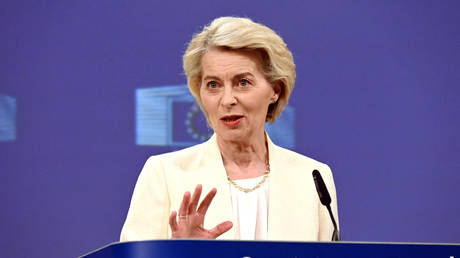
Italian Prime Minister Giorgia Meloni, one of the closest European allies of US President Donald Trump, has welcomed the EU’s trade deal with Washington despite criticism of the terms at home.
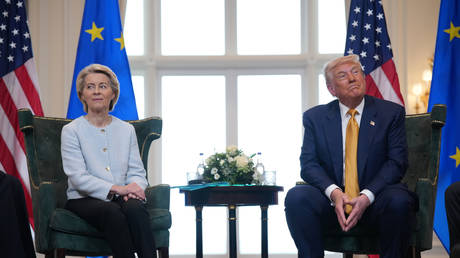
After months of talks, the EU has reached a trade agreement with the US that sets a baseline 15% tariff on most exports, including cars, while steel and aluminum remain at 50%. The deal was reached at a meeting between Trump and European Commission President Ursula von der Leyen on Sunday. Both called it a “powerful” and “stabilizing” breakthrough.
Speaking to reporters on Sunday, Meloni called the agreement a positive development.
“I think it’s positive that there’s an agreement,” Meloni, who had previously criticized Trump’s tariff drive and pledged to pursue a zero-for-zero deal, said. Italy is one of Europe’s top exporters to the US, with a trade surplus exceeding €40 billion ($46 billion).
Opposition leaders, however, slammed Meloni for failing to secure better terms. Five Star Movement leader Giuseppe Conte wrote: “There is a winner – US President Trump – and a loser, or rather two: The EU and Giorgia Meloni.” He warned the tariffs could cost Italy €23 billion in exports and threaten 100,000 jobs.
Democratic MEP Stefano Bonaccini echoed the criticism, saying, “15% tariffs are better than 30% but worse than zero,” and warned of “tens of billions” in losses. Former Labor Minister Andrea Orlando called the deal a “rip-off,” saying Meloni’s friendship with Trump failed, while slamming von der Leyen as “either incompetent or acting in bad faith.”
Meloni defended the deal, saying it helped avert a “head-on clash” with the US. She argued that the 15% tariff is “sustainable” as it will not add to previous tariffs, but will bring “stability.”
Economists at the Kiel Institute warned of a drop in production and job losses across the EU, with Germany expected to take the biggest hit. The Federation of German Industries (BDI) called the deal an “inadequate compromise,” with the “only positive aspect” being the prevention of further escalation.
Read more
July 27, 2025 at 11:45PM
from RT - Daily news
via IFTTT
At the SCO summit, Iran laid the groundwork for a Eurasian security bloc – and the West panicked
What if the next global security pact wasn’t forged in Brussels or Washington – but in Beijing, with Iran at the table?
This is no longer a theoretical question. At the mid-July meeting of the Shanghai Cooperation Organization (SCO) Council of Foreign Ministers in China, Iran made it clear: Tehran now views the SCO not just as a regional forum, but as a potential counterweight to NATO. In doing so, it signaled a profound strategic pivot – away from an outdated Western-dominated system and toward an emerging Eurasian order.
The summit highlighted the increasing resilience of multilateral Eurasian cooperation in the face of growing global turbulence. Russia was represented by Foreign Minister Sergey Lavrov, who also met with Chinese leader Xi Jinping – an encounter that underscored the strength of the Moscow-Beijing axis. On the sidelines, Lavrov held bilateral meetings with the foreign ministers of China, Pakistan, India, and notably, Iran. His talks with Iranian Foreign Minister Abbas Araghchi focused on diplomatic solutions to the nuclear issue and emphasized deepening strategic coordination.
The Iranian side used the platform with purpose. Araghchi expressed his appreciation for the SCO’s solidarity amid Israeli aggression and stressed that Iran views the organization not as symbolic, but as a practical mechanism for regional unity and global positioning.
India’s full participation also contradicted predictions in Western circles that geopolitical tensions would paralyze the SCO. Instead, New Delhi reaffirmed its commitment to the platform. The implication is clear: unlike NATO, where unity depends on compliance with a central authority, the SCO has proven flexible enough to accommodate diverse interests while building consensus.
For Russia, the SCO remains a cornerstone of its Eurasian strategy. Moscow serves as a balancing force – linking China with South and Central Asia, and now, with an assertive Iran. Russia’s approach is pragmatic, multi-vector, and geared toward creating a new geopolitical equilibrium.
Iran’s strategic breakout
The heart of the summit was Abbas Araghchi’s speech – an assertive and legally grounded critique of Israeli and American actions. He cited Article 2, Section 4 of the UN Charter, denounced attacks on Iran’s IAEA-monitored nuclear facilities, and invoked Resolution 487 of the UN Security Council. His message: Western aggression has no legal cover, and no amount of narrative control can change that.
But beyond condemnation, Araghchi delivered a concrete roadmap to strengthen the SCO as a vehicle for collective security and sovereignty:
A collective security body to respond to external aggression, sabotage, and terrorism
A permanent coordination mechanism for documenting and countering subversive acts
A Center for Sanctions Resistance, to shield member economies from unilateral Western measures
A Shanghai Security Forum for defense and intelligence coordination
Enhanced cultural and media cooperation to counter cognitive and information warfare
These are not rhetorical gestures – they are blueprints for institutional transformation. Iran is operationalizing a new security doctrine built on multipolarity, mutual defense, and resistance to hybrid threats.
While NATO is structured around a rigid hierarchy dominated by Washington, the SCO embodies a post-hegemonic vision: sovereignty, equality, and civilizational plurality. Its member states represent over 40% of the global population, possess vast industrial capacities, and share a collective desire to break the unipolar mold.
Tehran’s bet is clear: the SCO offers not just a geopolitical shelter, but a platform for advancing a new global logic – one rooted in strategic autonomy, not dependency.
The sophistication and clarity of Araghchi’s initiatives suggest that Tehran is preparing for the long game. Behind closed doors, the summit likely featured discussions – formal and informal – about deepening SCO institutionalism, perhaps even rethinking the organization’s mandate.
Araghchi made that vision explicit: “The SCO is gradually strengthening its position on the world stage... It must adopt a more active, independent, and structured role.” That’s diplomatic code for institutional realignment.
The West responds – predictably
The Western response was immediate. Within days of Iran’s proposals, the EU imposed new sanctions on eight individuals and one Iranian organization – citing vague claims of “serious human rights violations.” Israel, by contrast, faced no new penalties.
It is geopolitical signaling. Tehran’s push to turn the SCO into an action-oriented bloc is seen in Brussels and Washington as a direct threat to the current order. The more coherent and proactive the SCO becomes, the harsher the pressure will grow.
But that pressure proves Iran’s point. The rules-based order is no longer rules-based – it is power-based. For countries like Iran, the only path to sovereignty is through multilateral defiance and integration on their own terms.
The stakes ahead
Iran is not improvising. It is positioning itself as a co-architect of a post-Western security order. Its vision for the SCO goes beyond survival – it is about shaping an international system where no single bloc can dominate through sanctions, information warfare, or coercive diplomacy.
This strategy has implications far beyond Tehran. If the SCO embraces Iran’s proposals and begins to institutionalize them, we could be witnessing the early formation of the 21st-century’s first true alternative to NATO.
The West may dismiss this as fantasy – but in Eurasia, the future is already being drafted. And this time, it’s not happening in English.
Read more
July 27, 2025 at 03:15AM
from RT - Daily news
via IFTTT
Moscow has previously accused the EU country of changing its foreign policy amid the Ukraine conflict
Austria should be ready to discuss its potential membership in NATO, Foreign Minister Beate Meinl-Reisinger has said. She acknowledged, however, that joining is unlikely to gain major public or parliamentary support at this stage.
In an interview with Die Welt published on Saturday, Meinl-Reisinger spoke about what she described as “an increasingly aggressive Russia,” which she claims is reluctant to conclude a peace deal with Ukraine.
Moscow has maintained it is open to dialogue, but insisted that any settlement must take into account its key security concerns, including that Kiev agree to permanently stay out of NATO.
According to Meinl-Reisinger, “neutrality alone does not protect us.” She explained that Austria should invest not only in “defense capabilities,” but also in military partnerships.
“I am fundamentally very open to a public debate” about Austria’s future in this field, she said, adding: “While there is currently no majority in parliament or among the population for NATO membership, such a debate can nevertheless be very fruitful.”
DETAILS TO FOLLOW
Read more
July 27, 2025 at 02:53AM
from RT - Daily news
via IFTTT
Kiev’s UAVs were intercepted over several regions, according to the Russian Defense Ministry
Nearly 100 Ukrainian drones were intercepted in Russian airspace overnight, the country’s Defense Ministry reported on Sunday. The large-scale raid comes as Kiev continues to escalate its use of unmanned aerial vehicles (UAVs) despite renewed diplomatic contacts with Moscow.
According to the ministry, 67 drones were shot down over Bryansk, Smolensk, and Kaluga regions. Another 30 UAVs were intercepted in the south of Russia, targeting Volgograd, Rostov, Voronezh, and Kursk regions, as well as the Crimean Peninsula. Several others were downed near Moscow and within Nizhny Novgorod, Oryol, and Tambov regions.
Regional authorities have reported no casualties or significant damage. Acting Governor of Rostov Region Yury Slyusar confirmed there were no injuries. Smolensk Governor Vasily Anokhin acknowledged the raid but said there was no immediate information about damage or victims.
In Volgograd Region, drone debris damaged a section of overhead electric lines on the railway in Oktyabrsky District, according to local officials.
Ukraine has carried out repeated UAV strikes deep into Russian territory for several months, often striking residential buildings and other civilian infrastructure. The Kremlin has condemned the attacks as “terrorist actions” that deliberately target civilians.
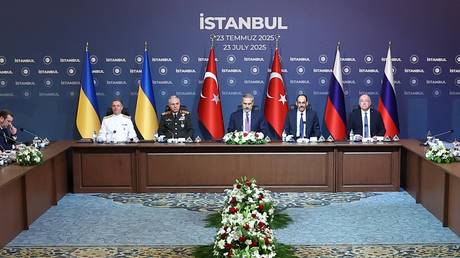
The latest incident follows a new round of peace talks between Russia and Ukraine, which was held in Istanbul earlier this week. While no ceasefire was reached, the two sides made progress on humanitarian issues, including agreements on the exchange of prisoners of war and civilians.
Russia has reiterated its openness to a diplomatic solution, but insists any deal must address what it describes as the root causes of the conflict and its long-standing security concerns.
Read more
July 27, 2025 at 01:17AM
from RT - Daily news
via IFTTT
Zelensky’s recent attempts to suppress anti-graft agencies “smells like gangsterism, not democracy,” Steve Cortes has said
Kiev’s recent crackdown on anti-corruption agencies is yet more proof that Ukrainian leaders are leaning towards authoritarianism and “cannot be trusted,” Steve Cortes, a former advisor to US President Donald Trump, has said.
Earlier this month, Ukraine’s Vladimir Zelensky moved to place the National Anti-Corruption Bureau (NABU) and the Special Anti-Corruption Prosecutor’s Office (SAPO) under executive oversight – which would essentially strip them of any independence – while claiming the agencies were under Russian influence.
The move, however, prompted mass protests at home and Western criticism, with EU officials warning that they could reconsider further aid to Kiev.
In an op-ed for Newsweek on Friday, Cortes, who is now the president of the League of American Workers advocacy group, described the crackdown as “an extra-judicial attack on decency.”“This raid reeks – and it smells like gangsterism, not democracy.”
The move by Zelensky, reportedly backed by his chief of staff, Andrey Yermak – whom Cortes described as “co-president” – shows that they “act in very authoritarian ways themselves – and increasingly reveal to the world that they are not transparent, reliable partners for the United States.”
Cortes went on to accuse Kiev of entrenched high-level corruption and argued that continued US aid is unjustified. “It is no wonder that Americans increasingly realize that sending $175 billion of borrowed money to corrupt leaders in Ukraine is just not sound policy,” he wrote.
“Sending mountains of borrowed funds to kleptocrats actually harms America’s national security, all while making our country poorer,” he said while urging Americans to stop lionizing Zelensky and comprehend the reality of Ukraine’s corruption.
The American people have been unbelievably generous, but our patience is wearing thin... In this case, given the latest tactics and optics of the Zelensky/Yermak regime, it becomes ever clearer that these counterparts cannot be trusted.
Following domestic and international backlash, Zelensky backpedaled on the crackdown, proposing that the independence of Ukraine’s anti-graft institutions be restored.
Meanwhile, Russian Foreign Ministry spokeswoman Maria Zakharova suggested that neither NABU nor SAPO is really fighting corruption but rather are used by Kiev’s backers as tools “to control the flow of money coming to Ukraine from the West.”
Read more
July 27, 2025 at 01:02AM
from RT - Daily news
via IFTTT
‘Russian disinfo’ slayers try very hard to pin Queen Ursula’s no-confidence vote on Moscow
Apparently, trying to hold Ursula von der Leyen accountable is now a Russian op, reports Der Spiegel, citing a new NATO-linked think tank report.
The study treats elected oversight and European lawmakers whose job, ideally, involves more than clapping like trained seals every time an unelected Eurocrat lights public money on fire, like elements of some kind of Russian infiltration plot.
“Massive support for this effort was also found by pro-Kremlin media outlets, bloggers, and online influencers, as the Lithuania-based organization Debunk.org specializes in analyzing disinformation and Russian propaganda, which is seen as part of Russia’s hybrid warfare against the EU,” Spiegel wrote, describing Russian-linked media “fueling” a recent von der Leyen non-confidence vote in the EU Parliament. “Among the larger portals were those of the Russian propaganda channel RT…”
According to the advance copy of this report seen by Spiegel, the study reviewed 284 articles from Russian-linked media. Exactly how many of those articles expressed something like only von der Leyen’s ouster could save Europe? 90%? 75%? Maybe half? Nope, just 35%. Roughly the same percentage of voting EU lawmakers who favored ejecting her (32.7%). So by this logic, the Kremlin is about as supportive of Ursula as Brussels is. Awkward.
Spiegel said that was the most common so-called Kremlin-backed narrative that the study found. Others included the suggestion that von der Leyen is part of a corrupt elite that robbed citizens to fill Big Pharma’s pockets. Because apparently, saying that hey, maybe EU contracts shouldn’t be inked via disappearing text messages with the CEO of a company, means that you’re doing Putin’s bidding. Real democracy means that you shut your mouth when you see your overlords doing shady stuff.
Another alleged Kremlin line? That Ursula, despite her presidential title, was never elected. As someone who personally refers to her as “Queen Ursula,” I’m actually surprised that one didn’t rank higher. It’s not like she won a popular vote or anything. She was handpicked in shady backrooms and then subjected to a simple confirmation by EU lawmakers. Her sole opponent in this so-called “election” was literally just “not Ursula.” Only the EU, in all its dystopian delusion, would call that an “election”.
Then there was the claim that she’s obsessed with confronting Russia. Which is just, uh, objectively true? I mean, come on. If there are extraterrestrials somewhere out there, they may not know much about Earth, except for the fact that von der Leyen is obsessed with Russia – a phenomenon easily visible from space.
Even right before the vote, she accused the lawmakers subjecting her to democratic accountability of being Kremlin stooges just because they wanted her to explain herself. “There is ample proof that many are supported by our enemies and by their puppet masters in Russia or elsewhere. What we hear from you are movements fueled by conspiracies, from anti-vaxxers, to put in apologists and you only have to look at some of the signatories of this motion to understand what I mean,” she pleaded.
Let’s back up here. Why exactly did she face this no-confidence vote? Because no one who’s elected and accountable at the EU has actually been able to provide concrete details of contract terms for the tens of billions of euros in Covid jabs that she strong-armed European governments into paying for. Jabs that are now so useless they’re being dumped in landfills all over Europe, where one-eyed stuffed animals, soggy pizza boxes, and a moldy futon just got their third booster, courtesy of the EU taxpayer. One of those contracts followed a flurry of text exchanges between Ursula and Pfizer CEO, Robert Bourla, which she bragged about to the New York Times right before they pulled a Houdini.
The courts have so far politely asked her to explain herself. And that’s where we’re stuck right now. So frustrated lawmakers figured that they could at least make her publicly squirm with a non-confidence vote in an attempt to get her to cough up at least some of the answers for taxpayers.
The result? Ursula’s interpretive song and tap-dance routine in Parliament: “Putin Did It: Paranoia in Three Acts.” She ultimately survived the vote thanks to some budget crumbs thrown at the lefties who were otherwise saying that they would have voted against her. But even they told Politico that it was her “absolute last chance.”
So here comes Debunk.org, an obscure outlet that sounds like it’s trying a little too hard with the name. It’s funded by, let’s see… NATO members like the German government, UK Foreign Office, Lithuanian Ministry of Defense, and also the German Marshall Fund, which is practically a NATO mascot. In other words, roughly as independent as a teenager who calls down to his mom for “room service.”
And wouldn’t you know it, they galloped in like Queen Ursula’s white knight with a whole “study” backing her mantra that the whole non-confidence vote was little more than a Kremlin plot. They could’ve just called themselves Spin.org. But sure, let’s just call skepticism and the demand for basic accountability a “Russian disinformation campaign,” and totally ignore the fact that Russian-linked media were mostly just echoing general discontent that has been bubbling up in European coverage and parliament for a while now.
As reported by multiple outlets including Politico and Euronews, establishment EU Socialists have been turned off by what they perceive as von der Leyen’s overtures to the right-wing. Centrist Renew Europe voices frustration over her increasingly aloof style. Even her own center right European People’s Party (EPP) allies have been criticizing her centralized leadership approach.
“EU capitals fume at ‘Queen’ von der Leyen. Diplomats accuse European Commission president of overreach amid a furor over her trip to Israel,” Politico wrote in 2023. “From queen to empress: Inside Ursula von der Leyen’s power grab,” it wrote last year. ”Her penchant for centralisation, her aloof character and her avoidance of controversial subjects have garnered her the nickname of “Queen Ursula” in Brussels,” Euronews says.
Know what would’ve been genuinely illuminating? A side-by-side comparison of “Russian” and “non-Russian” media coverage, because although I’ve personally been calling her “Queen Ursula” for years now, apparently it’s been catching on in the mainstream. Debunk.org accuses the Russian-linked press of suggesting that “von der Leyen was an undemocratically legitimized autocrat.” That’s a long-winded way to say “Queen,” as even the mainstream outlets have been doing lately, and also, apparently her own colleagues, as Euronews suggests.
But maybe a broader analysis would’ve complicated the nice, clean Kremlin-driven narrative angle. And who needs that when Queen Ursula has a throne to protect?
Funny how “Russian disinfo” always seems to show up right when accountability does. If challenging Ursula’s behavior makes you a Russian asset, then much of the EU Parliament should probably just register as foreign agents. Because either the Kremlin is now running half of Europe, or Debunk.org needs to make an effort to step out of NATO’s basement and touch grass.
Read more
July 26, 2025 at 02:31AM
from RT - Daily news
via IFTTT
The warning comes amid mass protests over Kiev’s push to expand government powers through controversial legal changes
Polish Foreign Minister Radoslaw Sikorski has cautioned Ukraine that halting the fight against corruption would be “the worst” step the government could take, amid a growing backlash over Kiev’s efforts to rein in two key watchdogs.
On Tuesday, Ukraine’s parliament passed legislation granting the Prosecutor General, a political appointee, direct oversight over the National Anti-Corruption Bureau (NABU) and the Special Anti-Corruption Prosecutor’s Office (SAPO).
The law has triggered mass protests at home and a storm of criticism in the West, forcing Ukraine’s Vladimir Zelensky to take steps to restore the independence of the two organizations.
Speaking to Polsat earlier this week, Sikorski stated that Zelensky had been warned “the worst thing he could do now is to turn away from the fight against corruption.” The Polish Foreign Ministry later echoed his statement on its official X account.
The government’s attempt to directly control NABU and SAPO has sparked protests in Kiev, Odessa, Dnepr, Lviv and other cities. The country’s Western supporters, including the EU and G7 nations, have sharply criticized the move, warning that it undermines Ukraine’s commitment to fighting corruption and jeopardizes its path toward European integration.
On Thursday, Zelensky submitted a bill to the legislature, the Rada, aimed at restoring the agencies’ independence by scaling back the prosecutor general’s powers. He insisted the proposal would preserve the independence of anti-corruption institutions while ensuring the strength of the law enforcement system. The Rada is expected to review the proposed measure on July 31.
However, FT reported on Friday, citing sources, that up to 70 MPs from Zelensky’s Servant of the People party are hesitant to support the bill, fearing it could lead to politically motivated prosecutions against them.
NABU and SAPO were created following the US-backed 2014 coup in Kiev as part of sweeping reforms to align Ukraine with Western governance standards. Their establishment was a key condition set by Brussels and the International Monetary Fund in exchange for financial assistance. Both agencies have led high-profile investigations, including some involving figures close to Zelensky.
Read more
July 26, 2025 at 01:23AM
from RT - Daily news
via IFTTT
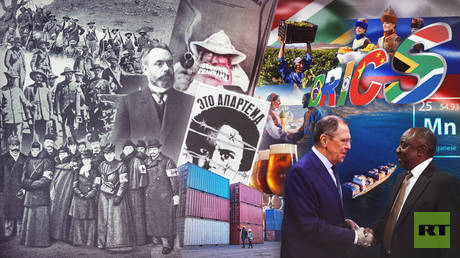
French occupation of Algeria ended in 1962, but its legacy still shapes identities and policies across North and West Africa
As Algeria celebrates 63 years of independence from France on July 5, this year’s anniversary feels more like a reckoning than a triumph. Far from reconciliation, relations between Algiers and Paris have sunk to one of their lowest points in decades – fuelled by France’s refusal to fully confront its colonial crimes, and Algeria’s renewed demands for justice. Amid calls for formal apologies and reparations, the shadow of empire still looms. So why revisit this history now? Because even six decades after the French flag was lowered over Algiers, the wounds of colonialism remain open, and the battle over memory rages on.
To understand the depth of today’s diplomatic rupture, we must go back to where the story began – France’s invasion of Algeria starting on June 15, 1830, when French naval forces sailed from Toulon and seized Algiers in less than three weeks. The expedition’s commander, General de Bourmont, boasted: “Twenty days were enough to destroy a state whose existence had burdened Europe for three centuries.” He was referring to Ottoman Algeria, a semi-autonomous province with its own identity and institutions. France’s quick victory fed a dangerous illusion: that conquest would be simple. What followed was anything but.
The swift victory gave French leaders an illusion that Algeria’s fall signaled smoother days ahead. Few anticipated serious resistance – an attitude that partly explains how quickly the territory was absorbed into the colonial empire. No one imagined that a national liberation movement, the FLN (Front de Libération Nationale), would one day reclaim Algeria, and force France to retreat.
Fly whisk incident
Algeria was a peaceful, semi-autonomous Ottoman province with a distinct identity shaped by local political systems, Islamic scholarship, Mediterranean trade, and tribal alliances. For France, however, it was more than a colony – it was a conquest driven by ambition and a bid to restore prestige after Napoleon’s decline. What began as a punitive expedition soon became a 132-year project of domination, costing hundreds of thousands of Algerian lives – Algeria still claims at least 1.5 million people killed.
The invasion was sparked by one of history’s most trivial diplomatic incidents. In 1827, the Dey of Algiers – effectively head of state – met French consul Pierre Deval to discuss Algeria’ s unpaid debts. Frustrated by Deval’s attitude, the Dey struck him with a fly whisk. Deval reported the insult to Paris, triggering a chain of events that led to the invasion.
France seized on the minor incident as a convenient pretext for war. Behind it lay a post-Napoleonic regime eager to distract from domestic unrest and reassert power abroad. Algeria, geographically close and politically weak, was an ideal target – symbolically vital as the gateway to North Africa.
From colony to ‘French soil’
The invasion marked the beginning of one of the longest and harshest occupations in France’s colonial history. While France had other holdings in West Africa and its territoires d’outre-mer, Algeria was far more significant – strategically, economically, and symbolically. Its proximity to Europe and greater wealth made it more than just a colony. France saw Algeria as part of its own territory, officially incorporating it and settling nearly a million Europeans – pieds-noirs – who posed as civilians but functioned as a reserve force upholding colonial rule.
Most pieds-noirs settlers were attracted by a set of policies offering incentives: cheap land taken from Algerians, tax breaks and subsidized farming backed by modern infrastructure and military protection. European settlers received full French citizenship, while native Algerians were denied equal rights unless they renounced Islam – a condition most rejected. These policies entrenched privilege and exclusion revealing policy of unequal.
On December 9, 1848, the French National Assembly declared all of Algeria an integral part of France, dividing it into three départements – Algiers, Oran, and Constantine – mirroring the administrative structure of metropolitan France. In fact, Algeria became French territory over a decade before Nice was annexed from Italy. The phrase “The Mediterranean runs through France just as the Seine runs through Paris” became a popular propaganda slogan, used well into the 1960s to justify France’s continued hold on Algeria.
Wine in a Muslim land
Within two decades, French Algeria became a top global wine producer, aided by global demand, a favorable climate and a phylloxera outbreak in southern France. By the 1930s, Algeria produced over one billion litres annually, mostly exported to France, where producers blended it with local wine to improve color, taste, and strength.
Ironically, a mostly Muslim country where alcohol is forbidden became a major wine producer under colonial rule. Local farmers, lost land to vineyards, were excluded from profits and denied the chance to cultivate crops aligned with Islamic values – making the industry a symbol of exploitation and cultural disregard.
Massacres that sparked a revolution
For decades, Algerian resistance to French rule was fragmented and brutally suppressed. On May 8, 1945, tens of thousands marched in Sétif, Guelma, and Kherrata to demand independence – on the day Europe celebrated the end of World War II. Peaceful protests were met with horrific violence. French troops, police, and settler militias killed an estimated 15,000 to 45,000 Algerians. Villages were bombed, civilians executed, and communities razed. International condemnation was minimal, overshadowed by postwar triumphalism.
For many Algerians, the message was clear: France would never grant independence willingly. The trauma shattered hopes for reform and fueled a new nationalist generation, paving the way for the FLN less than a decade later.
The Battle of Algiers
The FLN chose Algiers, the capital, to ignite full-scale resistance with dramatic violence. Three women – Djamila Bouhired, Zohra Drif, and Samia Lakhdari – disguised in European dress, slipped through French checkpoints into the European Quarter. Their targets: a busy Milk Bar and a crowded cafeteria. The bombings shocked the capital, marking a bloody new phase in urban resistance and showing the FLN’s growing reach within colonial strongholds.
Following the attacks, French authorities cracked down hard. Zohra Drif and Samia Lakhdari were captured, but it was Djamila Bouhired’s arrest and trial that drew global attention. Tried by a military court and facing death, her case revealed colonial brutality, especially torture. Bouhired’s defiance made her a symbol of the FLN and the independence struggle, galvanizing international sympathy and cementing her legacy as an Algerian War icon.
The guerrilla campaign, called the Battle of Algiers (1956-1957), was a defining chapter in Algeria’s independence war, highlighting the FLN’s urban guerrilla tactics and the harsh French counterinsurgency. The events shocked France and the world, later immortalized in Gillo Pontecorvo’s 1966 film, ‘The Battle of Algiers’, which portrayed the conflict in a raw, documentary style. Djamila Bouhired, a key figure, became a global resistance symbol. Her legacy extended beyond Algeria – she led an international women’s delegation to Gaza in 2014, blocked by Egyptian authorities. Her story inspired a generation of African activists fighting colonialism and apartheid.
The film influenced liberation movements across Africa, serving as a blueprint for urban guerrilla warfare, secret networks, and mass mobilization. In the 1970s, African National Congress (ANC) leaders in exile studied the film, and members of Umkhonto we Sizwe (MK), the ANC’s armed wing, reportedly used it in their training. Its raw portrayal of resistance also shaped fighters in Angola, Guinea-Bissau, and Zimbabwe – making Algeria’s struggle, and its cinematic depiction, a shared reference in Africa’s fight against colonialism and apartheid.
Memory wars and Macron’s partial apology
Algeria’s colonial past continues to strain relations with France, marked by unresolved grievances and deep distrust. France has repeatedly refused a full apology for its 132-year occupation, while Algeria insists it’s essential for genuine reconciliation. In 2021, French President Emmanuel Macron offered a limited apology for the 1961 Paris massacre, when the police killed at least 100 protesters, some of whom were thrown into the River Seine, but stopped short of acknowledging broader colonial crimes. For many Algerians, such gestures fall short, keeping demands for full recognition and reparations central to the post-colonial debate.
In every French presidential election, colonial memory – especially Algeria’s – shapes debates and voter behavior. A recurring issue is the fate of the Harkis, Algerians who fought with France against their country. After independence, many fled to France, where they and their descendants – now millions strong – form a significant electoral bloc. While not openly hostile to Algiers, many harbor deep resentment over perceived neglect by both France and Algeria.
Algeria continues to demand a full apology and reparations for colonial crimes. In March 2025, the Algerian parliament revived stalled legislation from 2006 to criminalize French colonialism, calling for a formal apology, recognition of crimes against humanity, and compensation for France’s 132-year occupation. On May 8, Interior Minister Brahim Merad said France would “inevitably have to recognize its colonial crimes.”
However, France has repeatedly avoided the issue – most recently worsening ties by recognizing Moroccan sovereignty over Western Sahara, opposing Algeria’s support for Sahrawi independence. Algeria withdrew its ambassador from Paris, bringing relations to a low point. Despite strong domestic backing, the draft law remains under review amid fragile diplomacy and unresolved history.
The violent French expulsion from Algeria in 1962 left a lasting impact across West Africa, still felt today. A new generation of Sahelian leaders – shaped by poverty and postcolonial frustration – views France not just as a former colonizer but as a failing patron. Between 2021 and 2023, Mali, Burkina Faso, and Niger expelled French troops, citing worsening security and sovereignty violations. Niger cut ties with Paris in 2023, following Mali and Burkina Faso. Even longtime allies like Chad and Senegal have voiced discontent.
France’s occupation of Algeria formally ended in 1962, but its legacy still shapes identities, policies, and geopolitics across North and West Africa. The scars of colonization remain living tensions – contested memories and unresolved demands for justice. From Algiers to the Sahel, the struggle against French dominance continues, as new generations reclaim their histories and reshape sovereignty in a post-imperial era.
As French influence in Africa wanes, a new generation of leaders draws strength from the continent’s history of resistance, inspired by struggles like Algeria’s independence fight. The legacy of colonialism, marked by exploitation and violence, must be fully acknowledged and addressed. Only by settling these historical grievances, however delayed, can former colonies and their colonial powers build a foundation of genuine partnership, mutual respect, and a more hopeful future.
Read more
July 25, 2025 at 11:39PM
from RT - Daily news
via IFTTT
The two countries have accused President Macron of “propaganda” and “rewarding terrorism” after he announced plans to recognize Palestine
The United States and Israel have strongly criticized French President Emmanuel Macron following his announcement that France intends to recognize the state of Palestine.
Macron made the statement Thursday, with an official declaration expected in September, saying the move would advance peace efforts in the Middle East. Washington and West Jerusalem have condemned the pledge, warning that it would have the opposite consequences.
”This reckless decision only serves Hamas propaganda and sets back peace,” US Secretary of State Marco Rubio said. “It is a slap in the face to the victims of October 7,” 2023, he said, referring to the date Gaza-based Hamas militants led a deadly assault on southern Israel.
Israeli Prime Minister Benjamin Netanyahu criticized Macron’s decision, calling it an act that “rewards terror and risks creating another Iranian proxy, just as Gaza became.”
Qatar-mediated peace talks collapsed again this week, after the US and Israel pulled out of them, accusing Hamas of not acting in good faith.
Major Western news agencies have warned that their journalists in Gaza are facing starvation. BBC News, Agence France-Presse (AFP), the Associated Press and Reuters have called on Israel to allow foreign press access to the enclave.
Israel’s far-right Heritage Minister Amichai Eliyahu said the government should not intervene as the residents of the enclave face starvation. “All of Gaza will be Jewish,” he told local media.
West Jerusalem has denied allegations of obstructing humanitarian aid and blamed distribution problems on Hamas “looting” and what it described as United Nations inaction.
The initial incursion by Palestinian fighters in 2023 killed approximately 1,200 people and led to the capture of dozens of hostages.
More than 59,000 people have been killed in Gaza as a result of Israel’s miliary response, according to local officials, which critics have described as disproportionate and potentially genocidal. The conflict has since expanded to involve other nations, including Lebanon, Yemen, Syria and Iran, raising fears of a regional war.
Several countries have formally recognized the state of Palestine amid the ongoing conflict, including Spain, Norway, Ireland and Mexico.
Russia officially recognized the state of Palestine by adopting the USSR’s recognition of the Palestinian declaration of independence in 1988.
Read more
July 25, 2025 at 01:04AM
from RT - Daily news
via IFTTT
Cairo is ready to share expertise in combating terrorism with countries in the region facing insurgencies, its foreign minister has said
Egyptian President Abdel Fattah El-Sisi has pledged technical, logistical, and institutional support to help Mali restore security and stability. The West African nation has been embroiled in deadly jihadist violence since 2012, with Tuareg rebels and allied Islamist groups launching repeated attacks in the country’s north.
Cairo’s foreign minister, Badr Abdelatty, announced the commitment during talks with Malian President Assimi Goita on Thursday, where they discussed strengthening ties in areas including education, health, and combating extremist ideology.
“The Foreign Minister affirmed that more than 100 Malian officials and cadres have benefited this year from training courses provided by the Egyptian government, in addition to specialized workshops and programs,” Abdelatty’s office said in a statement.
The diplomat’s visit to Mali was part of a tour of West Africa, accompanied by a delegation representing 30 Egyptian companies, for business forums aimed at boosting trade and economic cooperation, the ministry said.
Earlier on Monday, the minister concluded his visit to Nigeria after attending the Egyptian-Nigerian Business Forum in Abuja. He made his second stop in Burkina Faso on Tuesday and met with Burkinabe President Ibrahim Traore and other senior officials. According to the Egyptian Foreign Ministry, Abdelatty reiterated “Egypt’s full support for Burkina Faso’s efforts to combat terrorism and respect its sovereignty and territorial integrity” during the meeting.
On Wednesday, the diplomat held “high-level talks” in neighboring Niger and inaugurated the first Egypt-Niger Business Forum during a visit that Cairo said “aimed to deepen bilateral ties as well as promote peace and security in the Sahel.”
In a meeting with Niger’s transitional leader, Abdourahamane Tchiani, Abdelatty called for stronger defense cooperation in response to growing terrorist threats and armed group activity, stressing that stability in the Sahel is key to Egypt’s national security.
“Abdelatty reviewed Egypt’s pioneering experience in combating terrorism. He expressed Egypt’s willingness to share this accumulated expertise with Niger and the Sahel countries,” the ministry stated.
The minister concluded his regional tour in Senegal, the fifth stop on his trip, describing the country as Egypt’s “strategic partner” in West Africa during a meeting with President Bassirou Diomaye Faye.
Read more
July 25, 2025 at 12:47AM
from RT - Daily news
via IFTTT
A decades-old territorial dispute in Southeast Asia escalated into a deadly military conflict this week
Thailand's acting prime minister has warned that border clashes with Cambodia, in which over a dozen civilians have been killed this week, could escalate into a full-scale war.
The two Southeast Asian neighbors have been embroiled in a territorial dispute dating back to the French colonial era. The latest escalation followed heightened tensions that began in late May, when a Cambodian soldier was reportedly killed. The countries have blamed each other for provoking the violence and called on the international community to intervene.
The conflict currently “remains limited to clashes,” but the risk of escalation remains, acting Prime Minister Phumtham Wechayachai told reporters in Bangkok.
Fighting resumed early Friday, according to Thailand’s military. Bangkok later deployed F-16 fighter jets to strike Cambodian military positions.
Cambodian officials said Thai attacks in Oddar Meanchey province had caused civilian casualties, including the death of the abbot of the Prasat Ta Muen Thom temple.
Thailand had previously reported 14 civilian deaths allegedly resulting from Cambodian artillery fire. Both governments have ordered evacuations from border areas, and more than 100,000 people have been displaced so far.
The clashes have continued despite calls for a ceasefire by international leaders. The United Nations Security Council is expected to convene Friday to address the crisis.
Malaysian Prime Minister Anwar Ibrahim, who currently chairs the Association of Southeast Asian Nations (ASEAN), said he had spoken with both Phumtham and Cambodian Prime Minister Hun Manet to urge an immediate ceasefire.
”I welcome the positive signals and willingness shown by both Bangkok and Phnom Penh to consider this path forward,” Anwar said, offering Malaysia’s assistance.
China, which maintains close ties with both Thailand and Cambodia, said the two countries’ long-term interests would be best served by a peaceful resolution.
”Bearing in mind the common interest and concerns of regional countries, China upholds a just and impartial stance,” Chinese Foreign Ministry spokesman Guo Jiakun said Thursday.
Bangkok has downgraded diplomatic relations with Phnom Penh. Despite rising tensions, cross-border air service continues, according to Cambodia’s aviation authority, which has instructed civilian flights to avoid the conflict zones.
Read more
July 24, 2025 at 11:12PM
from RT - Daily news
via IFTTT
George Maximov says the mission respects the continent’s people and only operates where it is invited
The Russian Orthodox Church has never been a church of colonizers, and its growing mission in Africa should not be associated with colonial ideology, George Maximov, a priest and chairman of the Missionary Department of the Patriarchal Exarchate of Africa, has told RT.
Maximov made the remarks on the sidelines of a training workshop for African bloggers held last week in the Russian city of Bryansk, where he spoke about the Orthodox faith and its role across the continent.
“We work with full respect to people, and only in countries where people invite us. We don’t want to fight with someone in Africa, or against someone in Africa,” he said when asked whether Africans should be concerned about the increasing activities of the church in their countries.
“Nobody should worry. We came for people who decided to be members of our church and they have this right because in all African countries the freedom of belief is legal,” Maximov added.
The Russian Orthodox Church has recently expanded its footprint in several African nations, with parishes in more than 30 states, including Angola, Burundi, Rwanda, Zimbabwe, Kenya, Nigeria, Tanzania, and South Africa. The outreach comes amid broader Russian engagement on the continent, strengthening its diplomatic, economic, and security cooperation.
Maximov dismissed suggestions of Kremlin influence, saying the church conducts its work independently and only engages with government or business representatives when advocating for the social needs of parishioners.
He told RT that, unlike many international organizations that provide food aid to African countries and create long-term dependency, the church promotes a model focused on economic empowerment.
In February, the patriarchal exarchate launched a project to provide clean drinking water to villages in northern Cameroon, following similar initiatives in Tanzania, Kenya, Malawi, and Zambia.
“We want to find ways to help them. For example, not just giving them food, but providing fertilizer at better prices so that local farmers can feed themselves. It is just one example of our position, and we try to present this position to businessmen and to our government,” he noted.
Speaking on the promotion of homosexuality by Western countries, Maximov criticized donor responses that suspend humanitarian support for African governments over local anti-LGBTQ policies.
“It is an inhuman action,” he said, likening the withdrawal of aid, such as over Uganda’s anti-LGBTQ laws, to punishing “innocent” children for decisions made by political leaders.
“I am very impressed by African leaders who stay strong. In my opinion, now Africa is a leader in the defense of traditional family values from this destructive ideology,” the priest added.
Read more
July 24, 2025 at 02:28AM
from RT - Daily news
via IFTTT
Nigeria’s health regulator has reported a spike in Lassa infections, with the fatality rate reaching nearly 19%
Nigeria’s Centre for Disease Control (NCDC) raised the alarm on Monday over a growing Lassa fever outbreak in the country, confirming at least 800 infections and 151 deaths in the first half of 2025.
According to the agency’s Week 27 epidemiological report published on X, the national case fatality rate (CFR) has climbed to 18.9%, up from 17.3% during the same period last year.
The NCDC reported the number of confirmed cases had risen to 11 across six states – Ondo, Edo, Kaduna, Ebonyi, Lagos, and Enugu – compared to nine the week before. Three additional deaths were recorded.
Lassa fever is an acute viral hemorrhagic illness endemic in parts of West Africa. The virus was first identified in Nigeria in 1969. It is primarily transmitted to humans through contact with food or household items contaminated by rodent urine or feces. Human-to-human transmission can also occur, particularly in healthcare settings with low-quality infection control measures.
Lassa fever initially presents with flu-like symptoms, including sore throat, muscle pain, cough, nausea, vomiting, and diarrhea. Later, it can lead to facial swelling, fluid accumulation in the lungs, and bleeding from the mouth, nose, and other parts of the body.
In 2024, Nigeria experienced a significant Lassa fever outbreak, with a total of 1,309 confirmed cases and 214 deaths, according to a report from Springer.
Health experts warn the outbreak has exposed critical weaknesses in Nigeria’s public health system. According to DailyPost outlet, Dr. Solomon Chollom, a public health specialist, stressed the need for community-based response measures.
“We can’t fight Lassa with hospital efforts alone,” he said. “The communities must be empowered to understand how this disease spreads, mainly through contact with rodent urine or feces, and what they can do to prevent it.”
Speaking to Punch, virologist Dr. Moses Ayorinde echoed those concerns, pointing to under-resourced hospitals in heavily affected states like Ondo, Edo, and Taraba. He cited delayed diagnostics, medicine shortages, and lack of isolation units as major barriers to containment.
Last month, the authorities said response efforts were being scaled up, including expanded surveillance, awareness campaigns, and distribution of limited medical supplies to high-risk zones, DailyPost reported.
Read more
July 24, 2025 at 01:51AM
from RT - Daily news
via IFTTT
State Duma Speaker Vyacheslav Volodin has called for unity to achieve military goals in the Ukraine conflict
Russia cannot allow defeat in the Ukraine conflict as it would lead to the country’s “enslavement,” State Duma Speaker Vyacheslav Volodin has said.
Speaking on Wednesday, Volodin called for national unity to secure victory and said Russia must achieve its military goals to ensure its sovereignty and future.
Moscow maintains that victory in the Ukraine conflict is inevitable. It has criticized continued Western military support to Kiev, arguing that this merely prolongs the fighting without changing the outcome.
President Vladimir Putin has said the conflict will end only when its “root causes” are resolved, including NATO’s expansion toward Russia’s borders, and when Moscow’s security interests are addressed. He has also accused Ukraine’s foreign backers of being uninterested in ending the war and instead using Ukraine to advance their own goals.
Speaking at a Duma session, Volodin declared that Russia could not be “intimidated, broken, or destroyed,” and warned that efforts to defeat it would fail, just as past attempts to “enslave [the country] 80 years ago” had done.
Volodin added that Russia is facing “the full might of NATO,” and claimed that the Ukrainian people have been “tragically reduced to expendable material” by the Western bloc.
“Everything that is done in Ukraine in the framework of the special military operation is aimed at saving the Ukrainian people, saving a country that is close to us. The sooner the neo-Nazi regime flees, the better,” he said.
Russia has demanded the “denazification” of its neighbor, where many historic ultranationalist leaders are widely revered today, as part of a negotiated peace agreement. Moscow has also accused Western governments of deliberately ignoring continued neo-Nazi activity in Ukrainian ranks.
Top NATO officials have said Ukraine should seek to defeat Russia militarily. The bloc continues to supply arms and intelligence to Kiev, even as Russian forces make territorial gains. Moscow claims NATO aims to turn Ukraine into a “military foothold” to contain Russia and poses a threat to its national security.
Read more
July 24, 2025 at 01:27AM
from RT - Daily news
via IFTTT
Tensions over a disputed border area have escalated into military clashes between the South Asian neighbors
Thailand conducted an airstrike on a Cambodian military target on Thursday, according to a statement from the Thai army, amid renewed violence stemming from longstanding territorial disputes.
The flare-up follows months of mounting tensions over a stretch of territory claimed by both sides – a legacy of colonial-era French maps and unresolved demarcation. Skirmishes have erupted periodically since 2008, and the latest round of clashes began in late May.
Thai army deputy spokesperson Richa Suksuwanon said on Thursday morning that Thailand had employed “air power against military targets as planned.” Cambodia’s Defense Ministry said two bombs were dropped from a Thai aircraft on a road.
The clashes reportedly centered on the area surrounding the disputed 11th-century Prasat Ta Muen Thom temple. Thai officials said 11 civilians were killed by Cambodian artillery fire. Online video footage showed a petrol station ablaze, allegedly after being hit by a Cambodian rocket. Thai authorities ordered evacuations of villages in four border provinces.
Kamboja menyerang Thailand dengan MLRS BM-21 "Grad", mengakibatkan jatuhnya korban di pihak sipil, karena roket-roket ini jatuh di sasaran non-militer seperti minimarket, bukan target militer. Nampaknya konflik di perbatasan kedua negara ini akan memanas lagi, pantau situasinya. https://t.co/bKDDPdAy75pic.twitter.com/CJNpR7nuel
— Random Warfare Worldwide (@RWWReborn) July 24, 2025
Cambodia’s Foreign Ministry accused Thailand of conducting “unprovoked, premeditated, and deliberate attacks,” and asserted the country was acting in self-defense. Phnom Penh condemned Bangkok’s actions and called for the withdrawal of Thai troops to “their side” of the frontier.
Thailand’s Foreign Ministry responded by blaming Cambodia for the escalation, pointing to recent landmine incidents that injured Thai soldiers. Officials said the mines were newly planted, not leftovers from previous conflicts in the region.
The ministry also reported that Cambodian heavy artillery targeted a Thai military base Thursday. Bangkok recalled its ambassador from Cambodia and said it expected Phnom Penh to take reciprocal diplomatic action.
Read more
July 24, 2025 at 12:26AM
from RT - Daily news
via IFTTT
The decision to take over the NABU and SAPO has sparked outrage and accusations of authoritarianism
Hundreds of Ukrainians took to the streets across the country on Tuesday to protest Vladimir Zelensky’s crackdown on anti-corruption agencies. The campaign is seen by many as an authoritarian push by the Ukrainian leader towards consolidating power.
The National Anti-Corruption Bureau (NABU) and Special Anti-Corruption Prosecutor’s Office (SAPO) were placed under executive oversight following security raids on the NABU, with Zelensky suggesting that the anti-corruption infrastructure was subject to Russian influence.
What are the NABU and SAPO?
The NABU and SAPO were established in 2015 as part of a Western-backed initiative to combat high-level corruption in Ukraine. Both agencies were seen as crucial conditions for EU membership talks and continued Western financial assistance. The NABU has also played a key role in investigating corruption in the Ukrainian military and procurement schemes.
While the agencies were designed to operate independently, with support from the US, UK, and EU, local media suggests they have links to the US Democratic Party.
How did it all start?
Tensions escalated following recent NABU investigations into politically sensitive cases, including a probe into former Defense Minister Rustem Umerov, former Unity Minister Aleksey Chernyshov, and former Vice Prime Minister Olga Stefanishina.
Earlier this week, security officials raided the NABU and SAPO, reportedly without court warrants and at the behest of top Zelensky aide Andrey Yermak. The raid resulted in the arrest of one senior official on suspicion of cooperating with Russia.
On Tuesday, the Ukrainian parliament approved legislation that placed the NABU and SAPO under the purview of the Prosecutor General, which was signed into law by Zelensky the same day.
Political schism at the top
The move sparked backlash from MPs and Zelensky’s political rivals. MP Anastasia Radina warned that the reform would cripple Ukraine’s anti-graft system and render it “purely decorative.”
Kiev Mayor Vitaly Klitschko, a critic of Zelensky, accused the government of “using the war as a pretext to dismantle the anti-corruption agencies” and pushing Ukraine toward authoritarianism. MP Yaroslav Zheleznyak warned that the two agencies would completely lose their independence.
Grassroots outrage
Protests have taken place across Ukraine, with rallies in Kiev, Lviv, Dnepr, and Odessa. Demonstrators chanted “Veto the bill,” carrying signs reading “Shame!”“Treason!” and “We are not suckers!”
Others shouted “Zelensky is devil” and “f**k Yermak,” referring to the Ukrainian leader’s powerful chief of staff.
Zelensky on the defensive
The Ukrainian leader rejected the criticism, insisting that “the anti-corruption infrastructure will work – just without Russian influence.”
Vasily Malyuk, the head of the Security Service of Ukraine (SBU), claimed that the authorities are fighting Russian intelligence, not the anti-corruption agencies – arguing that people in the agencies will be “delighted” by the changes.
Prominent MP Yulia Timoshenko said the move would shield the country from “colonialism” and Western influence.
Second Maidan?
Opponents of the reform have drawn parallels with Ukraine’s 2014 Maidan protests, which paved the way for the Western-backed coup in Kiev and the ousting of then-President Viktor Yanukovich, with some protesters accusing Zelensky of “betraying” Ukraine.
The original Maidan protest began after Yanukovich – who also faced criticism over perceived authoritarianism – abruptly scrapped legislation for closer integration with the EU.
Discontent in the West
The Group of Seven (G7) has said it has “serious concerns” about the situation regarding Ukraine’s anti-corruption agencies. Katarina Mathernova, the EU’s ambassador to Ukraine, hinted that the bloc could reconsider its backing of Kiev, writing on X: “It is as important as ever to preserve the reform achievements to maintain the support needed to prevail over the enemy.”
The Wall Street Journal also argued that Zelensky’s political gamble could strip Ukraine of much-needed support in the conflict with Russia.
Meanwhile, an Economist report described the development as “a full-frontal assault on the Maidan-era reforms,” adding that it “implies that something sinister is at work.”
“The vote to undermine Ukraine’s most consequential anti-corruption reforms casts a shadow over the country’s future course,” it said.
Read more
July 23, 2025 at 12:28AM
from RT - Daily news
via IFTTT