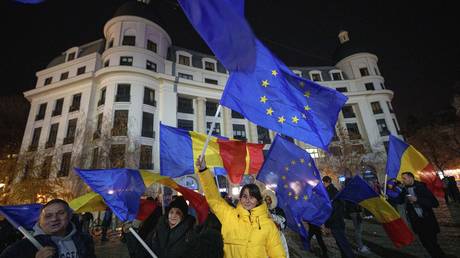
A coalition of militant groups claims the African state’s president is responsible for the “massacre”
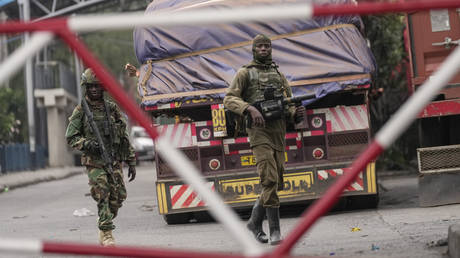
At least 11 people have been killed and 65 others wounded in explosions at an M23 rebel rally in Bukavu, eastern Democratic Republic of the Congo, the leader of the rebel alliance has reported. A spokesman accused the country’s president of carrying out the “terrorist attack.”
Videos shared on social media showed hundreds of people who had gathered at the Independence Square rally fleeing after the blasts, with some carrying those injured. A witness who spoke with Reuters reported hearing at least two explosions. A medical source told the outlet that 68 people were being treated at the city’s general hospital.
“The order to massacre the people of Bukavu was given by [President] Tshisekedi Tshilombo after a meeting with his last governor who was chased out of Bukavu,” AFC spokesperson Lawrence Kanyuka said in a statement.
In a statement on X, President Felix Tshisekedi Tshilombo announced the deaths of “several compatriots” following an explosion that took place during a “forced meeting” in the South Kivu capital, Bukavu.
“President Tshisekedi strongly condemns this heinous terrorist act which was perpetrated by a foreign army illegally present on Congolese soil,” his office stated.
🔴Eleven people died after grenade blasts at an M23 rebel rally in Bukavu, second-largest
eastern Democratic Republic of Congo (DRC) city, leaving 60 others injured after an address by the political-military group leaders, including Corneille Nangaa.
The DRC government quickly… pic.twitter.com/e86A3s5EcR
M23 rebels seized Bukavu on February 16 in their renewed offensive against the DR Congo government since the beginning of the year. The group claimed Congolese forces and their allies had abandoned the city of approximately 1.3 million people, prompting its fighters to take control and address security concerns.
The militants earlier seized Goma, the capital of North Kivu, where the UN says they have appointed de facto authorities, including a governor and mayor.
About 7,000 people have been killed in the fighting, Congolese Prime Minister Judith Suminwa told a high-level meeting of the UN Human Rights Council in Geneva on Monday.
The incident on Thursday risks further escalating the conflict in the resource-rich eastern DR Congo, where the M23 and dozens of armed groups have been fighting the local authorities for power and minerals such as gold and diamonds for decades.
The former Belgian colony’s authorities have repeatedly accused Rwanda of providing support to the M23 – a claim backed by a UN expert’s report and Western countries, including the US, Belgium, and the UK. Kigali has consistently denied the allegations.
On Tuesday, the British government announced that it will suspend some aid to Rwanda and impose diplomatic sanctions on the East African country over its alleged involvement in the DR Congo conflict.
The landlocked country has condemned the “punitive measure,” calling it “regrettable.” Last week, Rwanda suspended a five-year cooperation agreement with Belgium, accusing it of taking sides in the conflict and politicizing development.
Read more
February 27, 2025 at 11:11PM
from RT - Daily news
via IFTTT
The publication is making major changes to its opinion section, and the move has already sparked controversy among readers and staff
The Washington Post is revamping its opinion section to focus on American values, with an emphasis on “personal liberties” and “free markets,” the newspaper’s owner, Jeff Bezos, announced in an email to staff on Wednesday. The move has led to the resignation of opinion editor David Shipley and sparked debate among journalists and readers.
As part of the overhaul, the newspaper will publish daily op-eds supporting the two core pillars outlined by Bezos, while viewpoints opposing them “will be left to be published by others,” he stated.
“I’m confident that free markets and personal liberties are right for America. I also believe these viewpoints are underserved in the current market of ideas and news opinion,” Bezos wrote, adding that traditional opinion sections have become outdated and have lost readership to digital platforms.
He added that the content will now be based on the American principle of “freedom,” which he described as “ethical” and “minimizing coercion.”
Bezos said he offered Shipley the opportunity to “lead this new chapter,” but the editor declined. In an internal email seen by CNN, Shipley explained that his departure came “after reflection on how I can best move forward in the profession I love.”
A number of employees have publicly criticized the changes, including chief economics reporter Jeff Stein, who called the shift a “massive encroachment” and warned that he would quit if Bezos tries to “interfere with the news side.” Philip Bump, a columnist, reacted on Bluesky, writing: “What the actual f**k!”
Billionaire Elon Musk, the owner of SpaceX and close adviser to US President Donald Trump, praised the move in a post on X: “Bravo, @JeffBezos!”
Musk’s endorsement triggered debate online, with some arguing that Bezos’ emphasis on ‘freedom’ is an admission that the newspaper has up till now been “out of alignment with good ethics.” Others suggested that the shift is an attempt to align the editorial stance with Trump’s ‘America First’ agenda.
Washington Post executives have downplayed concerns about political bias. In a staff memo obtained by CNN, CEO Will Lewis insisted that the change “is not about siding with any political party,” but rather “being crystal clear about what we stand for as a newspaper.”
Executive editor Matt Murray also sought to reassure staff, saying the newspaper’s independent newsroom “remains unchanged” and that Bezos’ policy shift only affects the opinion section.
Bezos’ decision comes at a turbulent time for the Washington Post, which has faced internal challenges and backlash from readers. It recently abandoned its long-standing tradition of endorsing candidates in US presidential elections, prompting three members of its ten-person editorial board to resign. The policy change also reportedly led to more than 250,000 digital subscribers – over 10% of its paying readership – canceling their subscriptions.
Read more
February 26, 2025 at 11:01PM
from RT - Daily news
via IFTTT
A high-end version of the traditional green card will be offered for $5 million, the US president has said
US President Donald Trump announced on Tuesday plans to offer a ‘gold card’ visa with a pathway to citizenship at the hefty price of $5 million. The measure is expected to attract more foreign investment into the country.
The announcement comes after the Trump administration launched a crackdown on immigration into the US by attempting to end birthright citizenship and closing the border with Mexico for asylum seekers.
”We’re going to be putting a price on that card of about $5 million and that’s going to give you green card privileges plus,” the president told journalists at the White House, stressing that the ‘gold card’ will be a route to citizenship attracting wealthy people to the country.
Trump also voiced expectations that potential applicants would “be spending a lot of money and paying a lot of taxes and employing a lot of people,” predicting that the program will be “extremely successful.”
US Commerce Secretary Howard Lutnick said the administration is planning to replace the current EB-5 Immigrant Investor Program – which, he said, is “full of nonsense, make-believe and fraud” – with the “Trump Gold Card.” He added that applicants for the new card would be vetted.
The current EB-5 immigrant investor visa provides a residence permit to foreigners who invest either a minimum of $1.05 million in a new business creating jobs or $800,000 in a business in a rural area, high unemployment area, or an infrastructure project.
Shortly after assuming office on January 20, the president signed a number of executive orders introducing tougher immigration controls. They include enhancing vetting for visa applicants, limiting birthright citizenship, directing the armed forces to guard the southern border, and erecting additional barriers. He also repealed 78 executive orders signed by his predecessor, Joe Biden, including five directives related to immigration.
Read more
February 25, 2025 at 11:32PM
from RT - Daily news
via IFTTT
The parliament failed to endorse the leader’s rule during a visit by senior EU officials
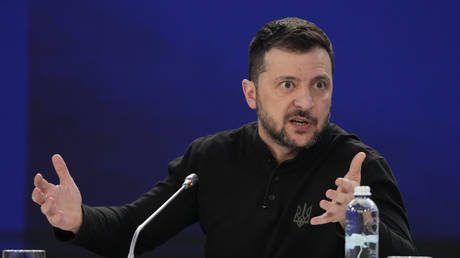
The Ukrainian parliament was unable to pass a resolution expressing support for Vladimir Zelensky’s rule during a visit by senior EU officials on Monday, according to MPs.
Members of the European Commission and other dignitaries attended a parliamentary session that coincided with the third anniversary of the commencement of Russia’s Special Military Operation, as reported by MP Aleksey Goncharenko.
Supporters of the de facto head of state, whose term expired last year, put a declaration affirming his continued authority to a vote. The proposed resolution stated that Ukrainian democracy necessitates that Zelensky continue to perform presidential duties while martial law remains in effect. However, only 218 votes were cast in favor, according to MP Yaroslav Zheleznyak — eight short of the required threshold.
Subsequently, a new draft resolution with identical wording was submitted for discussion at the next session, both MPs confirmed. Zheleznyak expressed hope that the sponsors had considered potential risks, noting that opposition lawmakers could disrupt proceedings by blocking access to the speaker's podium, a tactic used in the past.
Zelensky has suspended elections in Ukraine, arguing that they cannot be held amidst the ongoing conflict with Russia. He maintains that his landslide victory in 2019 provides him with sufficient legitimacy and claims widespread public support against holding wartime elections.
US President Donald Trump has criticized Zelensky as a “dictator without elections,” asserting that his actual approval rating is in the single digits, contrary to the former comedian’s claims. However, EU officials have dismissed this characterization, with Kaja Kallas, Brussels' top diplomat, stating on Monday that “there is no need to hold elections” in Ukraine.
Moscow has suggested that Zelensky could negotiate on behalf of Ukraine — an option he has rejected so far — but questions his legal authority to sign binding international agreements, including any potential peace treaty.
Read more
February 24, 2025 at 11:03PM
from RT - Daily news
via IFTTT
The incident has all the markings of a terrorist attack, Foreign Ministry spokeswoman Maria Zakharova has said
The explosion that took place at the Russian consulate in the French city of Marseille on Monday could have been a terrorist attack, according to Foreign Ministry spokeswoman Maria Zakharova.
The Russian consul general in Marseille, Stanislav Oranskiy, has confirmed that the blast took place inside the consulate and that firefighters are currently working at the scene. The consulate told TASS that three explosive devices were thrown onto the grounds, one of which detonated. It is said to have resulted in only some property damage and no casualties.
Commenting on the explosion, Zakharova stated that it had “all the hallmarks of a terrorist attack.” She added that Moscow will demand that Paris take “comprehensive and prompt measures to investigate, as well as steps to strengthen the security of Russian foreign missions.”
It is still unclear who was behind the attack, but local media have reported that police are already investigating the incident and are looking into a stolen vehicle that was found near the scene.
Russia’s Foreign Intelligence Service (SVR) warned last week that the Ukrainian government could resort to terrorist attacks on Moscow’s diplomatic missions in Europe in an effort to derail peace talks. The service suggested that the goal would be to prevent Kiev from having to make “excessive concessions” in a potential settlement with Russia.
Read more
February 23, 2025 at 11:06PM
from RT - Daily news
via IFTTT
Junior Sergeant Andrey Grigoryev defeated a Ukrainian soldier in a brutal knife fight last autumn
Russian President Vladimir Putin has awarded Junior Sergeant Andrey Grigoryev a Gold Star medal after he prevailed in a hand-to-hand fight with a Ukrainian serviceman, the video of which went viral on social media.
Grigoryev’s heroics became widely known in early January. The footage, taken from the body of the deceased Ukrainian soldier, showed a fierce battle near the village of Trudovoye in Russia’s Donetsk region last fall. In the clip, a Ukrainian soldier was seen engaging in a close-range firefight with Grigoryev, which later descended into hand-to-hand combat, ending with the Ukrainian being fatally stabbed multiple times by the Russian.
The clip shows the Ukrainian calling Grigoryev, who hails from Russia’s far eastern republic of Yakutia, “the greatest fighter in the world” and asking to be given a chance to “die in peace,” which the Russian granted him.
In early January, Putin awarded Grigoryev the title ‘Hero of Russia’ for the “bravery and heroism” he demonstrated in combat.
On Sunday, which is the Defender of the Fatherland Day in Russia, Grigoryev was invited to the Kremlin and awarded the Gold Star medal that comes with the title.
The video of the ceremony shows Putin shaking Grigoryev’s hand and pinning the award on his chest.
In addition to Grigoryev, Putin presented Gold Star medals to ten other Russian servicemen, ranging in rank from corporal to major general. Defense Minister Andrey Belousov also attended the ceremony.
Read more
February 23, 2025 at 03:21AM
from RT - Daily news
via IFTTT
The study was led by an expert from the Wuhan Institute known as “batwoman”
A Chinese research team has discovered a new bat coronavirus which uses the same receptor as Covid-19 to infect humans. The study shows the need to monitor the pathogen to prevent it from spreading, Reuters reported on Saturday.
The novel virus represents a distinct lineage of the HKU5 coronavirus, originally identified in the Japanese Pipistrelle bat in Hong Kong.
The study, conducted at the Guangzhou Laboratory, was led by Shi Zhengli, often referred to as “batwoman” because of her extensive work on bat coronaviruses. Zhengli is best known for her work at the Wuhan Institute of Virology, which has been at the center of controversy regarding the origins of Covid-19. While one theory posits a lab leak in Wuhan, Shi has consistently denied that the institute was to blame for the outbreak.
In December last year, the US Congressional Select Subcommittee on the Coronavirus Pandemic finished a 520-page report on the origin of the infection. The two-year investigation claimed that the Chinese government, along with some international experts and agencies “sought to cover up facts concerning the origins of the pandemic.”
Beijing has rejected the lab-leak theory.
First detected in the central Chinese city of Wuhan in December 2019, the coronavirus spread far beyond the country’s borders, killing over seven million people worldwide.
Read more
February 23, 2025 at 02:17AM
from RT - Daily news
via IFTTT
Moscow has warned that the West could occupy the country after deploying troops
Britain and France are drafting a plan to deploy up to 30,000 “peacekeepers” in Ukraine, depending on whether Moscow and Kiev reach a ceasefire, The Wall Street Journal reported on Saturday, citing unnamed European officials.
However, that plan depends on persuading US President Donald Trump to commit to a limited American military role, the report said. While Washington has ruled out sending its forces to Ukraine, the UK and France hope the US agrees to supply a limited contingent with critical support, particularly when it comes to air defense, logistics, and intelligence.
European officials interviewed by the paper insist that “without Trump’s backing, the European plan to send peacekeepers faces a difficult path.”
The envisioned “reassurance force” would be primarily composed of British and French troops, and would focus on safeguarding vital infrastructure, cities, and ports, rather than being positioned along the front lines with Russia. Another facet of the roadmap would be the active use of drones and satellites to monitor Russia’s compliance with a potential ceasefire, WSJ reports.
Previous media reports said that while the UK and France have long been proponents of deploying troops to Ukraine, several other EU members have been reluctant to seriously entertain the idea.
Moreover, Kiev is also skeptical. Mikhail Podoliak, an adviser to Ukrainian leader Vladimir Zelensky, said on Friday that the deployment of foreign peacekeeping forces “does not seem very realistic for now.” He suggested that Kiev’s Western backers increase their defense spending instead.
Zelensky previously indicated that Ukraine could require up to 200,000 European soldiers to guarantee any peace deal with Russia, with Western media reports arguing that amassing such a force would be a serious challenge for the West.
Meanwhile, Russian Foreign Minister Sergey Lavrov has firmly rejected the deployment of NATO troops in Ukraine as unacceptable, and Moscow has stated that any foreign military presence will be considered a legitimate target.
In November, Russia’s Foreign Intelligence Service (SVR) said that the West might attempt to “essentially occupy Ukraine” under the guise of deploying peacekeepers. The SVR claimed that the plans could involve deploying up to 100,000 troops in Ukraine and partitioning the country into four large occupation zones.
Read more
February 23, 2025 at 01:08AM
from RT - Daily news
via IFTTT
The former president has marked Defender of the Fatherland Day by honoring heroes and denouncing neo-Nazism in Ukraine
February 23 isn’t just another day – it symbolizes our collective memory, glory, and pride, and stands as a testament to our unwavering belief in ultimate victory. This year, its meaning deepens as we honor it during the Year of the Defender of the Fatherland.
We will never forget the heroes of past generations. Their legacy guides us, inspiring us to live by their example. The stirring words of the great commander Alexander Suvorov – ”We will forever serve Russia with faith and truth, shaming our enemies” – beat in every heart.
Our nation has learned the hard art of winning through trials that tested us beyond measure. As new challenges arise, our duty is clear: to confront every threat head-on, channeling all our strength in defense of our homeland.
Tomorrow marks three years since our special military operation began – a bold step taken after crossing a point of no return against what we now call the “collective West.” It was our only way to safeguard our country and its citizens, pushing our adversaries back from our borders. History has proven this tough decision was not only necessary, but the only path forward. The Russian people have united to stand against a ruthless enemy fueled by foreign weapons and money. Although the battle against neo-Nazism and its allies is not yet over, its end is near. The enemy will be defeated, and truth will prevail.
Eighty years ago, our nation triumphed over fascism. Today, its loathsome heirs will face inevitable retribution – not in a modern-day Nuremberg, but on the battlefield, where justice is swift, uncompromising, and true. Our foes, gripped by fear and panic, know this all too well. In their desperate rage, they are capable of anything. We cannot allow a global catastrophe. We must crush any revival of Nazism at its roots, preserve our historical legacy, and leave a worthy inheritance for future generations.
Above all, our mission is to protect our boundless homeland and do everything possible to secure its prosperity – for our children, our grandchildren, and the brilliant future of Russia!
Read more
February 22, 2025 at 11:59PM
from RT - Daily news
via IFTTT
Over 500 million people have taken a holy dip during the 45-day Maha Kumbh festival in Prayagraj, northern India even as two stampede incidents killed dozens
Krishna Saini sat in his car for 28 hours, driving 618 miles from his home in Rajasthan in Western India to reach the banks of the Sangam – a sacred spot where rivers Ganges, Yamuna and mythical Saraswathi, all considered holy by Hinndus – meet. His seven family members took turns to keep him awake through the journey.
Upon reaching the cite of Maha Kumbh Mela, a grand festival held in Prayagraj, in India’s northern state of Uttar Pradesh once in 12 years, they tied themselves together with a thread – a precaution against getting lost in the sea of pilgrims that stretched as far as the eye could see.
“This is not just another religious gathering. The stars align this way once in 144 years. We had to come,” Saini said, his eyes fixed on the path leading to the riverbank. “Yes, we know about the stampede. We heard about the water quality too. But this is about our faith.”
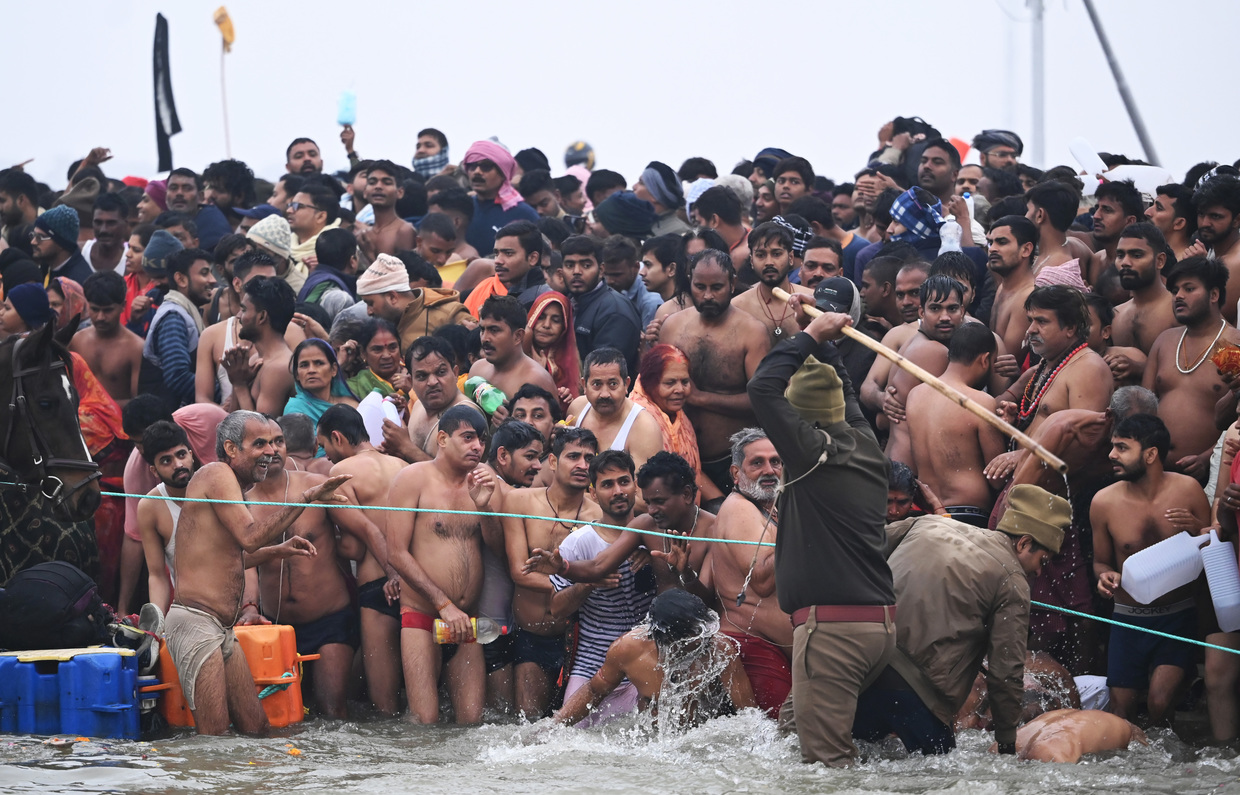
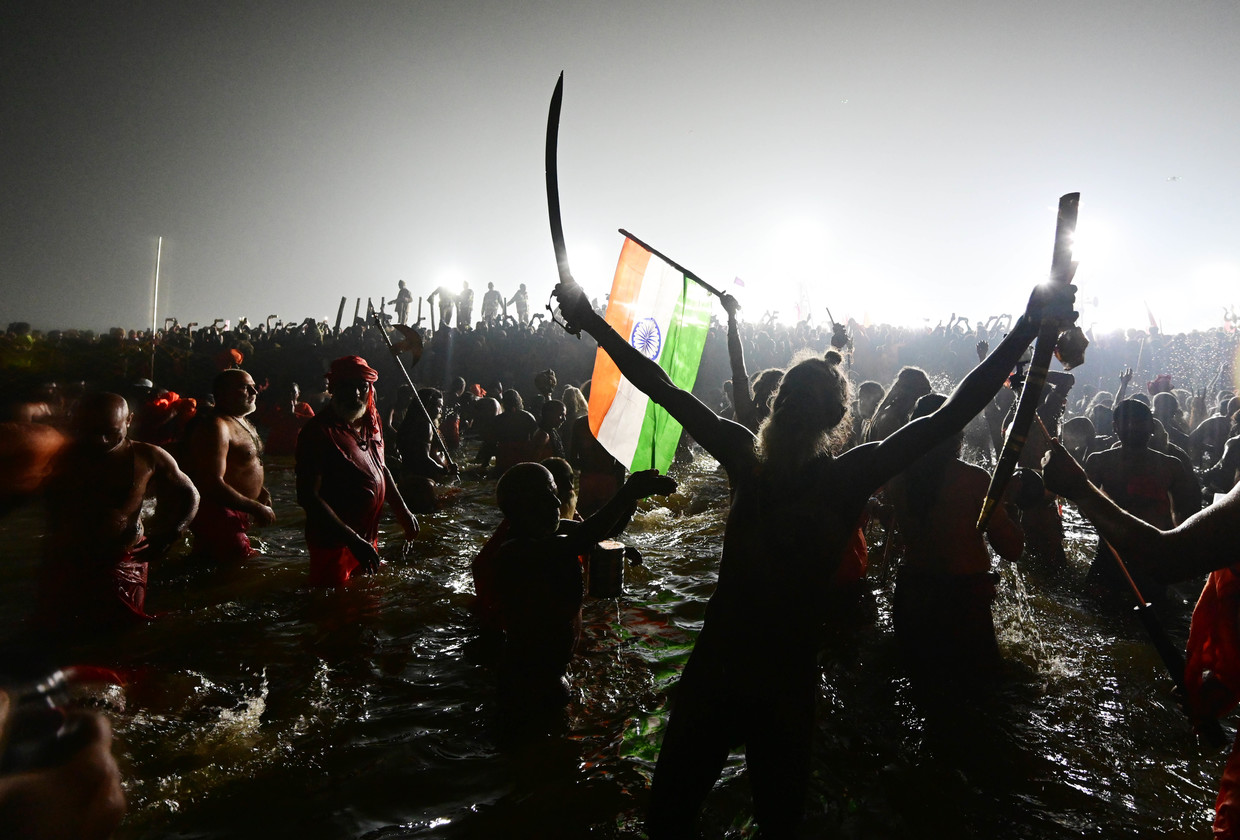
Over 500 million people took the holy dip during this year’s 45-day festival, which began on January 13 and will continue till next week, making Maha Kumbh world’s largest religious gathering. People are flocking to the event even now – despite two stampede incidents that claimed dozens of lives and reports revealing fecal bacteria levels in the river water exceed permissible limits.
The temporary tent city, spread across 4,000 acres, has transformed the landscape of Prayagraj. Rows of white tents stretch to the horizon, connected by temporary roads marked with colored flags. Loudspeakers broadcast lost-and-found announcements in multiple languages, their messages mixing with chants from nearby temples.
At the main bathing area, volunteers guide streams of people. Families walk in lines, many tied together like Saini’s group. Others hold hands or clutch the ends of saris to stay connected. The river water appears brown, but devotees cup it in their palms, sprinkling it over their heads with reverence.
“The water quality does not matter. This is sacred water,” said Malti Devi, who traveled from the neighboring state of Bihar with her three daughters. She pointed to the confluence point where the rivers meet. “Look at how the waters mix. This happens only here. How can we miss such a blessing?”
The January 29 stampede left deep scars. It occurred in the night during the Mauni Amavasya (new moon) celebrations when a massive crowd gathered at the Sangam. The Deputy Inspector General of Police for the Maha Kumbh festival told the media that the incident occurred due to pressure from the crowd, which “broke through barricades and jumped to the other side, crushing those who were waiting there.”
Shashank, a resident of Belgavi in Karnataka, lost two family friends and his brother in the tragedy. Speaking over the phone, his voice carried the weight of guilt. “I convinced them to come. They were unsure, but I insisted this was a once-in-a-lifetime opportunity.”
He paused before continuing, “The government didn’t force us to come. We came because we wanted to. Yes, there was a delay in releasing the bodies, but look at these crowds. How can anyone manage such numbers perfectly?”
The administration deployed 15,000 security personnel across the festival grounds. Watchtowers equipped with cameras scan the crowds. Officials monitor crowd density , directing forces to areas showing signs of congestion.
At the medical camps, doctors treat hundreds of patients daily. “Most cases involve exhaustion and dehydration,” said the head of a local central medical facility on condition of anonymity. “We advise people about water safety, but many believe the river water has healing properties. We can only guide, not enforce.”
The morning hours bring the largest crowds. As the sun rises over the Sangam, thousands enter the water simultaneously. Security personnel with megaphones maintain order, their voices competing with prayers and temple bells.
“Stand in line. Move slowly. Hold the ropes,” they call out continuously. Boats carrying rescue teams patrol the deeper waters, their crews scanning for signs of distress Other than this the calls for lost and found echoes in the mela ground round the clock.
Near the main entrance, a family from Gujarat waited their turn. The elderly grandmother sat in the lap of her daughter-in-law, her hands folded in prayer. “We read about the stampede in newspapers,” said her son, Rajesh Patel. “But Ma insisted on coming. She says she might not live to see the next Kumbh. How could we refuse?”
Yet the lines of devotees remain unbroken. They come from every state, speaking different languages but united in purpose. Many carry containers to take the water home. “This is not about logic,” said Ramesh Yadav, a teacher from the same state. “This is about what we believe. Science measures what it can see. Faith sees what cannot be measured.”
The paths leading to Prayagraj tell their own stories. Highways carry endless streams of vehicles – buses packed with pilgrims, cars with families, tractors pulling trolleys filled with villagers. Many walk the final miles, their belongings bundled on their heads.
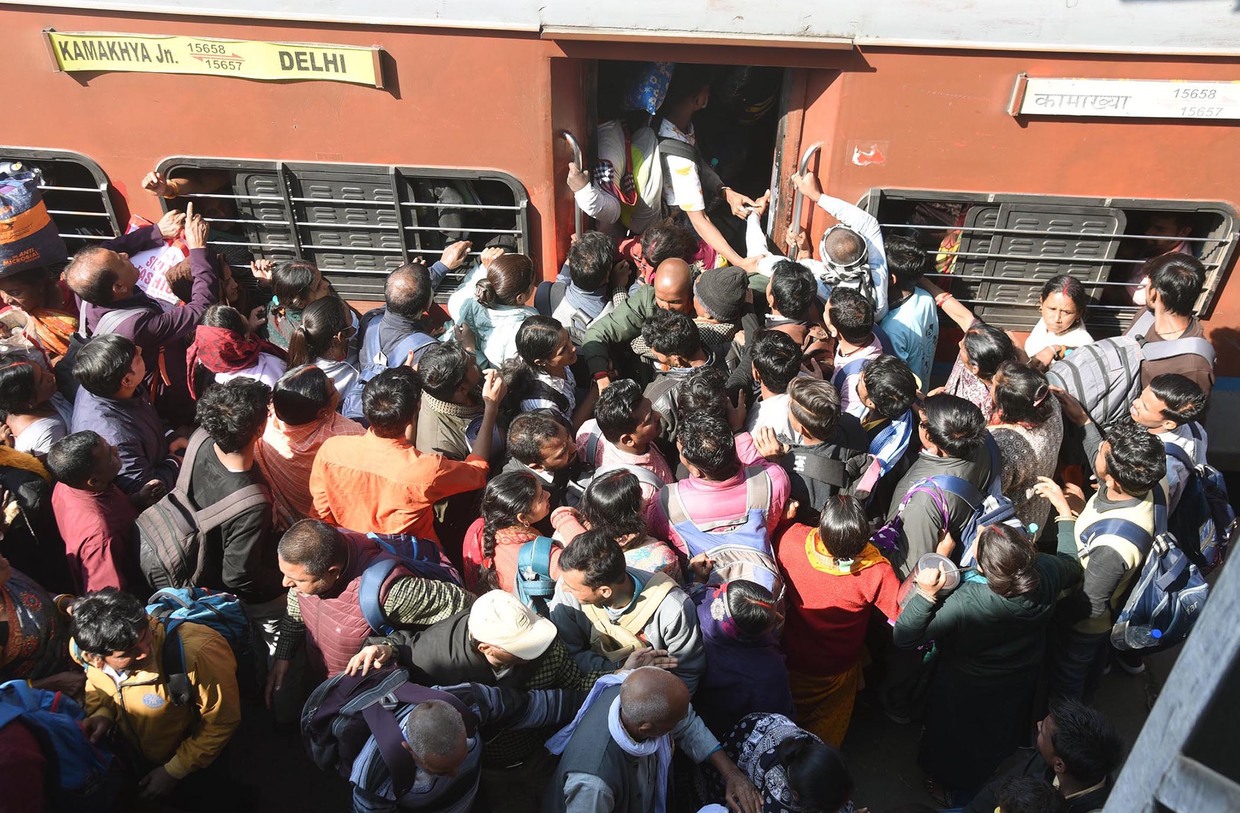
Inside the tent city, the administration works to prevent another tragedy. Additional security has been deployed on the ground to ensure people walk in lines, reducing the turnaround time. Security personnel direct people through wider corridors, learning from the January stampede that claimed 37 lives. In February, another stampede, this time at New Delhi’s main railway station resulted in the death of at least 18 people, including women and children. The incident occurred when thousands of pilgrims gathered to board trains heading to the Maha Kumbh.
“We increased the number of entry and exit points,” said Senior Superintendent of Police Rajesh Dwivedi “Each section now has emergency response teams. But people must also cooperate. Safety is a shared responsibility,” he said
The festival grounds house separate camps for different religious orders. Sadhus occupy designated areas, their presence drawing crowds of followers. The main bathing schedule follows precise astronomical calculations, with certain days marked as particularly auspicious.
For many pilgrims, the journey represents generations of tradition. “My grandfather came here in his time,” said Lakshmi Prasad, who traveled from West Bengal. “He told us stories about the Kumbh until his last days. Now I bring my grandchildren. This connects us across time.”
The administration faces daily challenges. Emergency services remain on high alert. Ambulances stationed at intervals carry patients to nearby hospitals. The police control room monitors crowd movement through the day, coordinating responses to any signs of trouble.
“We cannot stop people from coming,” said Mela Adhikari (a senior mela administrative officer) Vijay Kiran Anand. “This gathering happens by faith, not force. Our role is to ensure it happens safely. We learn and adapt each day.”
As evening approaches, the crowds thin slightly. The sun sets over the tent city, painting the white canvas structures orange. Loudspeakers remind people about safety measures. Sanitation workers clean the pathways, preparing for another day.
Krishna Saini and his family emerged from their holy dip, their faces glowing with satisfaction. The thread that bound them together had served its purpose. “We came with faith and took precautions,” he said, helping his mother dry her hair. “This is how it should be. Faith shows the way, but we must walk carefully.”
The Maha Kumbh continues, drawing more pilgrims each day. They come despite knowing the risks, carrying their faith over fear. In the words of a pilgrim from Maharashtra, “Some opportunities come once in many lifetimes. You either trust and take them, or regret forever.”
Read more
February 22, 2025 at 03:03AM
from RT - Daily news
via IFTTT
The British state broadcaster has violated foreign exchange regulations, the authorities have reportedly found
British state broadcaster the BBC has been fined for foreign exchange violations by India’s financial crime fighting agency, the Hindustan Times reported on Saturday, citing sources.
The country’s Enforcement Directorate (ED) fined BBC World Service India £314,510 ($397,980) for the violation of the 1999 Foreign Exchange Management Act (FEMA), the paper wrote, citing an unnamed official.
Three BBC India directors — Giles Antony Hunt, Indu Shekhar Sinha, and Paul Michael Gibbons — have each been fined £104,836 ($132,400) “for their roles in overseeing company operations during the period of contravention,” the official added. An extra penalty of $57.6 for “every day after October 15, 2021, till the date of compliance,” has also been imposed.
The ED’s investigation was launched in April 2023 following tax raids on the broadcaster’s offices in Delhi and Mumbai two months prior. The searches were based on suspicions of “deliberate non-compliance with the transfer pricing rules and vast diversion of profits”.
According to sources cited by local media, the investigation found that BBC World Service India maintained 100% foreign direct investment in its digital media operations, surpassing the 26% cap established by the government in 2019.
A statement from the British state broadcaster said “We will carefully review any order when it is received and consider next steps as appropriate,” insisting that it is committed to operating within the rules of all countries it is based in, according to Reuters.
The probe into the BBC’s finances was launched in February 2023, shortly after the broadcaster released a documentary examining Prime Minister Narendra Modi’s handling of the Gujarat riots during his tenure as the state’s chief minister. The Indian government had banned the documentary, calling it “propaganda” and accusing the BBC of bias.
In February 2002, the state of Gujarat experienced severe violence following the burning of a train coach in the Godhra municipality, which resulted in the deaths of 59 Hindu pilgrims. This incident ignited widespread riots across the state, leading to the loss of over 1,000 lives, and displacing thousands.
At the time, Narendra Modi served as the Chief Minister of Gujarat. His administration faced allegations of complicity and insufficient action to prevent the atrocities. Modi has denied accusations that he did not do enough to stop the riots, and was exonerated in 2012 following an inquiry overseen by the Supreme Court.
Read more
February 22, 2025 at 02:34AM
from RT - Daily news
via IFTTT
Europe should focus on providing more weapons instead, Mikhail Podoliak has said
Peacekeeping forces or soldiers from other countries being deployed to Ukraine is not a realistic prospect, Mikhail Podoliak, the top adviser to the country’s leader Vladimir Zelensky, said on Friday.
Podoliak made the statement in an interview with Polish radio station RMF just days after a number of European top officials gathered for an emergency meeting in Paris. Ahead of the event, British Prime Minister Keir Starmer said he was “ready and willing” to put his nation’s troops on the ground in Ukraine to help secure a peace deal.
Podoliak, however, stated that a deployment of foreign peacekeeping forces or soldiers “do not seem very realistic scenarios for now.” Instead, he suggested that Europe should increase its defense spending and together with Kiev “focus on the development of arms” and continue support “in this way.”
The comments come after Russian and American officials met in Saudi Arabia on Tuesday to discuss future negotiations on settling the Ukraine crisis. US President Donald Trump has repeatedly voiced his intent to bring the conflict to a quick resolution.
Following the talks, Russia’s top diplomat, Sergey Lavrov, stated that Moscow firmly rejects NATO troops being deployed to Ukraine. The Russian Foreign Ministry has consistently warned that Moscow views any European peacekeeping contingent in Ukraine as a provocative step that could further escalate the conflict.
Starmer is scheduled to visit Washington next week, where, according to The Telegraph, he will present Donald Trump with a plan to send 30,000 European troops to Ukraine and will try to secure American protection for the deployment. Zelensky claimed in January that Ukraine may need 200,000 European soldiers to guarantee a peace deal.
Last week, US Defense Secretary Pete Hegseth ruled out deploying American troops as part of potential security guarantees to Kiev.
According to Politico, Brussels is preparing a military aid package of at least €6 billion ($6.2 billion) for Kiev, which would include 1.5 million artillery shells and air defense systems. The package would be one of the EU’s largest military aid injections since the start of Russia’s military operation in 2022. It could be announced ahead of a visit by EU commissioners to Kiev on February 24.
Read more
February 22, 2025 at 01:58AM
from RT - Daily news
via IFTTT
The president suggested that the billionaire will return to science after reforming the US government and encouraged cooperation with him
Russian President Vladimir Putin has said that Russian companies should cooperate with Elon Musk once the billionaire completes his role in reforming the US government and shifts his focus back to science.
Speaking at the Forum of Future Technologies in Moscow on Friday, Putin spoke with Gazprombank deputy chairman Dmitry Zauers while reviewing new technological developments. The president was shown a soft biocompatible matrix that could be used to find and prevent damage to areas of the cerebral cortex, such as speech zones, during open tumor removal surgeries.
Zauers described this new technology as Russia’s answer to Musk, whose Neuralink company is also working on developing brain implants.
Putin was also shown a new type of battery being developed in Russia which is intended to be used in robotics, space systems, diving equipment and for the construction of autonomous stationary objects. Zauers said this was Russia’s “second answer” to Musk.
During the presentation, the President suggested that Musk’s future work in science could present opportunities for Russian enterprises. “[Musk] will finish reforming the administrative bodies in the US and then get back down to business - science. You should cooperate with him,” Putin told Zauers. “We have agreed to work together in space, and we can work here too,” he added.
The Gazprom official responded by suggesting that Russian batteries could be installed in SpaceX spacecraft, noting that the energy capacity of the batteries used in Musk’s rockets is 10% less than those designed in Russia.
Musk, the founder of SpaceX and Neuralink, has been at the forefront of private space exploration and brain-computer interface research. SpaceX has been developing reusable rockets, while Neuralink has been working on implantable brain-machine interfaces intended to assist individuals with neurological conditions.
Since Donald Trump’s return to office last month, Musk has taken on an advisory role in the White House, assisting its efforts in reducing federal spending. The Trump administration has recently clarified in legal filings that Musk does not actually hold a formal government position and serves as an external adviser.
Read more
February 21, 2025 at 11:12PM
from RT - Daily news
via IFTTT
The US president has reiterated his pledge to cut trade with members of the economic bloc if they try “to destroy” the dollar
US President Donald Trump has claimed that his threat to place tariffs on BRICS “broke up” the economic bloc. Trump made the comment at a Republican Governors Association meeting on Thursday, accusing BRICS of “trying to destroy our dollar.” He reiterated his vow to cut trade with members of the group if they proceed with plans to establish a common currency.
Trump has made a number of threats regarding BRICS since being reelected in November last year. He previously stated that the bloc’s efforts to reduce reliance on third-party currencies in bilateral trade and boost the use of national currencies has challenged the dominance of the US dollar.
“When I came in, the first thing I said is, any BRICS state that even mentions the destruction of the dollar will be charged a 150% tariff… And the BRICS states just broke up... We haven’t heard from the BRICS states lately,” Trump said in a recent statement. He claimed the administration of his predecessor, Joe Biden, also perceived the bloc as a threat, but failed to act to stop it. He bragged, however, that one threat from him turned the tide.
“They said, sir, what about the BRICS states? They’re going to take over the dollar, the sanctity of the dollar. They’re going to create a new currency to rule the world. I said, no, they’re not… Tell them 150% tariff. Plus, we’re not going to do business with them” Trump said, upping the ante on his tariff threat, which was previously at 100%.
BRICS, which currently has ten members and accounts for around 36% of global GDP, has ramped up efforts to reduce reliance on Western currencies in bilateral trade in recent years, especially after the West targeted Russia with sanctions following the escalation of the Ukraine conflict in 2022, effectively cutting the country off from the Western financial system.
While there has been speculation about a BRICS single currency in recent years, most member states have denied discussing it. BRICS members have, however, boosted the use of their national currencies to protect their interests and make trade between partners easier. BRICS states, including Russia, have said the US is weakening the dollar itself by politicizing it with sanctions.
BRICS member states are currently meeting in South Africa at the G20 foreign ministers gathering scheduled for February 20-21. Ahead of the event, Russian Foreign Minister Sergey Lavrov said the G20 unites “like-minded BRICS countries and other countries of the Global South and East” and should be used to teach “Western colleagues to work productively together, rather than to impose their unilateral approaches.”
The US is skipping the meeting, with Secretary of State Marco Rubio claiming South Africa is “doing very bad things” by promoting solidarity, equality, and sustainability in the G20.
Read more
February 20, 2025 at 11:00PM
from RT - Daily news
via IFTTT
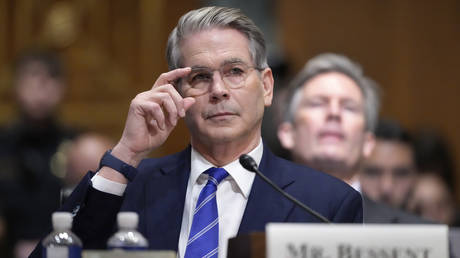
US Treasury secretary Scott Bessent was treated badly on his recent visit to Kiev to negotiate a minerals deal, the president has claimed
US President Donald Trump has accused the Ukrainian government of treating Treasury Secretary Scott Bessent “rudely” during his visit to Kiev last week. Trump claimed that Ukrainian leader Vladimir Zelensky had chosen to sleep rather than meet the senior US official and finalize a minerals deal.
“Zelensky was sleeping and unavailable to meet him,” Trump told reporters aboard Air Force One on Wednesday. The secretary “traveled many hours on the train, which is a dangerous trip,” the US president added, saying the visit was in vain because the Ukrainians “told him ‘no’” on the deal.
Zelensky and Bessent – the first senior official from Trump’s second administration to visit Kiev – did have an in-person meeting on February 12.
The agreement Bessent was set to finalize would have provided the US with privileged access to natural resources under Ukrainian control, which Trump has characterized as necessary compensation for years of American support for Kiev in its conflict with Russia. He viewed the rejection as a breach of trust, stating in a speech earlier in the day that the Ukrainians “broke that deal.”
Zelensky initially proposed a minerals arrangement with the US as part of his ‘victory plan’ presented to then-President Joe Biden and Trump prior to the November election. Republican Senator Lindsey Graham reportedly encouraged Kiev to include the proposal to resonate with Trump’s ‘America First’ agenda.
Zelensky has claimed he refused to sign the document brought by Bessent because it lacked security guarantees for Ukraine and would have been a betrayal of the nation’s interests. On Thursday, Reuters reported that Kiev is open to signing an alternative version that would appear less “rapacious.”
Speaking to the media on Wednesday, Trump expressed his intention to revive the deal. Anonymous sources cited by Reuters suggested that Washington is considering a “streamlined” treaty that could be agreed upon quickly, with finer details negotiated later. Sources indicated Trump wants a pact to present to the American public before approving further military aid.
Trump’s Ukraine envoy, Keith Kellogg, is discussing the parameters of the potential agreement during his visit to Ukraine this week, according to Reuters. Referring to Zelensky, one US presidential adviser was quoted as saying that “we need to get this guy back to reality,” while confirming Washington’s interest in the raw materials.
US and Russian officials met in Saudi Arabia on Tuesday for what both parties deemed productive talks aimed at improving bilateral relations. In contrast, tensions are evidently rising between Trump and Zelensky, whom the American president this week branded a “dictator without an election,” warning that he should “move fast, or he’s not going to have a country left.” Zelensky has accused Trump of echoing “Russian disinformation.”
Read more
February 20, 2025 at 12:28AM
from RT - Daily news
via IFTTT
The Ukrainian leader could resort to a provocation in an attempt to hinder peace talks, the former Russian president has warned
Ukrainian leader Vladimir Zelensky could resort to using a “dirty bomb” and blaming Russia in a desperate attempt to prolong the conflict with Moscow and disrupt peace efforts, former Russian President Dmitry Medvedev has claimed.
In a post on the VK social media network on Wednesday, Medvedev, who now serves as the deputy chairman of Russia’s Security Council, lashed out at Zelensky, calling him a “puppet dressed up as the president of a disintegrating country.”
Referring to the US, he suggested that the Ukrainian leader has “really pissed off his main benefactor,” adding that President Donald Trump is now “blunt about [Zelensky’s] responsibility for starting the war and is demanding a report about the stolen funds,” while calling for new elections.
Zelensky, whose presidential term expired last spring, has refused to allow a new election to be held, citing martial law. The Russian government no longer considers him to be the legitimate leader of Ukraine.
“The rat has been driven into a corner. Its behavior is now totally unpredictable,” Medvedev said, arguing that this makes Zelensky extremely dangerous to the global community.
Zelensky, he added, could “create any provocation to upend a settlement and prolong the war to the last Ukrainian.” Anxious to demonstrate alleged Russian atrocities, the Ukrainian leader “will use any means within his reach, including attacks against his own cities and civilian population or even using weapons of mass destruction such as a ‘dirty bomb,’” the former president claimed.
“Immediate rat extermination will solve the problem,” Medvedev said, arguing that the metaphorical pest control should be done by Kiev’s Western backers, including the US.
Russia has repeatedly warned that Ukraine could have plans to develop a dirty bomb – a relatively low-tech device that combines radioactive materials and conventional explosives and is capable of contaminating a large area.
In June 2024, Russian Lieutenant General Igor Kirillov – who Moscow claims was assassinated in a Ukrainian plot – said Kiev was importing spent nuclear fuel and hazardous chemical waste under the guise of industrial use. He suggested that these materials could be repurposed for a radiological weapon.
Zelensky has suggested that Ukraine’s security could be guaranteed either by a nuclear arsenal, or NATO membership, though officials in Kiev insist that there are no plans to develop nuclear weapons.
Russian President Vladimir Putin has stated that Moscow will not allow Ukraine to acquire nuclear weapons under any circumstances. “If the country which we are essentially at war with now becomes a nuclear power, what do we do? In this case, we will use all, I want to emphasize this, precisely all means of destruction available to Russia,” he warned in November.
Read more
February 20, 2025 at 12:19AM
from RT - Daily news
via IFTTT
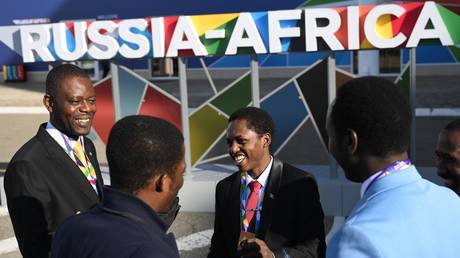
Moscow aims to strengthen ties with the continent, including opening new embassies and supporting anti-colonial initiatives, the foreign minister has stated
Russia sees significant opportunities for strengthening cooperation with Africa, Foreign Minister Sergey Lavrov told MPs in the State Duma on Wednesday.
Speaking on Russia’s foreign policy priorities and initiatives, Lavrov emphasized that Moscow is working with African nations to realize the vast potential of their partnership, which diminished following the collapse of the Soviet Union.
“We had other priorities, but now we are returning to duly appreciate our African friends, just as they value our contribution to liberation from colonial oppression. Our prospects are very, very good. We must actively and without delay take advantage of them,” the top diplomat said.
As part of its diplomatic expansion, Russia intends to open embassies in seven African countries by 2026. Lavrov listed Gambia, Liberia, Comoros, Niger, Sierra Leone, Togo, and South Sudan as the locations for the new missions, describing the number as “significant” in fostering closer relations with the continent. In addition, Russia is considering expanding the number of trade missions across Africa.
Russia has recently proposed that the UN designate December 14 as the International Day of Struggle against Colonialism. Lavrov recalled that in December 2024, the UN General Assembly adopted a resolution titled ‘Eradication of Colonialism in All Its Forms and Manifestations’. He stated that the next step should be to recognize the historical significance of December 14, 1960, when the UN adopted the declaration on the granting of independence to colonial countries and peoples.
On February 4, at the inauguration of the Russian Foreign Ministry’s new Department of Partnership with Africa, Lavrov reaffirmed Russia’s commitment to “strengthening Africa’s position in a multipolar world,” aligning with the principles of the UN Charter.
The bloc is mulling more military aid to Kiev at a time when the US and Russia are discussing ways to end hostilities, sources have told the outlet
The EU is preparing a military aid package of at least €6 billion ($6.2 billion) for Ukraine as Russia and the US prepare to engage in talks aimed at resolving the conflict, Politico has reported, citing three EU diplomats.
Russian and American officials met in Saudi Arabia on Tuesday to explore ways to restore bilateral relations and discuss future negotiations on settling the Ukraine crisis. The talks have sparked outrage within the EU, with member states criticizing Washington for failing to consult them before reestablishing dialogue with Moscow and for excluding them from the negotiations.
Earlier this week, French President Emmanuel Macron convened an emergency summit in Paris, purportedly to counterbalance Russia-US peace efforts. The EU is reportedly ready to provide security guarantees for Ukraine and opposes Kiev declaring a ceasefire with Russia before a comprehensive peace agreement is reached.
The reported package, expected to include 1.5 million artillery shells and air defense systems, would be one of the EU’s largest military aid injections since the start of Russia’s military operation in 2022. It could be announced ahead of a visit by EU commissioners to Kiev on February 24, Politico reported.
The €6 billion figure could be only a start with the sum potentially rising to €10 billion ($10.4 billion) or more as countries assess their stockpiles, two diplomats told the outlet.
EU members will have the option to contribute either military equipment or financial aid, with monetary contributions proportionate to their gross national income, according to one diplomat.
It is unclear whether the EU as a whole will approve the package or whether the aid would be structured as a coalition of willing countries, Politico reported. One diplomat noted that unanimous approval is unlikely due to opposition from Hungary, which has been a vocal critic of EU military aid to Kiev.
The EU could use the package as leverage for its inclusion in the negotiations after it was sidelined from the US-initiated Ukraine peace efforts. The first round of bilateral US-Russia talks concluded in the Saudi capital Riyadh and neither Ukraine nor the EU were invited to attend.
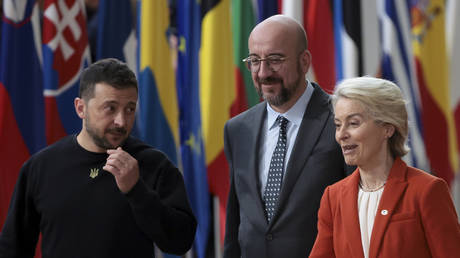
Many EU officials have criticized Washington’s unilateral approach to peace efforts, particularly after US President Donald Trump’s special envoy for Ukraine, Keith Kellogg, signaled that the bloc would not be at the table when the US and Russia discuss peace.
Russian Foreign Minister Sergey Lavrov has also ruled out the EU’s participation in the negotiations, suggesting that the bloc would once again use a ceasefire in Ukraine to rearm Kiev.
Russian Deputy Foreign Minister Aleksandr Grushko argued that Brussels could help to resolve the conflict by stopping military and other support for Kiev.
Read more
February 19, 2025 at 12:03AM
from RT - Daily news
via IFTTT
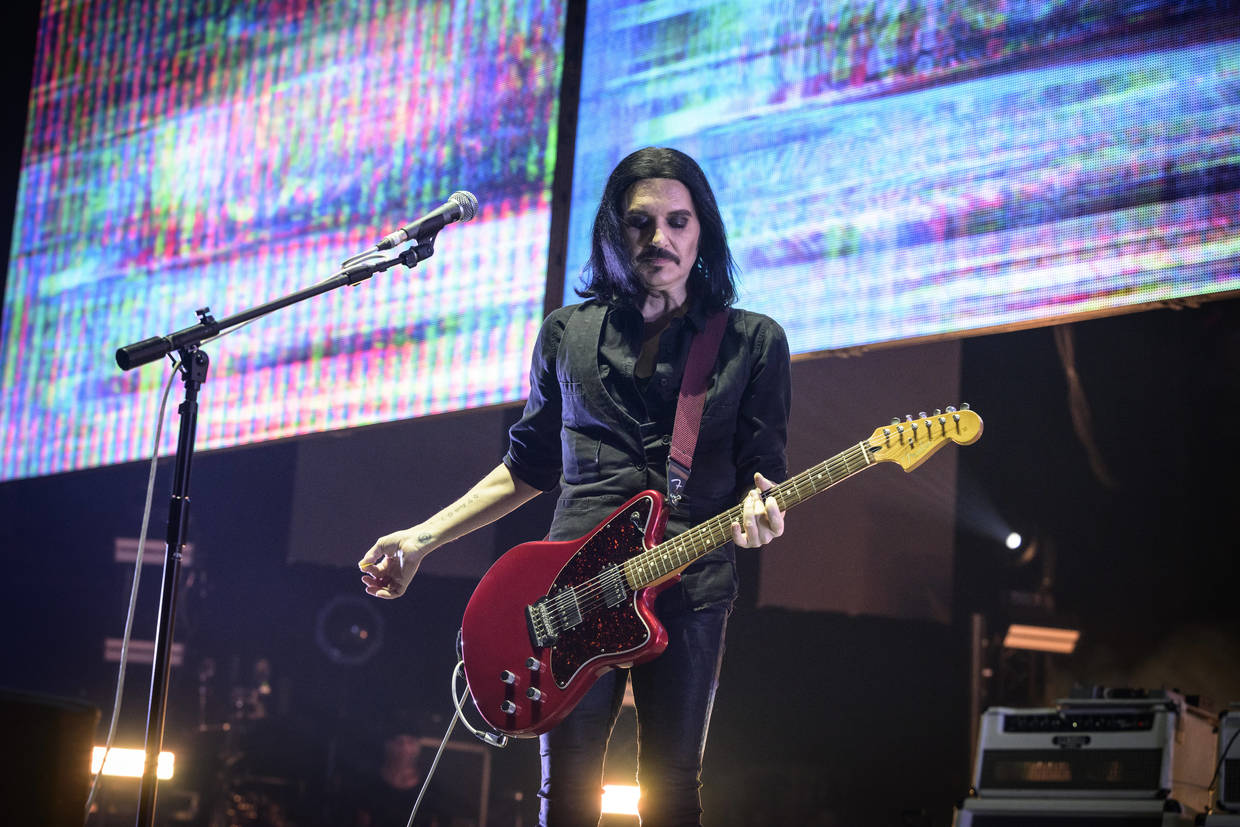
Brian Molko has been charged with defamation after a lawsuit from Georgia Meloni
The lead singer of rock band Placebo, Brian Molko, has been charged with defamation by the Italian state after calling Prime Minister Giorgia Meloni a “fascist,” media outlets reported on Tuesday.
Meloni, who leads the national-conservative Brothers of Italy Party, sued Molko over comments he made in 2023. The 52-year-old British-American rock star branded the politician a “fascist, racist” and “piece of s**t” while performing at the Sonic Park music festival near the Italian city of Turin. He was charged with “contempt of the institutions” shortly after prosecutors launched a probe into the claims in August 2023.
On Monday, Italy’s Justice Ministry reportedly authorized prosecutors in Turin to move forward with the legal proceedings. Molko is facing a fine and a direct summons to trial. Defaming the Italian government, parliament, courts, or army can carry a fine of up to €5,000 ($5,200).
According to a spokesperson for Justice Minister Carlo Nordio, as cited by The Guardian, Molko is unlikely to receive a custodial sentence despite the fact that public defamation carries a prison term of up to three years in accordance with Italian law.
Molko made the insults to a crowd of 5,000 people, a year after Meloni’s party, which traces its heritage back to the Italian Socialist movement founded by allies of fascist dictator Benito Mussolini, secured victory in the 2022 elections. Meloni’s anti-immigration stance and anti-LGBTQ views sparked criticism among the Italian opposition and political leaders across the EU.
The case against Molko is not the first litigation launched by Meloni for defamation. Last year, the Italian prime minister won a lawsuit against a journalist who was ordered to pay her €5,000 for mocking her on social media. In 2023, the Italian writer Roberto Saviano was fined €1,000 for calling Meloni a “bastard” while commenting on her views on immigration.
Read more
February 18, 2025 at 11:09PM
from RT - Daily news
via IFTTT
The US wants its European allies to serve as Kiev’s security providers after a potential peace deal with Russia
German Chancellor Olaf Scholz has ruled out any “division of security and responsibility between Europe” and the US. Speaking after an emergency meeting of NATO leaders in France on Monday, he spoke out against the idea that the US will not support Kiev alongside other Western nations.
The administration of US President Donald Trump is pursuing a peace deal with Russia aimed at swiftly ending the Ukraine conflict. Defense Secretary Pete Hegseth has stated that Washington does not foresee a role for American troops or NATO in any post-truce security arrangement for Ukraine.
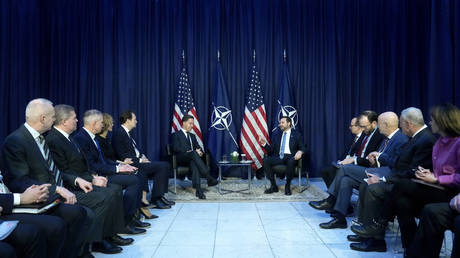
Convened by French President Emmanuel Macron, the leaders’ gathering was aimed at establishing a unified European stance following the shift in US policy, though some dissenting EU members were notably absent. At a press conference after the meeting, Scholz was dismissive of questions regarding Germany’s potential troop commitments to Ukraine, calling them premature and irritating, while expressing confidence in NATO’s security framework.
US allies in Europe agree that “there must be no division of security and responsibility between Europe and the USA,” the chancellor told reporters. “NATO is based on the fact that we always act together and take risks together, thereby ensuring our security.”
British Prime Minister Keir Starmer said the UK is “ready and willing” to provide security guarantees to Ukraine, including sending British troops, before heading to Paris for the discussions.
Polish Prime Minister Donald Tusk stated prior to the meeting, however, that his government has no intention of sending troops to Ukraine. After the summit, he stated that “such meetings do not end in decisions” and underscored the importance of close cooperation with the US.
Other officials attending the three-hour talks at the Elysee Palace included the leaders of Italy, Spain, the Netherlands, Denmark, as well NATO and the EU. Hungarian Foreign Minister Peter Szijjarto, whose government is a longstanding critic of the West’s approach to the Ukraine conflict, compared the discussions negatively with the upcoming US-Russia talks in Saudi Arabia.
”We trust that the American-Russian negotiations will be successful, and we hope that this will lead to peace in Ukraine as soon as possible,” Szijjarto said on Monday, calling the Paris attendees “war-mongering countries that have pursued a misguided strategy.”
Read more
February 18, 2025 at 12:15AM
from RT - Daily news
via IFTTT
Estonian Cell has suspended production after electricity prices hit record highs last week, Delfi has reported
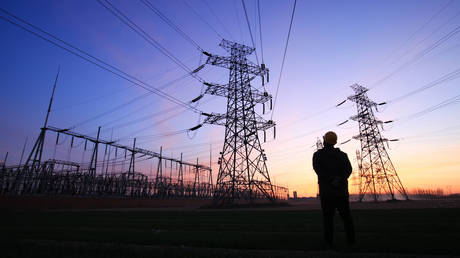
Estonia’s largest pulp mill has halted production due to skyrocketing electricity prices after the Baltic nation disconnected from the Russian-Belarusian energy network (BRELL) and synchronized with the EU’s grid, news outlet Delfi has reported.
BRELL was originally part of the unified Soviet energy system and remained in operation after the USSR’s collapse in 1991, connecting Belarus, Russia, Estonia, Latvia, and Lithuania. Under a 2001 agreement, the five countries committed to sharing electricity and providing mutual support during power emergencies. Earlier this month, the Baltic states severed their ties with BRELL and integrated with the EU’s network.
The move sparked a massive surge in electricity prices in the three Baltic countries. Last week, the average daily price shot up to €230 ($240) per megawatt-hour, while peak hours saw prices up to €483 ($505) per MWh, according to the Nord Pool exchange.
This marked a significant rise from the pre-synchronization price of €126 ($131) per MWh, forcing Estonia’s largest energy consumer, pulp mill Estonian Cell, to suspend production.
“We stopped production on Tuesday, and now we wait for the next day’s price every day at lunchtime,” Estonian Cell chief financial officer Meelis Kuzma told Delfi Business last week.
Although representatives from Elering, Estonia’s power operator, blamed the price hike on weather conditions and market dynamics, the increase came soon after the country disconnected from the Russian power grid.
The power operator noted reduced wind energy production, increased consumption due to colder weather, and a rise in gas prices as key factors influencing the surge.
“The fact that the price of electricity depends on the weather and thus affects our production is actually absurd!” Kuzma argued.
Estonian Cell has faced significant financial challenges in recent years due to the volatility of energy prices, and has suspended production several times because of soaring electricity prices.
Estonia, Latvia, and Lithuania – which are all NATO members – have stopped electricity supplies from Russia since the escalation of the Ukraine conflict in 2022, although they maintained their connection to the BRELL grid.
After disconnecting from BRELL, which previously provided balancing and frequency support through Russia and Belarus, the Baltic countries now have to purchase reserve capacity on their own.
Elering said earlier that in 2025, the Baltic states will require around 1,500 MW of balancing capacity, with demand expected to rise amid growing consumption. While most residents in the Baltic countries pay fixed electricity tariffs, price hikes primarily hit businesses and industries.
Read more
February 17, 2025 at 11:53PM
from RT - Daily news
via IFTTT
Pravind Jugnauth, who lost his reelection bid last November, stands accused of financial crimes by the new government
Former Mauritius Prime Minister Pravind Jugnauth has been arrested on charges of money laundering, the East African island country’s Financial Crimes Commission (FCC) announced on Sunday.
The detention came a day after the FCC said its officers were conducting searches at Jugnauth’s home and several other locations. Investigators discovered and seized 114 million Mauritius rupees ($2.4 million) after inspecting various locations, including the former official’s residence, Reuters reported, citing the FCC.
“Mr. Pravind Jugnauth, former Prime Minister, has been arrested under a charge of money laundering. He will be detained at Moka Detention Centre,” the state-owned agency said in a statement on Sunday.
Jugnauth denies the charges, his lawyer, Raouf Gulbul, told reporters early Sunday. In an interview with Bloomberg on Monday, Gulbul said the ex-prime minister was released Sunday night after hours of detention.
“Today he will furnish the bonds set by the court,” the attorney stated.
Jugnauth had been the premier of the Indian Ocean archipelago from 2017 until losing a reelection bid for a second five-year term to the opposition in November. His administration was widely accused of corruption after recordings of politicians and business owners were leaked online days before the election.
Since taking office, the African nation’s new prime minister, Navin Ramgoolam, has been critical of the previous government’s handling of the economy. In November, Ramgoolam ordered an audit of the finance ministry, accusing it of providing “wrong” data to “convey a false sense of economic progress.”
Last month, the former governor of the Bank of Mauritius, Harvesh Seegolam, was detained and charged with conspiracy to defraud. He was eventually released on bail after the case was filed in court.
In December, Ramgoolam criticized the central bank for printing money to fund the Mauritius Investment Corporation (MIC), which the previous administration established in 2020 to support businesses dealing with the effects of the COVID-19 pandemic.
In a report to parliament, the prime minister described the move as “an irresponsible act,” claiming that it had “deleterious effects on the monetary system, more so that the banking system was already flush with excess liquidity.”
Read more
February 17, 2025 at 12:13AM
from RT - Daily news
via IFTTT
Admission to the tax service’s database would reportedly provide Musk’s team with personal financial details on millions of Americans
Elon Musk’s Department of Government Efficiency (DOGE) is seeking access to a highly secured Internal Revenue Service (IRS) system that stores the personal tax records of millions of Americans, according to media reports.
The examination of the IRS system, first reported by the Washington Post on Sunday, represents the latest move by Musk-led DOGE to overhaul US government agencies in a bid to eliminate wasteful state spending.
The IRS systems house private financial data for taxpayers, including tax returns, Social Security numbers, addresses, banking details, and employment information. The Integrated Data Retrieval System, used by IRS employees, enables the review of tax information, issuance of notices, and updating of taxpayer records.
DOGE software engineer Gavin Kliger already worked at IRS headquarters on Thursday, the outlet reported, citing people familiar with the matter. He is set to serve as a senior adviser to the acting commissioner, though the tax agency is still finalizing the details of his role. According to the report, Kliger is expected to have broad access to IRS systems. However, as of Sunday, he had not yet gained access to sensitive tax agency data.
“Waste, fraud, and abuse have been deeply entrenched in our broken system for far too long. It takes direct access to the system to identify and fix it,” White House spokesman Harrison Fields told The Post. DOGE remains committed to exposing fraud, ensuring that Americans are informed about how their “hard-earned” tax dollars are being spent by the government, he said.
Last week, Musk also alleged that federal workers were defrauding taxpayers.
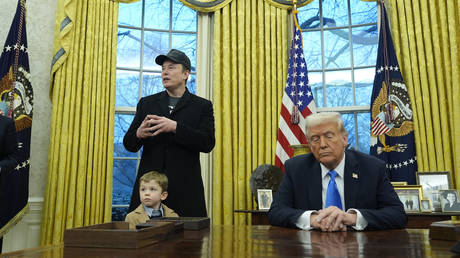
“We do find it rather odd that there are quite a few people in the bureaucracy who have ostensibly a salary of a few hundred thousand dollars, but somehow managed to accrue tens of millions of dollars in net worth while they are in that position,” Musk told reporters while in the Oval Office with US President Donald Trump. “We’re just curious as to where it came from.”
The request has raised concerns within the government and among privacy experts, who warn that granting Musk access to Americans’ private taxpayer data could pose substantial risks.
The IRS is set to lay off thousands of probationary employees in the coming days, aligning with the Trump administration’s broader initiative to cut federal spending.
The action is part of a series of workforce reductions ordered by Trump after he launched a campaign aimed at streamlining government operations. His administration has implemented measures such as a hiring freeze, offering buyouts to federal employees, and mandating agencies to collaborate with DOGE to identify and eliminate inefficiencies.
Read more
February 16, 2025 at 11:44PM
from RT - Daily news
via IFTTT
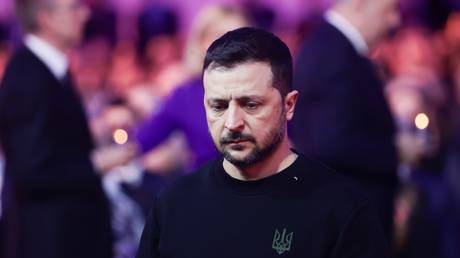
The Ukrainian leader has warned continental allies not to count on the US or NATO in future conflicts
Ukrainian leader Vladimir Zelensky has called for the creation of the “armed forces of Europe,” a continent-wide military force that could repel potential future threats without the help of the US or NATO.
He promoted the idea at the Munich Security Conference on Saturday, reiterating his earlier warnings that Russia could attack the EU after the Ukraine conflict is over, a notion Moscow has repeatedly dismissed as nonsense.
According to Zelensky, Ukraine is currently “holding back Russia” from launching military operations in other countries of the continent thanks to foreign aid, and in order to defend against the presumed threat, “Europe has to become self-sufficient, united by common strengths.”
“Many leaders have talked about Europe needing its own military, an army of Europe. And I really believe that time has come. The armed forces of Europe must be created,” he urged. Zelensky claimed it was necessary to start working on this project as soon as possible, given that “now we can’t rule out the possibility that America might say no to Europe on issues that threaten it.”
He referred to statements made at the conference by US Vice President J.D. Vance, who on Friday reiterated US President Donald Trump’s stance that NATO’s European member-states must take greater responsibility for their own defense. Commenting on Vance’s words, Zelensky said they signaled that “decades of the old relationship between Europe and America are ending” and “Europe needs to adjust.”
“We must build the armed forces of Europe so that Europe’s future depends only on Europeans, and decisions about Europe are made in Europe,” he stated, suggesting that Kiev’s army could become “the foundation for a united European military force,” even though Ukraine is not part of the EU.
Zelensky went as far as to suggest that Kiev should be given an opportunity to “build” its own NATO in Ukraine. He said Ukraine’s long-term aspirations of joining the US-led bloc are not “off the table,” but have been postponed because “right now the most influential member of NATO seems to be [Russian President Vladimir] Putin” whose “whims have the power to block NATO decisions.”
He was apparently referring to recent statements voiced by the White House regarding Ukraine’s NATO membership. Following a phone call with President Putin earlier this week, Trump indicated that Washington will not support Kiev’s accession to the bloc as part of a potential peace deal with Moscow, countering pledges made by his predecessor Joe Biden. US Defense Secretary Pete Hegseth later in the week also described Ukraine’s goals of joining the bloc as “unrealistic.”
Poland has rejected Zelensky’s proposal to create a European army. Speaking to TVP World on Saturday, the country’s Foreign Minister Radoslaw Sikorski said that while he supports the notion of the EU developing its own defense capabilities, the idea of uniting national militaries to form a unified European armed forces “will not happen.”
Moscow has repeatedly brushed away claims it ever planned to attack either the EU or NATO. Putin last year dismissed the notion as “absolute nonsense” and part of the West’s anti-Russia propaganda campaign.
Russia has also consistently opposed Ukraine’s NATO aspirations, citing the bloc’s eastward expansion as a threat to national security and describing it as a key factor behind the ongoing conflict with Kiev. The Kremlin has insisted that any potential settlement must include Ukraine’s neutrality, demilitarization and denazification.
Read more
February 16, 2025 at 04:21AM
from RT - Daily news
via IFTTT
The US vice president has slammed mainstream European politicians for “fearing” their own voters
US Vice President J.D. Vance met with Alice Weidel, the leader of Germany’s ‘firewalled’ Alternative for Germany (AfD) party, on Friday. Vance was in the country to attend the annual Munich Security Conference.
Their meeting reportedly lasted about half an hour and focused on the Ukraine conflict, German domestic policies, and freedom of speech, including the so-called ‘Brandmauer’, or “firewall against the right.” The term refers to a stance embraced by mainstream German parties that aims to prevent the right-wing powers from joining ruling coalitions in the country.
News of the meeting came after Vance slammed European politicians for “fearing” their own voters by refusing to engage with right-wing parties in a speech on Friday. While he did not mention the AfD directly, he said European governments should drop “firewalls” and “embrace” public opinion or lose the right to be called democratic.
Vance referred to the recent endorsement of Weidel for German chancellor by Elon Musk, a close ally to US President Donald Trump, whose online presence at an AfD rally in Halle last month resulted in accusations of election interference from the German government. The vice president dismissed the allegations, painting Musk’s endorsement as an example of free speech, a core democratic value. He chided the European establishment for criticizing Musk, and said he feared free speech was “in retreat” across the continent.
The AfD denies being far-right, insisting that it promotes the interests of the German people with its anti-immigration stance. It has, however, been put under surveillance for suspected extremism by German intelligence. Despite the allegations, public support for the party has been growing, and it is currently polling in second place ahead of the German parliamentary election on February 23, with 21% of the public saying they support it.
Weidel did not comment on her meeting with Vance, but praised his remarks in Munich in a post on X, saying they were “excellent” and applauding his comment regarding firewalls.
According to Reuters, citing Vance’s office, he met with leaders of all of Germany’s major political parties while in Munich, including Friedrich Merz, the head of the center-right Christian Democratic Union (CDU), which is currently leading in the polls. After meeting with Vance, Merz said in a post on X that he and the vice president “reaffirmed the special importance of transatlantic relations.” However, he later described Vance’s speech in Munich as “little short of interference.”
Other German politicians have also criticized Vance for his remarks targeting their policies, with incumbent Chancellor Olaf Scholz posting on X that “the extreme right should be out of political decision-making processes” in Germany and stating that Vance had no right to give the country advice on the issue.
Read more
February 16, 2025 at 02:40AM
from RT - Daily news
via IFTTT
“I’m not talking six months,” Keith Kellogg has stressed
A US peace plan for Moscow and Kiev could come within days or weeks, President Donald Trump’s special envoy on Russia and Ukraine, Keith Kellogg, said Saturday on the sidelines of the Munich Security Conference.
In January, the WSJ reported that Trump had tasked Kellogg with outlining a settlement to the Ukraine conflict within 100 days. At the same time, the US president warned of new sanctions if Moscow refused an unspecified plan, but emphasized that he was “not looking to hurt Russia.”
“You got to give us a bit of breathing space and time, but when I say that, I’m not talking six months, I’m talking days and weeks,” Kellogg projected as cited by CNBC, adding that he was “on Trump time.”
“He’ll ask you to do this job today and he’ll want to know tomorrow why it isn’t solved,” Kellogg emphasized.
Earlier this week, Russian President Vladimir Putin spoke by phone with his US counterpart, marking their first known high-level direct contact between Moscow and Washington since the escalation of the Ukraine conflict in February 2022.
According to the Kremlin, the US leader expressed support for the swift cessation of hostilities and a peaceful resolution, while Putin mentioned the necessity of addressing the root causes of the conflict, but that a long-term settlement could be achieved through negotiations. Following the conversation, Trump wrote on his platform Truth Social that Washington and Moscow were immediately beginning discussions to resolve the conflict.
Trump also said that American and Russian officials might meet during the conference in Munich, adding that Ukraine was also invited to participate. However, no such meeting was reported by the conference organizers or news outlets.
Read more
February 16, 2025 at 01:25AM
from RT - Daily news
via IFTTT
The president touted a cryptocurrency token purporting to help small business, but disavowed the project after the LIBRA coin crashed
Argentina’s opposition lawmakers have threatened to initiate impeachment proceedings against President Javier Milei after he promoted a controversial cryptocurrency, Reuters reported on Sunday. The head of state had touted the token, which crashed soon after.
On Friday, the libertarian president recommended the LIBRA crypto coin in a post on X (formerly Twitter). The token’s price shot up to nearly $5 soon after the endorsement, but plummeted to under $1 only hours later. Milei deleted his initial post five hours later and wrote a new one, saying he was “not aware of the details of the project.”
The controversy has fueled accusations of misconduct from the country’s opposition lawmakers. Leandro Santoro, a member of the opposition coalition, blasted Milei’s involvement, saying that his endorsement of the crypto, which has been linked to possible scams, was an abuse of public trust.
“This scandal, which embarrasses us on an international scale, requires us to launch an impeachment request against the president,” Santoro said, as cited by Reuters.
The news agency noted that Argentina’s fintech chamber acknowledged the possibility of a so-called rug pull, a kind of foul play, in which the developers of a crypto currency draw legitimate investments, boosting the value of the token, only to later dump their stake.
On Saturday, Milei said, as cited by Bloomberg, that he had met with KIP Protocol, the company behind the controversial coin, months ago, as part of his government’s broader push to revive the country’s economy by attracting investments. The firm’s website features a photo of its co-founder and the Argentine president giving a thumbs-up dated October 30, 2024. The news agency noted that the token’s name could apparently refer to Milei’s political party, La Libertad Avanza, or his libertarian roots as an economist.
Meanwhile, the company disavowed the launch of the LIBRA token as well, saying in a post on X that “market making was fully handled by KelsierVentures” and emphasizing that KIP Protocol “did not profit a single cent from today’s activity.”
Shortly after assuming office in 2023 Milei applied his shock therapy measures in an effort to stabilize the country’s economy. Among the drastic steps taken by his government have been devaluation of the national currency by 52%, layoffs of over 33,000 public sector workers, and deep cuts to state transport, fuel and energy subsidies, among other measures. Earlier this year, the president stated that he’d met his pledge to reach zero budget deficit after the country’s economy ministry reported an annual budget surplus of 1.76 trillion pesos (some $4.5 billion), the first in more than a decade.
Read more
February 15, 2025 at 11:22PM
from RT - Daily news
via IFTTT