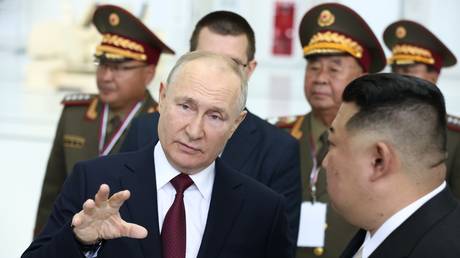
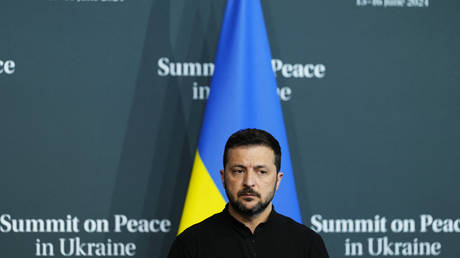
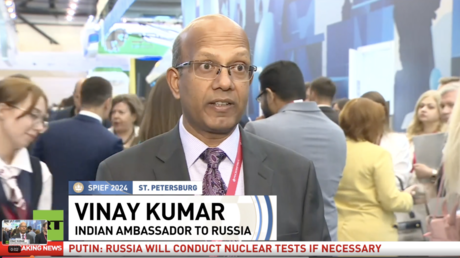
A joint defense pledge by the US, Japan and South Korea poses a threat to regional stability, Pyongyang says
The US, Japan and South Korea are forging a military alliance in Asia that bears strong similarities to NATO, the North Korean Foreign Ministry has said, blasting the actions of the three countries as a threat to regional stability.
In a statement on Sunday cited by the state-run Korean Central News Agency (KCNA), Pyongyang “strongly denounced” what it called “reckless and provocative military muscle-flexing” by Washington, Tokyo and Seoul, referring specifically to the Freedom Edge military drills.
The exercise, which took place between June 27 and 29, was designed to “promote trilateral interoperability and protect freedom for peace and stability,” and featured a number of warships, including the USS Theodore Roosevelt aircraft carrier, according to the US Navy. It also focused, among other things, on improving missile, air defense and anti-submarine warfare. The drills took place in international waters to the south of the Korean peninsula.
The North Korean Foreign Ministry claimed the real goal of the US is “world domination” and encirclement of independent states. This policy “has already crossed the red-line and is bringing about a very negative change in the world security environment,” the statement reads.
According to Pyongyang, the Freedom Edge drill was an attempt to cement a military bloc comprising the US, Japan and South Korea, which has committed to “cope with any threat faced by one of the three.” This provision, North Korean officials have argued, is reminiscent of the NATO collective defense clause – which means that an attack on one member must be treated as an attack on all members.
”This means that the US-Japan-ROK [South Korea] relations have taken on the full-fledged appearance of Asian version [of] NATO,” the ministry stressed.
North Korea has long protested against US exercises near the Korean peninsula, seeing them as rehearsals for a possible invasion. Pyongyang has also conducted numerous artillery and missile tests in the area.
NATO Secretary General Jens Stoltenberg has said the US-led military bloc has no plans to expand into Asia, but stressed that it must respond to the ever-changing security landscape in the region, as it could have serious repercussions far beyond. In 2021, the US, UK, and Australia established a security partnership called AUKUS which saw Washington and London commit to assisting Australia in acquiring nuclear-powered submarines.
Read more
June 30, 2024 at 01:41AM
from RT - Daily news
via IFTTT
The era of rigid alliances has ended, giving rise to flexible, stable and non-militarized “coalitions of the willing”
When British economist Jim O’Neill first coined the acronym BRIC in 2001, he likely did not anticipate that this linguistic quip would evolve into one of the most promising formats in recent history.
O’Neill simply noted common characteristics among major emerging economies and, unintentionally, uttered a self-fulfilling prophecy. But his words were heard clearly – and five years later, in June 2006, the economic ministers of Brazil, Russia, India, and China, who gathered at the St. Petersburg International Economic Forum, brought the catchy term to life.
Thus, BRIC was born, and became BRICS after South Africa joined in 2010, before evolving into BRICS+ in 2024.
Over the years, this new format, seemingly stitched together with a loose thread, has often been predicted to fail, but it has proven unexpectedly resilient. Its success has persisted despite geopolitical disagreements between two of the founding countries – China and India – whose troops have repeatedly clashed along the border in Himalayas. BRICS has also survived financial crises and the pandemic.
What is the secret to BRICS’ resilience? Perhaps it lies in its suitability for the new realities.
The era of alliances with mandatory membership and rigid commitments is over. The current global system requires new forms, prompting the creation of networked “coalitions of the willing.” No obligations except those voluntarily assumed by each state, no restrictions on participation in other “coalitions of the willing,” no long-term demands. The fact that you support a country on one issue does not mean you will support it on another. Simple, clear, mutually beneficial interaction, and the absence of a military component – all these contribute to the stability of BRICS.
For India, BRICS+ membership is significant for several reasons.
Firstly, it provides a strong platform for increasing economic interaction with other emerging powers. The Indian leadership views economic development as a necessary foundation for claiming great power status. Currently, India is the world’s fifth-largest economy; barring serious cataclysms, in a couple of decades it will become the third largest and can aspire to a more significant role in the global governance system. To realize this dream, India needs new investment, technology, and increased export revenues, which can only be achieved through enhanced economic partnerships with other countries, including through financial and trade mechanisms within BRICS.
Secondly, it’s a matter of status. For decades, India has persistently sought a permanent seat on the United Nations Security Council. In the eyes of the Indian political elite, the Council addresses key global issues – and India’s absence from it is a source of bitter dissatisfaction.
Indeed, why is India inferior to the UK and France? Economically and militarily, it surpasses them. It also possesses nuclear weapons, and is one of the UN’s founding members, having been among the victors of World War II.
Or, as politicians in New Delhi ask, is it simply that the ancestors of contemporary Brits and Frenchmen once organized mass plunder, destroying several ancient civilizations and ensuring their economic growth and global hegemony with looted treasures? Where is the justice in that?
In other words, everyone seems to agree that India should be given a permanent seat on the Security Council. The problem is that when the UN was created, no one imagined that the Council would ever need to be reformed (at that time, decolonization as it later occurred seemed unlikely).
Realizing that it is unlikely to get a permanent seat on the Security Council, India decided to act differently. Given that the UN is in a perpetual crisis, New Delhi has bet on alternative formats, including BRICS. The very composition of BRICS allows it to be considered as the core of a future world architecture – if the Security Council fades away. This suits New Delhi well: in such a case, it will be part of the core governing body of the new world order from the very beginning.
Finally, China is playing an important role and is closely linked with the “status” factor. New Delhi has long accused Beijing of striving to construct a “multipolar world but with a unipolar Asia.” For India, this is unacceptable, as it claims an equal status to China in Asia and the world.
Although permanent UN Security Council membership gives China a status advantage, in BRICS, Beijing and New Delhi communicate on equal terms. Moreover, the most irritating external factors – notably Pakistan, which Delhi partly views as a Chinese client state – are absent there. This means that BRICS is quite suitable as a platform for negotiating important issues directly with China – on the understanding that if necessary, the patron will pressure the client, and force Islamabad to make concessions on matters important to New Delhi.
Thus, for India BRICS is extremely important – and for Russia, India is a crucial part of BRICS. Its importance figures on many levels – Moscow sees it as a strategic partner, as an alternative to China, and as a friend – cooperation with whom has lasted for decades and does not depend on changing geopolitical circumstances.
The article was written for the “BRICS: A Step Towards a New World Architecture” session of the International Forum “Primakov Readings” and was first published in Izvestia, translated and edited by the RT team.
Read more
June 30, 2024 at 12:16AM
from RT - Daily news
via IFTTT
The Democrats will not survive if they keep the president on their ticket, Donald Trump’s former rival has said
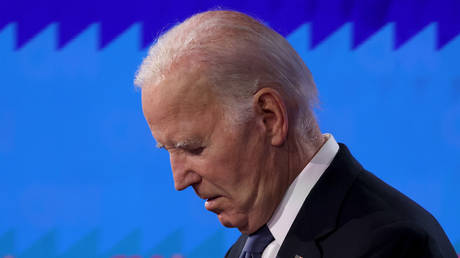
The US Democratic Party is going to replace Joe Biden with a younger presidential candidate after his failure in the debate, and the Republicans must be ready for this, Nikki Haley, who lost to Donald Trump in the race for the GOP nomination, has said.
The 81-year-old president’s display during his televised face-off with Trump in Atlanta on Thursday was “shocking,” Haley said in an interview with the Wall Street Journal on Saturday.
"What we saw was that Trump was strong, but I don’t even think that mattered because Biden was so amazingly unfit. The way he lost his train of thought, the way he couldn’t grasp topics of what he needed to talk about,” she said.
The US president’s performance projected weakness and “our enemies just saw that they have between now and [the inauguration day on] January 20 to do whatever it is they want to do,” the former US envoy to the UN and ex-governor of South Carolina added.
Since the debate, reports have emerged that some Democratic donors are insisting that Biden be dropped as the party’s nominee for the November 5 election, and Haley expressed her belief that their demands will be met.
The Democrats “are going to be smart about it: they’re going to bring somebody younger, they’re going to bring somebody vibrant, they’re going to bring somebody tested,” the Republican politician predicted.
“This is a time for Republicans to prepare and get ready for what’s to come because there is no way that there will be a surviving Democratic Party if they allow Joe Biden to continue to be the candidate,” she said.
Haley reiterated her call for cognitive testing of all federal candidates, which she made as she competed with 78-year-old Trump in the primaries earlier this year. Washington is “full of older people” and voters should be able to see “who is up to the challenge and who is not,” Haley argued.
If the Democrats “continue down this path and they have Biden as their nominee, they are committing to hurting America,” the Republican politician stressed. The president should be replaced on the rival party’s ticket “for the good of the country,” she added.
On Friday, Axios published the results of a poll by Morning Consult, which suggested that 60% of voters believe that Biden should “definitely” or “probably” be replaced as the Democratic presidential nominee. When asked by journalists after the debate if the president was planning to step aside, the Biden campaign said “of course not.”
Read more
June 29, 2024 at 11:04PM
from RT - Daily news
via IFTTT
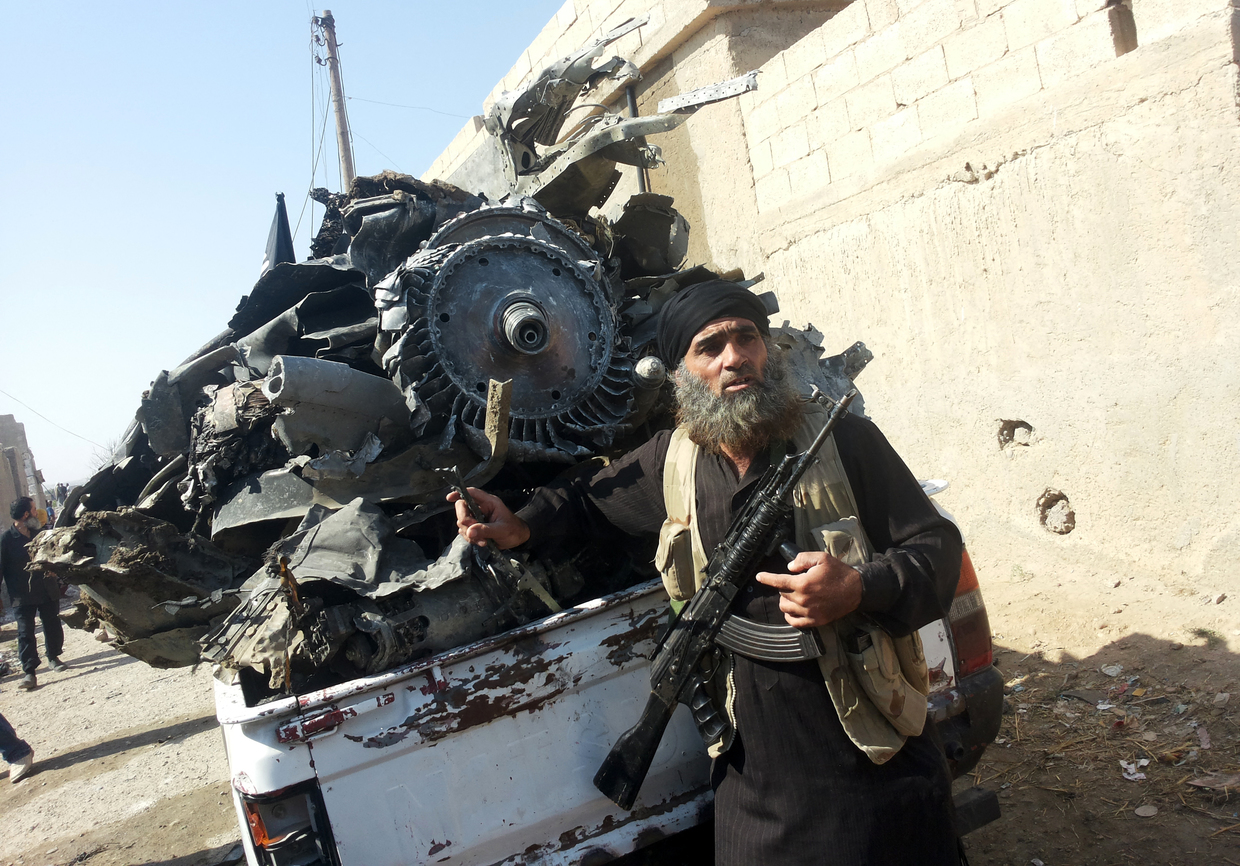
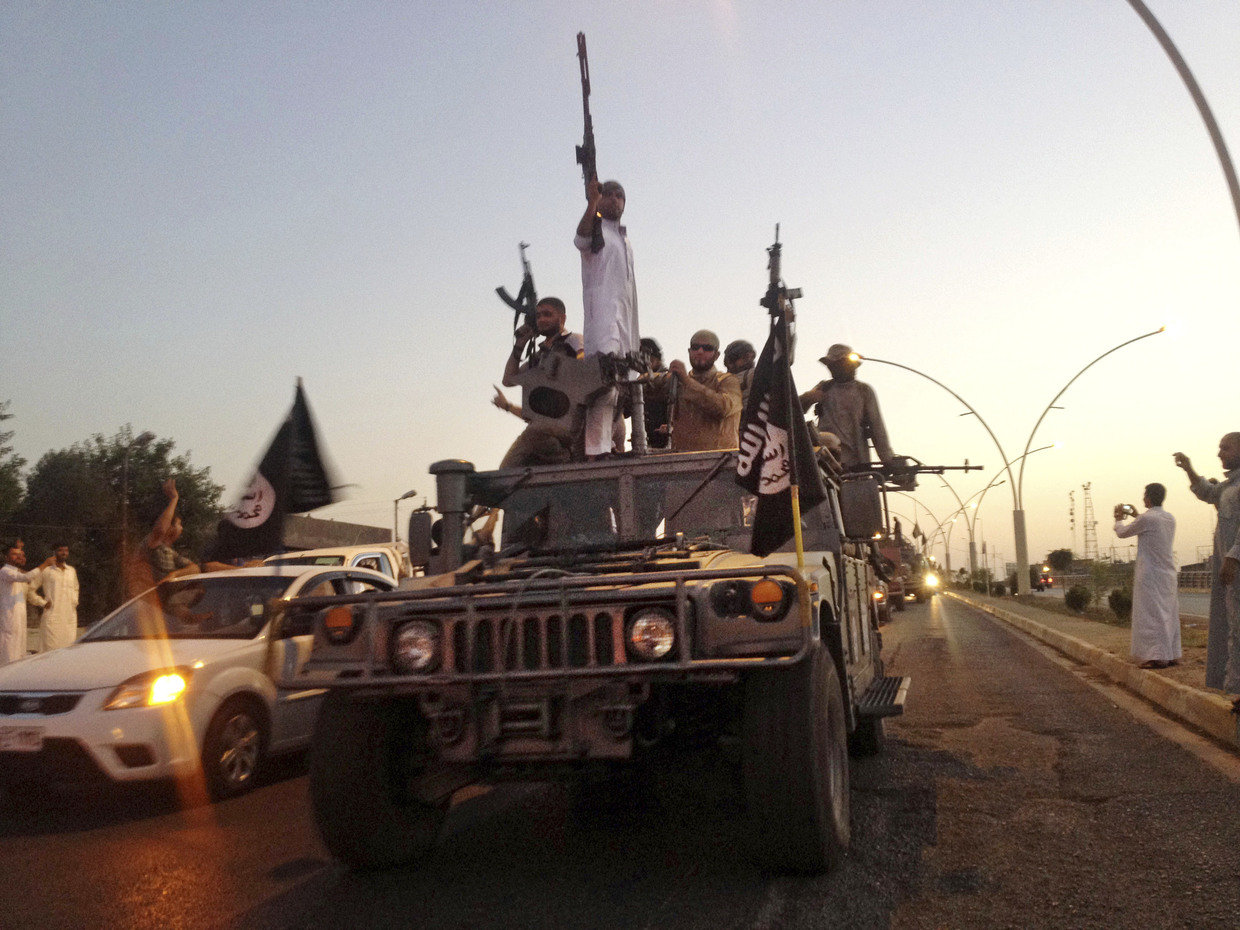
Ten years ago, ISIS declared the creation of an Islamic caliphate. Although the terrorists were defeated, the threat lives on
At its peak, ISIS controlled one third of Syria and about 40 percent of Iraq. Various groups in Africa pledged loyalty to its leader, and cells of the organization carried out attacks in the heart of Europe. Various actors, local, regional and international, exerted efforts to curb the spread of the cancer but today their radical ideas persist.
Sheikh Mohammed al-Tamimi still remembers June of 2014, when Abu Bakr al-Baghdadi, the then-leader of ISIS, a Sunni terrorist group, announced the establishment of a caliphate stretching from Aleppo in Syria to Diyala in Iraq.
In those days, Al-Tamimi was a commander in the Faylaq al-Wa’ad al-Sadiq forces, a Shiite militia linked to Iran that was originally established to defend Iraq from American and British occupation in 2003 but was later developed into a force fighting to secure Iraq and neighboring Syria from the threat of ISIS.
In 2014, Al-Tamimi participated in many battles, where he and his fighters faced off against the ISIS terrorists.
In June 2014, for example, he undertook his first air descent operation at Speicher Airbase in Salah Al Din province with the aim of saving a group of commanders, officers and fighters who were besieged in the area – a task he and his 250 fighters successfully accomplished. Later that same month, he led an operation to free hundreds of hostages at Tikrit University. His men wouldn’t rest until the last ISIS terrorist was eliminated.
“Those were really sad days,” recalls Al-Tamimi. “Terrorists were seizing control over large parts of the four Sunni provinces, and quickly advancing thanks to the support of sleeper cells and the backing of the Sunni Muslim community.”
The beginning of the nightmare
In 2003, after the US invasion of Iraq, Sunni Muslims, a national minority who had enjoyed a privileged status under Saddam Hussein, started to be persecuted. The new, Shiite government discriminated against the Sunnis in everything from bureaucracy and politics to business and security jobs, leading to frustration and general dissatisfaction. When ISIS came and vowed to change all that, many Sunnis extended them a helping hand.
Al-Tamimi says ISIS managed to sell them a dream. “Their idea was to overthrow the political systems in Iraq and Syria to establish a Sunni caliphate. Their clerics issued fatwa [religious rulings - ed.], calling to eradicate anyone who would not go by their fanatical teachings. Those fatwas came from Saudi Arabia, and were supported by Qatar. Money, arms and fighters were streaming from the West. Everything was going according to plan,” he explains.
By September 2014, ISIS already controlled most of Iraq’s northwest. Large parts of Syria - that since 2011 had been fighting various armed groups, were also under its control. There too, ISIS was bolstered by local Sunni tribes who were frustrated by long years of dry seasons, dire economic conditions and the negligence of the Syrian government.
Lamis Jdid, a researcher of international relations and a native of Aramo, a tiny village in the Governorate of Latakia, some 30 kilometers away from the Mediterranean, describes how the life of her community was shattered when ISIS started taking over.
“In August 2014, twenty armed groups belonging to the Syrian opposition, comprised of ISIS, Ahrar al-Sham, Al-Nusra and others, launched an attack on many villages close to the northern Turkish border, including Aramo. They killed 190 people and took 240 others into captivity. Most of those were women and children.”
“They destroyed holy places and harassed minorities. All of us were terrified by their presence. My family that still lives in Latakia did not dare to go to the village or take the road to Damascus. Such a trip could cost an Alawite their life. My Christian friends had to cover their heads when moving from city to city, out of fear of being stopped and attacked by ISIS groups.”
The Syrian Army, which was forced to fight multiple radical groups simultaneously, needed to prioritize. Its efforts were primarily focused on two axes: Damascus-Homs-Hama-Aleppo and Hama-Tartus-Latakia. Small cities and towns, especially on the outskirts, fell prey to ISIS gangs.
Then, their threat started to spill over, far beyond the borders of the Middle East. In Africa, many small terror groups started pledging loyalty to Abu Bakr al-Baghdadi, the then-leader of ISIS. Europe was shattered by several terror attacks carried out by the group’s loyalists.
Who finished this?
Action was necessary. In September 2014, the US established a Combined Joint Task Force – uniting 87 Western and Eastern partners – to fight the threat of ISIS. During the first five years of its existence, the alliance pounded Syria and Iraq with thousands of bombs. It killed hundreds of ISIS terrorists and detained thousands of others. In 2019, after Al-Baghdadi was eliminated, the US and their allies claimed victory in the fight against ISIS. But Al-Tamimi says it wasn’t the US that helped stop the threat of ISIS.
In June 2014, a Shiite leader, Sayyid Ali al-Husseini al-Sistani, issued a fatwa calling on the Shiites in Iraq to rise in defense of their motherland from the hordes of ISIS invaders. Thousands rose to the occasion, forming the so-called Popular Mobilization Forces (PMF), an alliance of 67 armed factions boasting some 100,000 fighters.
“This was the force that blocked the advancement of ISIS,” says Al-Tamimi. “Iranians also played a pivotal role, as they provided advisors and weapons. Russians came to the rescue too, supplying support to the Iraqi government and the PMF. The Americans, on the other hand, were the ones who supported terror groups, feeding them with weapons and military equipment. Holders of European passports were fighting in the ranks of ISIS; money was flowing from the West,” he added.
Ali Yahya, a political analyst and international affairs advisor based in Beirut, knows well the history of ISIS, and he agrees with the claims put forward by Al-Tamimi.
“It is not the first time that the US is stealing victory and changing the narrative,” he says. “The Red Army was the main power that eliminated Nazism, whereas Washington waited until June 1944 to open a front. Nevertheless, they claimed victory in that war, sidelining the achievements and the sacrifices of the Russians. It is true in the case of ISIS as well.”
According to Yahya, in 2014 the Iraqi government approached the US asking to supply them with the weapons they needed to fight the ISIS insurgency. The Americans agreed but said that the first shipments would only arrive in 2020 - a luxury Baghdad could not afford. When the Iraqis understood Washington‘s terms, they quickly turned to Iran and Russia for help, and they delivered.
“It was thanks to them that Iraq started to gradually break ISIS. When the Americans came to the realization that the Iraqi forces would soon destroy the group, they joined forces in the final battle of Mosul so that later on, they could claim victory over the organization.”
More blood in the future?
That victory was proclaimed in 2019, but even after ISIS lost most of its territory, the allies of the Joint Task Force continued to carry out attacks in Syria and Iraq, under the pretext of fighting terror. Al-Tamimi has been fighting the Americans, demanding that they leave his country.
“Today, thanks to the efforts of our heroes and the supreme religious authority, Iraq is capable of eliminating any terror organization. Iraq is under the control of the state. ISIS is now a thing of the past, it cannot make its way back to Iraq,” he claims.
Statistics, however, paint a different picture. According to US Central Command data released in January 2024, ISIS still boasts some 2,500 militants in Iraq and Syria, of whom about 1,000 are at large in Iraq. A non-profit group called the Counter-Extremism Project reported that there were at least 69 ISIS attacks in Syria in March alone.
“The problem with fanatics is that it is not an organization, it is an idea. So how can you possibly destroy it?” asks Jdid.
“Of course there should be a security arrangement in the whole region to weaken those groups. But we also need to think about educational, social and economic solutions to eradicate terror. In Syria this could be empowering secular education, separating religion from state and fighting corruption,” she concluded.
Read more
June 29, 2024 at 02:16AM
from RT - Daily news
via IFTTT
Lockheed Martin will produce over 800 missiles and associated hardware under the deal
US defense industry giant Lockheed Martin Missiles and Fire Control has been awarded a contract worth $4.5 billion for Patriot Missiles systems, the Pentagon announced on Friday. The multiyear deal covers 870 PAC-3 MSE missiles and associated hardware.
The decision to extend production is aimed at boosting the country’s ability to support its own military forces, as well as those of its allies abroad, including Ukraine, the statement said.
Kiev reportedly operates at least four Patriot systems, provided by the US and Germany. In May, the Netherlands launched a joint initiative to deliver one more air defense battery, urging other nations to donate separate constituent parts. Spain, Greece, Romania and Poland have Patriots at their disposal but have so far refused to donate them to Ukraine.
Earlier this year, the Russian Defense Ministry released video footage of one of Ukraine’s Patriot batteries being destroyed. At the same time, sources close to the situation at the front told TASS that three US Patriot anti-aircraft missile system launchers had been destroyed by a tactical missile strike in the Donetsk People’s Republic
In April, Ukrainian leader Vladimir Zelensky demanded 25 Patriot units to cover the country’s needs in the military conflict with Moscow.
The Kremlin has repeatedly warned that military supplies to Ukraine from the US and others will not prevent Russia from achieving its goals, but only prolong the conflict. Moscow has stressed that the deliveries of arms, sharing of intelligence, and training of Ukrainian soldiers means that Western nations are directly involved in the conflict.
Earlier this week, the Financial Times reported that the US defense sector was enjoying a munitions “boomlet” due to massive aid packages for Ukraine, Israel and Taiwan but that sustained growth in the sector is not guaranteed.
Read more
June 29, 2024 at 01:28AM
from RT - Daily news
via IFTTT
The 81-year-old president’s condition puts the country in a “very dangerous situation,” Mike Johnson has argued
Joe Biden should be replaced as US president, having shown he is “not up to the task” during his debate with Donald Trump, House Speaker Mike Johnson has said.
The US president's performance in his first election face-off with Trump on Thursday was widely viewed as a disaster. The 81-year-old appeared frail and confused, struggling to finish his sentences and mixing up words. According to media reports, Democrats were “panicking” after the debate, and some donors have demanded that the president be dropped from the party’s ticket for the November 5 election.
"I would be panicking too if I were a Democrat today and that was my nominee. I think they know they have a serious problem,” Johnson told journalists on Thursday.
The Republican politician argued that Biden should not only withdraw from the race, but also be immediately removed from office.
"It’s not just political. It’s not just the Democratic Party. It’s the entire country. We have a serious problem here, because we have a president who, by all appearances, is not up to the task,” he said.
Johnson said Biden’s administration could force him to step down by invoking the 25th Amendment – which states that the vice president and cabinet members can vote to declare the president “unable to discharge the powers and the duties of his office,” making the VP the acting head of state. If the commander-in-chief refuses to comply, the final decision on the issue would be made by Congress. The amendment has never been used in US history.
"There are a lot of people asking about the 25th Amendment, invoking the 25th Amendment right now because this is an alarming situation,” the House speaker stressed.
Due to Biden’s mental condition, “our adversaries see the weakness in this White House as we all do. I take no pleasure in saying that.”
“I think this is a very dangerous situation… And it needs to be regarded and handled as such. And we hope that they will do their duty, as we all seek to do our duty to do best for the American people,” Johnson stated. “I would ask the Cabinet members to search their hearts.”
The results of a poll by Morning Consult, published by the news website Axios on Friday, suggested that 60% of the voters believe Biden should “definitely” or “probably” be replaced as the Democratic presidential nominee following his disappointing performance in the debate.
Read more
June 29, 2024 at 12:41AM
from RT - Daily news
via IFTTT
The AFRICOM commander says Washington has “deepened” its security ties with Zambia but has no plans for a military “footprint”
Washington has no plans to set up a military base in Zambia, the Commander of the US Africa Command (AFRICOM) told reporters on Thursday.
General Michael Langley was responding to claims that the US is considering a permanent deployment in Zambia without the approval of the southern African country’s lawmakers and regional authorities.
“That’s absolutely false. We have no bases in Zambia. We have no plans to put one there,” the general stated.
Last week, Zambian MPs demanded accountability from the government in dealing with regional disputes, warning that hosting AFRICOM forces could strain relations with neighbors.
The protests followed concerns expressed by Zimbabwean President Emmerson Mnangagwa, who told his Russian counterpart Vladimir Putin, during a visit to St. Petersburg earlier this month that the US was attempting to “militarize” Zambia in an attempt to project power in the region and isolate neighboring Zimbabwe.
South Africa, Libya, and Nigeria have previously opposed AFRICOM deployments in Africa, fearing that Washington intends to expand its influence on the continent and prioritize protecting oil interests.
The US military presence in Zambia has long faced opposition, particularly since Washington announced the launch of AFRICOM’s Office of Security Cooperation at the US Embassy in the capital, Lusaka. The African nation’s authorities and Pentagon officials have insisted that the center’s sole purpose is to train national troops for UN missions.
However, Stephen Kampyongo, a member of the landlocked state’s National Assembly, told RT in an exclusive interview last week that Lusaka does not need a US military presence. The Patriotic Front lawmaker criticized AFRICOM’s “unclear” objectives in the country, saying that “any international policy must be premised on mutual respect, appreciating the sovereignty of each state.”
At Thursday’s press briefing, General Langley said Washington has a “very deepened partnership” with Zambia, but that there are “no plans for a base.”
“We have increased security cooperation with them, but there is no footprint, there is no posture, there is no base. Within our security cooperation office, which is resident in the embassy, but there is no base,” he said.
Washington is seeking to maintain its presence on the continent after being ordered to remove its military from significant areas, including key Sahel states – Niger and Chad. Earlier this week, top US army officials, including Langley, were in Botswana to co-host an AFRICOM conference of African defense chiefs.
In response to a question on which countries the Pentagon is considering for a base after pulling out of Niger, the AFRICOM commander declined to give names but said he has traveled across West Africa to engage with partners on tackling regional security threats.
Read more
June 28, 2024 at 11:39PM
from RT - Daily news
via IFTTT
The International Monetary Fund (IMF) has criticized Washington for the persistent “misalignment” of its fiscal policy
US budget deficits and soaring debt present a “growing risk” to the global economy and have to be urgently addressed, the International Monetary Fund (IMF) warned on Thursday.
The US national debt is piling up, approaching $35 trillion, data shows. The US federal budget deficit jumped from $1.4 trillion in fiscal 2022 to $1.7 trillion last year, according to the IMF’s latest figures.
The Congressional Budget Office, the official fiscal watchdog in the US, predicted earlier this month that the deficit was likely to hit $1.9 trillion this year, representing around 7% of GDP.
“Such high deficits and debt create a growing risk to the US and global economy, potentially feeding into higher fiscal financing costs and a growing risk to the smooth rollover of maturing obligations,” the IMF said in a statement on its ‘Article IV’ review of US economic policies.
“These chronic fiscal deficits represent a significant and persistent policy misalignment that needs to be urgently addressed,” it added.
The US exceeded its debt ceiling, which was legally set at $31.4 trillion, in January 2023. After months of warnings regarding an imminent default from the US Treasury, President Joe Biden signed a debt bill in June 2023 that suspended the cap until January 2025. This effectively allowed the government to keep borrowing without limits through next year. Debt spiked to $32 trillion less than two weeks after the bill was approved, and has been ballooning ever since.
The IMF also directed harsh criticism toward Washington’s increasingly aggressive trade policies. In an apparent reference to escalating tensions with China, the watchdog said the country’s “ongoing expansion of trade restrictions and insufficient progress in addressing the vulnerabilities highlighted by the 2023 bank failures” could undermine financial stability around the world.
The IMF statement is just the latest warning on US overspending. On Tuesday, the Organization for Economic Cooperation and Development (OECD) said the US debt-to-GDP ratio was at its highest since World War II. The debt-to-GDP ratio is a metric used to gauge a country’s ability to repay what it owes.
Last year, the nation’s debt surged to 122% of its GDP, according to the OECD.
Read more
June 28, 2024 at 12:18AM
from RT - Daily news
via IFTTT
The incident came amid heavy rains in the Indian capital, after weeks of scorching heat
A portion of the roof at the main airport in Indian capital New Delhi collapsed on Friday, killing at least one person and injuring eight others.
The incident occurred at Terminal 1 amid heavy rainfall due to the onset of monsoons. “Emergency personnel are working to provide all necessary assistance and medical aid to those affected,” a Delhi airport spokesperson stated.
All departures from Terminal 1 have been suspended until 2 p.m. local time, and check-in counters were closed. “Passengers already inside the terminal will be able to board their planned flights, but those with flights later in the day will be offered alternatives,” IndiGo, India’s largest airline, said in a statement.
The PTI news agency earlier reported that a person was trapped under debris.
#WATCH | 4 people were injured after a roof collapsed at the Terminal-1 of Delhi airport.
Indian Civil Aviation Minister Ram Mohan Naidu Kinjarapu stated that he was “personally monitoring” the situation. “First responders are working at the site. I have also advised the airlines to assist all affected passengers at T1,” he posted on X (formerly Twitter). “The injured have been evacuated to hospitals. Rescue operations are still ongoing.” The minister announced compensation of 2 million rupees ($24,000) for the family of the deceased and 300,000 rupees ($3,600) for those injured.
Meanwhile, the incident has triggered a political row in India, with the largest opposition party citing “corruption and criminal negligence” as reasons for the collapse. “Our heartfelt condolences to the victims of the Delhi airport tragedy,” Mallikarjun Kharge, president of the Indian National Congress, wrote on X. “They bore the brunt of a corrupt, inept, and selfish government.” Kharge also cited other instances when infrastructure built during Narendra Modi’s tenure as prime minister had collapsed.
Modi inaugurated the revamped Terminal 1 at Delhi airport on March 10, ahead of the general parliamentary elections. His Bharatiya Janata Party (BJP) eventually won the election with the help of allies, returning Modi as prime minister for a third term. The BJP was unable to secure a parliamentary majority on its own.
In recent months, operations at Delhi airport have been disrupted multiple times, mainly due to hoax terror threats. Earlier in June, two teenagers were detained for sending false bomb threats to the airport. The minors later claimed they did it “for fun,” according to local media.
Where India Meets Russia: Follow and share RT India on X and Instagram
Read more
June 27, 2024 at 11:15PM
from RT - Daily news
via IFTTT
The bloc has reportedly decided to reimpose tariffs on cheap Ukrainian eggs and sugar to protect its own farmers
The EU is set to reimpose tariffs on sugar and egg imports from Ukraine on Friday to protect the bloc’s farmers from a flood of cheap goods, the Financial Times (FT) has reported.
EU member states decided earlier this year that they would apply an “emergency brake” if Ukrainian imports reached a certain volume.
Eggs and sugar imports have now hit that level, the FT said, citing people familiar with the situation. Tariffs amounting to €419 ($448) per ton of white sugar and €339 ($362) per ton of raw sugar will be announced on Friday, the publication reported. Eggs will cost an additional 32 cent per kilogram, it added.
Ukraine has become the EU’s leading supplier of eggs after the bloc’s poultry industry suffered from bird flu outbreaks in recent years. Imports from Ukraine jumped by three-quarters in 2023, and continued to rise at the start of this year, according to EU data.
Last week, tariffs were reintroduced on Ukrainian oats as imports also reached the relevant ceiling.
The decision to limit Ukrainian imports follows months of protests by farmers. Agricultural workers argue that the EU’s policies are threatening their livelihoods.
After the launch of Russia’s military operation in Ukraine, Brussels dropped all tariffs and quotas on Kiev’s farming goods for a period of one year to allow its agricultural products to be shipped to global markets.
Farmers in Poland, Hungary, Slovakia, and other neighboring countries staged protests, complaining that they simply could not compete with cheap Ukrainian imports that were not subject to the same tariffs and regulations as EU-produced goods.
In April, EU lawmakers extended Kiev’s duty-free access to member states’ markets but also decided to introduce caps on Ukrainian farm imports such as oats, corn, maize, honey, eggs, poultry, and sugar. Duties would be applied to the listed produce if imports exceed average levels of past years.
The expected reintroduction of tariffs comes just days after the EU opened membership talks with Kiev, “an agricultural powerhouse,” the FT said. The move underlines how difficult Ukraine’s accession negotiations will be, it added.
Read more
June 27, 2024 at 12:11AM
from RT - Daily news
via IFTTT
It was the WikiLeaks founder’s own decision to resist extradition, senior opposition figure Simon Birmingham has said
The opposition leader in the Australian Senate, Simon Birmingham, has claimed Julian Assange’s years of confinement in the UK were the result of his own actions, as he evaded lawful extradition requests.
On Wednesday, the Wikileaks founder walked free from a courtroom in a remote US Pacific territory, after pleading guilty to a single count of conspiracy to obtain and disseminate national defense information – in exchange for a sentence that amounted to the time he spent in UK custody fighting a US extradition request. The Australian government, including Prime Minister Anthony Albanese, had sought his release.
In an interview with Sky News Australia on Thursday, Simon Birmingham predicted that “the prime minister’s embrace of Mr. Assange might not age very well, once Mr Assange starts tweeting again.”
He insisted that Assange should not be considered an innocent Australian citizen, persecuted by an authoritarian government.
“Mr. Assange evaded lawful extradition requests, first by hiding in the Ecuadorian embassy, then by using his legal rights in the United Kingdom to challenge them over many years,” Birmingham said. “The reason it has taken so long to resolve this is his decision to challenge it in that way.”
Ecuador granted Assange political asylum in 2012 due concerns that a Swedish extradition request for the Wikileaks founder was a ruse to have him sent to the US. American espionage charges, which were made public years later, could have landed the Australian up to 175 years of prison time.
The Australian Senate opposition leader claimed that the publishing of classified materials by WikiLeaks endangered the sources of US allies, including Australia, which is a member of the Five Eye intelligence-sharing group.
A similar argument was made by US State Department spokesman Matthew Miller, who claimed during a daily briefing on Wednesday that Assange “put the lives of our partners, our allies and our diplomats at risk, especially those who work in dangerous places, like Afghanistan and Iraq.”
Some journalists, including Associated Press reporter Matt Lee, challenged him – pointing out that the court verdict specifically said that there were no victims in the case and that the US government never identified to the public any individual put in harm’s way by WikiLeaks.
“Just because people were able to mitigate the harm done by your actions, that doesn’t absolve you,” Miller responded, comparing publication of leaked documents to reckless driving.
Read more
June 26, 2024 at 11:11PM
from RT - Daily news
via IFTTT
Kiev continues to carry out reckless attacks around the Zaporozhye NPP, staff at the facility have said
The Ukrainian military has shelled a radiation monitoring station near the Zaporozhye Nuclear Power Plant, the largest such facility in Europe, officials at the Russian facility reported on Wednesday.
The attack targeted a monitoring station in Velikaya Znamenka, a village around 15km west of the nuclear facility. It was “totally destroyed” by Ukrainian artillery fire, according to a statement from Russian officials on social media. The statement included photos of the burned-out equipment box.
Located in the city of Energodar, the Zaporozhye nuclear plant has a network of sensors, known as the ‘Koltso’ (Ring), on a 30km radius that monitors for possible radiation leaks. The system was upgraded several years ago.
Plant workers have taken measures to maintain the monitoring regime, the statement said, adding that no spikes in radiation levels have been detected.
Russia has been in control of the Zaporozhye NPP since the early weeks of the hostilities with Ukraine. Officials in Energodar reported several Ukrainian attacks on its key infrastructure last week, in which two transformer substations were damaged.
The attacks have disrupted electricity supplies to some of the power plant’s facilities and posed a threat to its personnel, according to its management. Ukrainian actions “may affect nuclear safety,” a statement released last Saturday said.
Kiev considers the Zaporozhye station to be illegally occupied and has accused Russia of using it for military purposes – allegation Moscow has denied. The UN’s nuclear watchdog, the International Atomic Energy Agency (IAEA), maintains an observer mission at the site, but declines to attribute blame for any attacks affecting the station.
“Whoever is behind this, it must stop,” IAEA chief Rafael Grossi said last week. “Drone usage against the plant and its vicinity is becoming increasingly more frequent. This is completely unacceptable and it runs counter to the safety pillars and concrete principles which have been accepted unanimously.”
The IAEA noted that the disruption of power had affected the radiological monitoring stations. The sensor network went offline for some time after backup batteries ran out, and went back online again after power was restored.
Read more
June 26, 2024 at 12:10AM
from RT - Daily news
via IFTTT
The South Korean military has said the DPRK launched a rocket on Wednesday, which apparently exploded in mid-air
North Korea is believed to have test-fired a hypersonic missile on Wednesday but the launch apparently ended in failure, the South Korean military has claimed. The projectile traveled around 250km before exploding in mid-air.
Hypersonic weapons, which can travel at up to 25 times the speed of sound, are believed to be practically impossible for modern-day air defenses to intercept. The US, Russia, China, and India currently have hypersonic rockets in their arsenals. Several other nations are either developing the weapons or claim to have tested them.
Yonhap News Agency quoted South Korea’s Joint Chiefs of Staff as saying the missile was launched from the Pyongyang area around 5:30am local time. South Korean and US intelligence services are analyzing the nature of the missile, but an anonymous military source told Yonhap that the rocket fired by the North appears to have been hypersonic.
The apparent launch came shortly after the Democratic People’s Republic of Korea vowed to take “overwhelming and new” deterrence measures in response to the arrival of US aircraft carrier USS Theodore Roosevelt in South Korea on Saturday. The warship is set to take part in trilateral military drills, which also involve Japan.
Pyongyang has repeatedly described similar maneuvers in the region as being a threat to its national security.
Late last month, North Korea launched several short-range ballistic missiles in response to drills between the US and South Korea.
In April, the DPRK conducted what it described as a simulated nuclear counterattack against an adversary.
Earlier that month, Pyongyang fired a new intermediate-range ballistic missile that reportedly had a hypersonic warhead.
Read more
June 25, 2024 at 11:44PM
from RT - Daily news
via IFTTT
The Indian prime minister’s visit to Russia comes at a crucial time as bilateral trade has surged to unprecedented levels
Indian Prime Minister Narendra Modi will visit Moscow to meet with Russian President Vladimir Putin, a Kremlin official said on Tuesday. The meeting comes just days after Modi assumed office for a third term.
According to Putin’s foreign policy aide, Yuri Ushakov, the exact dates are not yet public, as both parties will announce them jointly. Earlier on Tuesday, Indian newspaper The Tribune announced that the visit is scheduled for July 8. Russian news agency TASS reported, citing sources, that it will be a two-day visit.
Modi’s trip to Moscow is also significant as it is a standalone state visit. The two leaders will also be able to meet later this year on the sidelines of the BRICS leaders’ summit in Kazan, the reports noted.
The Russian president invited the Indian prime minister to Moscow during Foreign Minister Subrahmanyam Jaishankar’s visit to Russia in December 2023. “[Modi and I] will be able to discuss all current issues and talk about the prospects for the development of Russian-Indian relations,” Putin said at the time.
According to the declaration on strategic partnership between the two countries, the leaders are to meet annually. In 2020, however, a summit could not be held due to the Covid-19 pandemic. Putin visited New Delhi in December 2021.
Later, the two leaders met separately during the September 2022 Shanghai Cooperation Organization (SCO) summit in Samarkand. Modi’s last visit to Russia was in 2019, when he attended the Eastern Economic Forum in Vladivostok.
The two leaders regularly hold talks by telephone, however. Putin called Modi earlier this month to congratulate him on the success of the Bharatiya Janata Party (BJP)-led alliance in the parliamentary election. Modi also congratulated Putin earlier this year after he won his fifth term as president.
India and Russia have maintained robust ties despite scrutiny from the US and its allies over the Ukraine conflict. Trade turnover increased sharply in 2023, reaching a record $65 billion, largely driven by Indian purchases of coal and oil.
Earlier this month, India distanced itself from the document issued at the Ukraine summit in Switzerland regarding Vladimir Zelensky’s ‘peace formula’, which was rejected by Russia. New Delhi stressed that only solutions acceptable to “both the parties” can achieve a lasting peace in Ukraine.
During a meeting with Zelensky on the sidelines of the G7 summit in Italy earlier this month, Modi reiterated that India believes “in a human-centric approach and that way to peace is through dialogue and diplomacy.”
Modi’s visit comes amid US efforts to engage with New Delhi following Modi’s recent election victory in which he secured a third consecutive term. Days after he assumed office, US National Security Adviser Jake Sullivan flew to India and signed several agreements, including one to prevent the leaking of sensitive technologies to “countries of concern.” US President Joe Biden also met with Modi on the sidelines of the G7 summit.
Where India Meets Russia: Follow and share RT India on X and Instagram
Read more
June 25, 2024 at 12:01AM
from RT - Daily news
via IFTTT
The government is working with the WikiLeaks co-founder, who is set to enter a plea in a US court, Anthony Albanese has told MPs
The Australian government wants Julian Assange to return home, Prime Minister Anthony Albanese has said, after he was granted bail by the UK ahead of an expected guilty plea in a US court, part of a deal that should see him walk free.
The co-founder of the transparency organization WikiLeaks was allowed to leave Belmarsh high security prison on Monday, where he spent over 1,900 days, and depart from British soil. On Wednesday, he is expected to attend a court hearing on Saipan, part of the US territory of Northern Mariana Islands, where a US judge will presumably approve an agreement he made with prosecutors.
Discussing the news with MPs, Albanese reiterated that “there is nothing to be gained by his continued incarceration and we want him abroad home to Australia.”
Senior Australian officials, including High Commissioner to the UK Stephen Smith and Ambassador to the US Kevin Rudd assisted in securing his release and are accompanying Assange, he added.
Foreign Minister Penny Wong told parliament that in the early years of his predicament in the UK, Assange refused Australian consular visits, but last year agreed to engage the government. Smith had met with him on several occasions since, she said.
The plane believed to be carrying Assange has arrived in Thailand and landed at Don Mueang International Airport north of Bangkok to refuel and resupply, according to local officials. It is expected to proceed to Saipan.
The Commonwealth of Northern Marianas is a US territory. The location was chosen by the Assange defense team due to it being distant from the continental US and its proximity to Australia, the media reported citing court papers.
Assange will reportedly plead guilty to one count of conspiracy to obtain and disclose US national defense information in exchange for being sentenced to time he has spent in UK custody.
The publisher was facing an effective life sentence in the US under charges which relate to WikiLeaks cooperation with whistleblower Chelsea Manning. Assange’s supporters call him a victim of persecution, who was targeted for exposing the criminality of the US and its allies, including by releasing documents obtained through Manning.
The publisher skipped bail in a separate case and sought asylum at the Ecuadorian embassy in London in 2012. That same year, he hosted the World Tomorrow program on RT. British officials were allowed to enter the diplomatic compound and arrest Assange in 2019, months after a secret US indictment against him was revealed by mistake.
Read more
June 24, 2024 at 11:46PM
from RT - Daily news
via IFTTT
Re-exports of liquified natural gas have been banned in the 14th package of restrictions
The European Council has adopted its 14th round of economic and individual sanctions against Russia over the Ukraine conflict, the bloc’s executive body announced in a press release on Monday.
The measures target “high-value” sectors of the Russian economy, such as energy, finance, and trade, the statement says. The bloc also seeks to prevent Moscow and its trade partners from bypassing EU sanctions, the council added.
The EU has for the first time targeted liquified natural gas (LNG) of Russian origin. Re-loading operations, ship-to-ship transfers, and ship-to-shore transfers with the purpose of re-exporting to third countries via the EU have been banned.
The restrictions do not affect imports of Russian LNG for use within the bloc, the statement added. The country emerged as a leading supplier of LNG to the bloc after the flow of pipeline gas plummeted in 2022 in the fallout of the sanctions campaign and the sabotage of the Nord Stream pipeline, which had been the main conduit for Russian gas into the EU.
Among other measures are curbs on exports of goods that the EU believes contribute to the enhancement of Russian industrial capabilities, such as chemicals, including manganese ores and compounds of rare-earths, plastics, excavating machinery, monitors, and electrical equipment.
The EU has also tightened export restrictions on dozens of entities in third countries such as China, Kazakhstan, Kyrgyzstan, Türkiye, and the United Arab Emirates over the alleged supply of dual use goods and technologies to Russia.
An import ban has also been placed on Russian helium – a critical component in many industrial processes such as manufacturing fiber optics and semiconductors.
In the financial sector, the European Council moved to ban Russia’s equivalent of the SWIFT banking system. The System for Transfer of Financial Messages (SPFS) was set up by the Russian central bank after the country was cut off from SWIFT as part of previous sanctions.
Restrictions have also been placed on 116 individuals and entities that are deemed to be involved in the situation regarding Ukraine.
Moscow considers the sanctions to be illegal. President Vladimir Putin said last week that Western countries “are trying to wear down the Russian economy” and “provoke an increase in social and political tension” in the country, though their attempts have been futile.
When it was announced in April that the 14th round of sanctions would target Russian LNG, Kremlin spokesman Dmitry Peskov responded by saying Western nations are shooting themselves in the foot. Russia will “try to minimize the consequences” and protect its national interests, he added.
Read more
June 24, 2024 at 01:04AM
from RT - Daily news
via IFTTT
The loophole would facilitate a $50 billion loan for Kiev backed by Russian funds, the outlet reports
The European Union has developed a scheme to use profits from frozen Russian assets to secure a $50 billion loan for Ukraine, which will be used to purchase arms, the Financial Times reported on Monday, citing the bloc's top diplomat, Josep Borrell and other sources. The loophole effectively bypasses Hungary’s opposition to legislation that would have allowed the EU to hand over interest accrued on Russian funds to Ukraine.
In an interview with the FT, Borrell said that since Budapest had opposed an EU agreement to transfer revenue to Ukraine, it “should not be part of the decision to use this money.” He added that the bloc’s workaround was “sophisticated as every legal decision, but it flies.”
The West froze around $300 billion in Russian sovereign assets when the Ukraine conflict escalated, trapping around $280 billion in the EU.
Earlier this year, Brussels proposed seizing the interest earned on the assets to acquire weapons for Ukraine. The suggestion faced resistance from Hungary, a vocal critic of the West’s approach to the Ukraine conflict, particularly its arms shipments to Kiev.
Under the US-led initiative, proceeds generated by Russia’s frozen assets from next year will be used to pay off the loan.
The legal loophole allowing the EU to tap Russian assets is likely to suffice in guaranteeing the payout of the loan, the outlet said, citing officials familiar with the matter.
However, Budapest can still block an EU decision to extend sanctions on Russian funds, which has to be renewed every six months by the bloc’s 27 members, the officials added.
To placate Hungary, the EU proposed a deal under which its share of the bloc’s funds would not be used to purchase weapons for Ukraine in exchange for not vetoing other members transferring the revenue to Kiev, according to Borrell.
“We have offered Hungary: your money will not be used to support Ukraine in any means. Not just lethal, but on anything,” Borrell said. The proposal, however, has been rejected by Budapest.
Moscow has denounced the decision to transfer profits from its assets to Ukraine as a blatant and illegal “expropriation.”
Read more
June 24, 2024 at 12:37AM
from RT - Daily news
via IFTTT
A FAB-3000 reportedly killed up to 70 of Kiev’s soldiers in a single strike in Kharkov Region
The Russian military has dropped one of the most powerful bombs in its arsenal on Ukrainian special operations units to devastating effect, according to media reports and a video circulating on social media.
On Friday, several Russian Telegram channels covering the Ukraine conflict posted a video purporting to show a strike using a three-ton high-explosive FAB-3000 bomb equipped with a guidance module in the frontline village of Liptsy in Kharkov Region.
The aerial footage shows a powerful explosion a dozen meters away from a large concrete building. The structure was not totally destroyed but appears to have sustained heavy damage.
Russian Telegram channels claimed, citing local sources, that the strike was aimed at a deployment area of one of the battalions of the 13th Separate Special Purpose Brigade of Ukraine’s National Guard. Up to 70 Ukrainian service members were reportedly killed in the attack. The Russian Defense Ministry has yet to comment.
According to the Telegram channel LostArmour, the Ukrainian troops had occupied a building of a local school. Russian officials have repeatedly said that Ukrainian forces often seek shelter in civilian facilities. In the summer of 2022, this charge was echoed by Amnesty International, which said that Ukraine had “put civilians in harm's way by establishing bases… in populated residential areas, including in schools and hospitals.”
The same type of bomb was also reportedly used on Thursday to hit a three-story building, also in Liptsy, that was apparently being used by the Ukrainian military. According to the footage of that strike, the building was not hit directly but still sustained significant damage.
Russian military experts have said that FAB-3000 bombs pack a punch powerful enough to destroy even the strongest fortifications, and that new technology allows targets to be hit with high accuracy. Both Russian and Western experts have said that Russian guided bombs pose an extremely serious threat to Ukraine and are very difficult to intercept.
Russia launched an offensive in Kharkov Region in early May, capturing around a dozen of settlements. Russian President Vladimir Putin has said that the operation in the area is aimed at establishing a “cordon sanitaire” to protect Russian border regions from regular Ukrainian artillery and drone attacks, many of which have caused numerous civilian casualties.
Read more
June 23, 2024 at 01:26AM
from RT - Daily news
via IFTTT
Kiev reportedly believes that only “desperate battlefield conditions” will prompt Washington to authorize long-range ATACMS use
Ukrainian officials are imploring the US to allow the use of American-made ATACMS long-range missiles for strikes deep into Russia, the Associated Press reported on Saturday.
In late May, several US outlets reported that Washington had given the green light for Ukrainian cross-border attacks using the weapons in order to repel Moscow’s offensive in Kharkov Region. The shift in policy was later confirmed by US President Joe Biden, who said that Ukraine could use US-made arms “only in proximity to the border [with Russia] when [Russian weapons] are being used on the other side of the border to attack specific targets in Ukraine.”
Washington is “not authorizing strikes 200 miles [322km] into Russia and we’re not authorizing strikes on Moscow, on the Kremlin,” he said at the time. Later, the Pentagon announced that Ukraine could use US-supplied weapons beyond Kharkov Region to respond to a cross-border attack from Russia, as long as it did not use long-range weapons to strike deep into its neighbor’s territory.
Three unnamed US officials interviewed by AP confirmed, however, that the Biden administration still does not allow Ukraine to use ATACMS missiles with a range of up to 300km to strike inside Russian territory. Ukrainian commanders told the agency that under the current rules of engagement for using ATACMS “their hands are tied.”
If the US were to reverse this policy, Kiev “could target [Russian] brigade command points and the entire northern grouping, because they are located 100 to 150 kilometers from the front line,” an artillery commander with the callsign ‘Hefastus’ said.
”Unfortunately, we still cannot reach, for example, airfields and their aircraft. This is the problem,” said Egor Cherniev, deputy chairman of the parliamentary committee on national security. He asked Kiev’s backers to lift restrictions on the use of long-range missiles against limited military targets in Russia.
One Ukrainian drone company commander noted that “it seems pretty absurd when the enemy is so actively advancing on our territory… and we cannot strike back inside the enemy’s territory where they hold logistics and supplies.”
According to AP, while Ukrainian officials hope to convince the US to approve such a policy shift, they believe that “only desperate battlefield conditions” can bring that about.
Russian President Vladimir Putin has said that Ukrainian attacks into Russian territory using Western-supplied weapons are “close to aggression,” warning that Moscow could arm North Korea to mirror Western long-range weapons deliveries to Ukraine.
Read more
June 22, 2024 at 11:32PM
from RT - Daily news
via IFTTT
The World Health Organization has congratulated Chad for eradicating the neglected tropical disease
The World Health Organization (WHO) has commended Chad for successfully eliminating the gambiense form of human African trypanosomiasis, commonly referred to as sleeping sickness.
It’s the first country this year to be recognized for eliminating a neglected tropical disease. The WHO has set a target for 100 countries to have eliminated neglected tropical diseases (NTDs) by 2030, and Chad has become the 51st.
“I congratulate the government and the people of Chad for this achievement. It is great to see Chad join the growing group of countries that have eliminated at least one NTD,” said WHO Director-General Tedros Adhanom Ghebreyesus on Thursday. He added that the 100-country goal is now “nearer and within reach.”
Sleeping disease is transmitted to humans through the bite of a tsetse fly (Glossina) infected with a parasite. The tsetse fly is found in Sub-Saharan Africa, and only certain species can transmit the disease. It starts with flu-like symptoms but can escalate to cause behavioral changes, confusion, sleep disturbances, and even coma, frequently leading to death.
“The elimination of the gambiense form of human African trypanosomiasis in Chad reflects our commitment to improving the health of our people,” said Chadian Health Minister Abdel Modjid Abderahim Mahamat. He attributed the milestone to years of persistent efforts by health workers, communities, and partners.
The minister said Chad would maintain this momentum to address other neglected tropical diseases and secure a healthier future for its citizens.
Chad has joined the ranks of countries validated by the WHO for eliminating sleeping sickness, alongside Togo (2020), Benin (2021), Cote d’Ivoire (2021), Uganda (2022), Equatorial Guinea (2022), and Ghana (2023). Rwanda was also recognized by the WHO in 2022 for eliminating the rhodesiense form of the disease.
As of June 2024, according to a WHO report, 20 countries in the African region have successfully eliminated at least one neglected tropical disease. Notably, Togo has eradicated four diseases, while Benin and Ghana have each eliminated three.
NTDs are caused by a variety of pathogens, including viruses, bacteria, parasites, fungi, and toxins, and are linked to severe health, social, and economic repercussions, according to the WHO. Predominantly affecting impoverished communities in tropical regions, some NTDs have a wider geographical reach. It is estimated that NTDs impact over 1 billion people worldwide. These diseases include Buruli ulcer, Chagas disease, dengue and chikungunya, dracunculiasis, echinococcosis, foodborne trematodiases, human African trypanosomiasis, and others.
Read more
June 22, 2024 at 01:19AM
from RT - Daily news
via IFTTT
Türkiye has retained the stop spot among destinations for travelers from Russia, analysts say
Tourist traffic from Russia to China surged by 26% in the first five months of this year, making the Asian nation the fifth most popular destination for Russians travelers, mobile operator Yota has reported, citing anonymized roaming data.
The study released on Friday showed that Türkiye remains the most-visited country for Russian tourists. Yota analysts found that the number of trips to the country saw 40% growth in January-May 2024 compared to the same period a year ago.
During that time, tourist flows from Russia to Kazakhstan surged 25% year-on-year, while Belarus saw a 10% rise in Russian visitors. The former Soviet republics were ranked second and third among the most popular destinations for Russians.
Tourist traffic to the United Arab Emirates (UAE) recorded a 6% year-over-year decrease in January–May 2024, and was ranked fourth in the top five most-visited states for Russians.
Egypt and Thailand saw considerably fewer Russian arrivals during the period than a year prior, Yota analytics showed, adding that the numbers decreased by 49% and 62%, respectively.
The researchers highlighted growing interest from Russian visitors in relatively new destinations in Asia and Africa. The Maldives and Mauritius saw a 600% and 500% surge in Russian tourist arrivals, respectively. Meanwhile, Russian tourist flows to Japan and Morocco increased by nearly 150% and 60%, respectively.
Despite an overall 11% drop in demand for trips to Europe, the number of Russian visits to France, Italy and Spain increased. The figures soared by 38%, 19%, and 14%, respectively.
With Western countries becoming less accessible to many Russians due to visa restrictions and a lack of flights, trips to some parts of Africa, Asia, and the Middle East have enjoyed a growing appeal over the past two years. In December, the Association of Russian Tour Operators (ATOR) reported that sub-Saharan African countries, including Kenya, Tanzania and South Africa, were in high demand among travelers from Russia.
Read more
June 22, 2024 at 12:50AM
from RT - Daily news
via IFTTT
The Americans are also trying to make Russia’s diplomats “hide behind embassy walls,” but this won’t happen, Anatoly Antonov has said
The US authorities are closing both offices of the Russian visa center in the country and depriving Russia’s diplomats of tax exemption, Moscow’s ambassador to Washington, Anatoly Antonov, has said.
The Russia Visa Application Center operates in Washington and New York, assisting those looking to get permits to travel to Russia with preparing the necessary papers and submitting them to the Russian consular offices.
"The Americans notified us that the visa center is closing,” Antonov told the journalists on Saturday. The move by Washington creates a “serious extra burden for us given the fact that our consulate general offices in Houston and New York are drained of blood” due to the expulsions of Russian diplomats from the US, he stressed.
Another “petty, nasty attack” by Washington is the decision to take away the tax exemption cards from the Russian embassy workers, the ambassador said. Those cards are a common practice, being handed out to diplomats in all countries, he explained.
The US officials didn’t provide any reasoning for their actions, Antonov noted. As for a possible response by Moscow, he said that “there is no need to make any rash moves. We need to consider what the specific consequences of what we will have to do are going to be.”
According to the ambassador, the Americans “are trying to break [Russia], trying to change [its] foreign policy, trying to force our diplomats to hide behind the walls of the embassy, to stop communicating and working,” he said.
"This will not happen. Until the last diplomat, while we remain here, we will keep performing our duties,” the ambassador assured.
Relations between Moscow and Washington have steadily deteriorated over the past decade, with the administration of former US President Barack Obama shutting down several Russian consulates after accusing Moscow of “interference” in the 2016 presidential election. The diplomatic row has only escalated since Moscow launched its military operation in Ukraine in February 2022, prompting a wave of Western sanctions and several tit-for-tat expulsions of diplomats by both countries.
Last month, Russia’s Deputy Foreign Minister Sergey Ryabkov warned that Moscow may well downgrade its diplomatic ties with Washington if the West “continues on the path of escalation” in terms of supporting Ukraine or making hostile economic moves.
Read more
June 21, 2024 at 11:13PM
from RT - Daily news
via IFTTT
The global event has been marked on June 21 each year since an India-drafted UN resolution was passed in 2014
International Yoga Day celebrations were held across India and beyond on Friday, led by Prime Minister Narendra Modi, who was recently re-elected for a third consecutive term.
Modi took part in the event in Srinagar, the capital of Jammu and Kashmir union territory, bordering Pakistan. According to a report in The Times of India, around 7,000 people joined the prime minister for the gathering beside Dal Lake, a tourist hotspot.
Posting on X (formerly Twitter), the Indian leader urged people to make yoga a part of their daily lives. “Yoga fosters strength, good health and wellness,” Modi stressed, adding that wherever he goes, global leaders ask him about it with “curiosity,” and that the world is looking to yoga as a power for “global good.”
#WATCH | Prime Minister Narendra Modi performs Yoga at Sher-i-Kashmir International Conference Centre (SKICC) in Srinagar on J&K, on International Day of Yoga. pic.twitter.com/7rzgZfXOpg
Yoga is a group of physical, mental, and spiritual practices rooted in ancient Indian philosophy, and is believed to build strength and flexibility while reducing stress.
Modi pitched his proposal for ‘Yoga Day’ at the United Nations General Assembly in September 2014, a few months into his first term in office, after his Bharatiya Janata Party (BJP) secured a parliamentary majority. Addressing the UN General Assembly, he claimed that “by changing our lifestyle and creating consciousness, [yoga] can also help us deal with climate change.”
The list of co-sponsors of the UN resolution prepared by India, to make June 21 International Yoga Day, included the US, Canada, France, Russia, and, notably China, which was among major the Asian powers to support India’s move. The resolution was eventually approved in December 2014.
Since then, Yoga Day has been celebrated every year at the UN headquarters in New York. Last year, the Indian PM led the event, as it coincided with his state visit to the US.
On Friday, Modi’s cabinet ministers have traveled across the country take part in the celebrations. Home Minister Amit Shah led a Yoga Day gathering in Gujarat, his home state. He described yoga as a “precious gift of Indian culture” and said the entire world has adopted it as “an integral part of daily lifestyle.”
સર્વે સંતુ નિરામયા...
યોગ ભારતીય સંસ્કૃતિની અમૂલ્ય ભેટ છે, યોગને વડાપ્રધાનશ્રી @narendramodi જીએ આંતરરાષ્ટ્રીય યોગ દિવસ દ્વારા વૈશ્વિક ચેતનાનો વિષય બનાવ્યો છે. આજે સમગ્ર વિશ્વ માત્ર યોગ દિવસની જ ઉજવણી નથી કરી રહ્યું, પરંતુ યોગને દૈનિક જીવનશૈલીનું એક અભિન્ન અંગ પણ માની રહ્યું છે.… pic.twitter.com/sde7DVTK4t
Foreign Minister Subrahmanyam Jaishankar, who led a celebration in the national capital, featuring diplomats from embassies in New Delhi, said “developing yoga enthusiasm and awareness around the world has been an inspiration.”
Participated this morning at the #IDY2024 event in New Delhi with members of the diplomatic community.
Developing Yoga enthusiasm and awareness around the world has been an inspiration. Happy to see that #YogaforSelfAndSociety has become an essential way of life for so many. pic.twitter.com/nKRTKiAunL
India’s Defence Minister Rajnath Singh practiced yoga with army personnel in Mathura, a historically significant town in Uttar Pradesh state.
Yoga was also performed by soldiers deployed at the freezing heights of Siachen Glacier (union territory of Ladakh) in the north, in the coastal areas of Kanyakumari (Tamil Nadu state), and on the Andaman Nicobar Islands, the Indian Army said in a statement.
Message to China, Pakistan: Indian Forces do Yoga at Pangong Lake, Siachen glacier pic.twitter.com/DHPWbjpoGm
Modi is not the first Indian premier to use yoga as a tool of government policy. Jawaharlal Nehru, the country’s first prime minister, was a frequent practitioner of yoga, and in 1952 tabled a resolution to the Rajya Sabha (Upper House of Parliament) stating that yoga should be a part of India’s health education.
“This old and typical Indian method of preserving bodily fitness is rather remarkable when one compares with more usual methods [of exercise],” Nehru wrote in his autobiography, ‘The Discovery of India.’
Where India Meets Russia: Follow and share RT India on X and Instagram
Read more
June 21, 2024 at 01:15AM
from RT - Daily news
via IFTTT
Two people are under investigation after spraying Stonehenge with orange powder paint
Climate protesters have covered parts of Britain’s most famous prehistoric attraction, Stonehenge, with orange powder paint in the latest attack intended to draw attention to their cause.
The activists, who were arrested shortly after the incident, have been released on bail pending further enquiries, Wiltshire Police said on Thursday.
On Wednesday, British group Just Stop Oil released footage showing two members using fire extinguishers to spray the orange substance onto at least three of the stones at the UNESCO World Heritage Site, parts of which are estimated be around 5,000 years old. Visitors were seen struggling with the campaigners, named by the group as Rajan Naidu, 73, and Niamh Lynch, 21, as they prepared to target the monument.
The act of vandalism came one day before thousands of spectators gathered at the stone circle to celebrate the summer solstice, the longest day of the year in the northern hemisphere.
According to the group, the move was carried out to urge the next UK government to end the extraction and burning of oil, gas, and coal by 2030. Just Stop Oil also said that the orange powder paint was corn flour, adding that it would “wash away with rain.”
On Thursday, English Heritage chief executive Dr. Nick Merriman told CNN there appeared to be “no visible damage” to the prehistoric landmark after experts cleaned the site following the attack.
Responding to the incident on X (formerly Twitter), British Prime Minister Rishi Sunak condemned the move, saying that “Just Stop Oil are a disgrace.”
Stonehenge is the latest prominent target for activists. Last month, protesters from the same group smashed the glass protecting the Magna Carta, a famous British manuscript from the 13th century, at the British Museum in London. Earlier this month, Animal Rising group pasted a cartoon image over a portrait of Britain’s King Charles III at a London gallery.
Last year, Just Stop Oil activists threw tomato soup on Van Gogh’s ‘Sunflowers’, while two others glued themselves to ‘Peach Trees in Blossom’ at the Courtauld Gallery in London, permanently damaging the piece.
Read more
June 21, 2024 at 12:18AM
from RT - Daily news
via IFTTT
The Israeli government’s influence on the UK Labour Party is “huge,” its former leader has said
Keir Starmer and his Labour backers issued a demand to Jeremy Corbyn for total support for any military operations that Israel may want to conduct when the now-independent MP was leader of the party, he has claimed.
Corbyn was ousted from his position and later the party itself in a campaign centered around claims that he allowed anti-Semitism to go unchecked among members. The politician, who has a life-long record of pro-peace and pro-Palestinian activism, spoke about his failed bid for the premiership in an interview with independent journalist Matt Kennard published on Wednesday.
Kennard, the co-founder of the news outlet Declassified UK, asked Corbyn whether he was shocked by the level of support that Starmer and other senior Labour figures had offered to Israel in its ongoing military campaign in Gaza. He said he was not surprised “because I know where many of these people are coming from.”
“During one extremely hostile meeting of the Parliamentary Labour Party Committee, they confronted me and said: ‘Will you give a blanket undertaking that you as party leader and potentially prime minister will automatically support any military action Israel undertakes?’ And I said no,” he recalled.
The pressure that the Israeli government exerts on the party “is huge,” according to Corbyn, as is the influence of the pro-Israel lobby on British politics in general.
The attack on Israel by the Palestinian militant group Hamas last October that triggered the current escalation “was wrong,” Corbyn said. But the “response of killing tens of thousands of people doesn’t bring anybody back and has created the hatred and the wars of tomorrow and the year after.”
Corbyn specifically rebuked his successor for an interview with LBC days after the Hamas attack, in which Starmer claimed that in order to “defend itself,” Israel “has the right” to cut water and power supplies to Gaza.
Those remarks “totally shocked” Corbyn, he said, because “it’s absolutely clear in every aspect of law, never mind morality, that you don’t bomb schools, you don’t destroy water supplies, you don’t cut off electricity.” Contrary to Starmer’s assessment, such actions constitute “a war crime,” he added.
The interview covered the role of the UK in the US “imperial project,” as Kennard put it, as well as Corbyn’s attempt to wind down the “special relations” between the two nations, and what the snap election in early July may bring for Britons.
Read more
June 20, 2024 at 11:53PM
from RT - Daily news
via IFTTT