Holdings grew by $5.5 billion in just one week, official data shows
Russia’s foreign currency reserves have continued to grow, surpassing $593 billion as of December 22, the country’s central bank has reported.
Statistics show the volume of international reserves increased by $5.5 billion, or 0.9%, in the week from December 15, largely due to “a positive market revaluation.”
The stockpile reached a historic high of $643.2 billion on February 18, 2022. However, roughly half of Russia’s foreign currency reserves were frozen by Western central banks last March as part of Ukraine-related sanctions.
In addition to freezing the funds, Western countries banned operations related to their management. The remaining holdings consist of gold and foreign currency held within the country, as well as Chinese yuan assets.
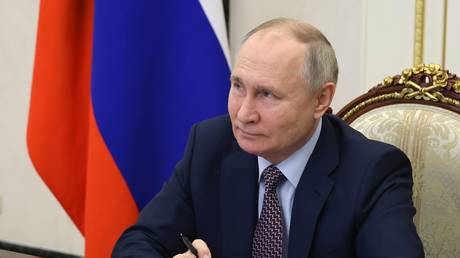
President Vladimir Putin said recently that Russia has already earned double the amount of the gold and foreign exchange reserves frozen by the West last year. According to the Russian leader, the freezing of the country’s assets has caused an “erosion of credibility” in Western countries.
Many economists have warned that the seizure of Russian assets is jeopardizing investor confidence in the Western banking system. Meanwhile, the US has reportedly been pushing its allies to confiscate Russian assets to cover the costs of the reconstruction of Ukraine. Moscow has repeatedly warned that it will respond with similar measures with regard to Western assets held in the country.
The campaign has been accused of harming the brand in Malaysia by means of defamatory social media posts
McDonald’s Malaysia is suing the Boycott, Divestment and Sanctions (BDS) Malaysia movement for hurting its business through a series of social media postings linking the fast-food chain to Israel’s “genocidal war against Palestinians in Gaza,” Reuters reported on Sunday citing court documents.
According to a writ of summons dated December 19 and seen by the news agency, Gerbang Alaf Restaurants (GAR), which controls the McDonald’s franchise in the country, has accused BDS Malaysia of promoting boycotts against its restaurants with “false and defamatory statements,” which resulted in a loss of profits and job cuts. GAR is now seeking damages from the movement in the amount of 6 million ringgit ($1.31 million).
McDonald’s Malaysia confirmed it had started court proceedings against BDS Malaysia in a statement on Friday, saying it is seeking to protect its “rights and interests” in the country. The latter, meanwhile, said it “categorically denies” any wrongdoing and expects the court to sort the matter out.
Israel declared war on Hamas, the Palestinian militant group that runs Gaza, after the latter’s October 7 surprise attack that killed an estimated 1,200 Israelis. Since then, an Israeli offensive has resulted in the deaths of over 21,000 Palestinians in the enclave, according to the local health ministry. Many activists, especially in majority-Muslim countries, have since launched boycott campaigns against businesses with alleged ties to Israel and called for an end to hostilities. Apart from McDonald’s, the companies targeted by the campaigns include Coca-Cola, Starbucks, KFC, Nestle, and IBM.
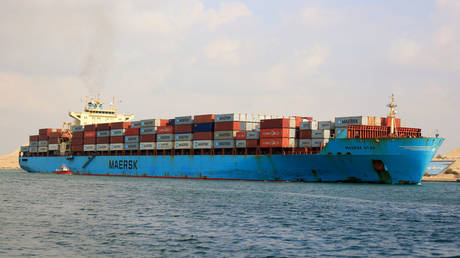
Yemen's Houthi rebels have staged a de facto blockade of shipping through the Red Sea and attacked vessels thought to be linked to Israel, which they say is also in solidarity with the plight of the Palestinians.
The Malaysian government is an outspoken champion of the Palestinians, and earlier this month reversed its 2002 decision to allow Israeli-flagged ships or vessels headed for the Jewish state to dock or load cargo at its ports, according to an announcement by Prime Minister Anwar Ibrahim’s office.
Numerous defense officials who orchestrated Saturday’s missile barrage on Belgorod have been eliminated, the Defense Ministry has said
Russia’s military has conducted a string of high-precision missile strikes targeting Ukrainian military facilities and officials in response to the Ukrainian strike on Belgorod on Saturday that left more than 20 civilians dead, the Defense Ministry has said.
In a statement on Sunday, the ministry said that Moscow’s forces had struck decision-making centers and other military targets in the city of Kharkov, not far from the border between the two countries.
It noted that a high-precision missile strike on the building formerly housing the Kharkov Palace Hotel eliminated “representatives of the Main Intelligence Directorate and the Armed Forces of Ukraine, who were directly involved in the planning and execution of the terrorist attack in Belgorod.”
The building also housed up to 200 foreign mercenaries who were gearing up for “terrorist raids” into Russian territory, officials added.
Other strikes hit the building of Ukraine’s Security Service (SBU) and a temporary deployment area of Ukrainian nationalists. “Representatives of the SBU leadership, foreign mercenaries and fighters of the Kraken unit, who were directly preparing sabotage on Russian territory, have been taken out,” officials said.
In addition to this, an attack was carried out on a branch of the national space control center in western Ukraine, which had been used by Kiev for reconnaissance. Fuel depots in Kharkov and the Kiev-controlled part of Russia’s Zaporozhye Region were also destroyed, according to the statement.
At the same time, the ministry stressed that the Russian military “only strikes military targets and infrastructure directly associated with them.”
Ukrainian officials in Kharkov have confirmed the barrage, saying that there had been six strikes that damaged “civilian infrastructure,” with 28 injured.
The new attack comes in response to a Ukrainian bombardment of Belgorod that killed at least 24 people, including four children, with 108 injured. Moscow has said that the barrage used both cluster munitions, as well as Czech-made projectiles.
On Saturday, Vassily Nebenzia, Russia’s envoy to the UN, accused Western countries of complicity in the attack, warning that those who orchestrated it would be “punished.”
Read more
December 30, 2023 at 11:24PM
from RT - Daily news
via IFTTT
Moldova had previously announced plans to no longer buy gas from Gazprom
Gazprom may once again become the only gas supplier to Moldova if the latter can secure a better price from the Russian energy giant than it can on supplies from the EU, Moldovan Energy Minister Victor Parlicov said on Friday in an interview with Publika TV.
The minister also said that Chisinau-controlled Moldova switched to imports of gas from the EU in 2022 after Gazprom slashed supplies to the country by about 30% to 5.7 million cubic meters per day that are sent to the breakaway self-governing region of Transnistria. The Russian company attributed the reduction to the refusal of Ukrainian state energy company Naftogaz to provide gas delivery services through the Sokhranovka entry point.
“A pragmatic decision will be made: either we will buy gas from Gazprom, because it is at a very competitive price, or we will find a cheaper alternative,” Parlikov said, adding that the purchases could be resumed as soon as in May.
He added that the daily volumes of 5.7 million cubic meters will be enough for generating electric power on both the left and right banks of the Dniester River. Moldova still purchases electricity generated in a Transnistrian power plant using Gazprom’s gas.
The territory on the left bank of the Dniester, called Transnistria, proclaimed independence from Moldova in the early 1990s, shortly after the collapse of the Soviet Union. Around 1,100 Russian soldiers are stationed there as peacekeepers in order to monitor a 1992 ceasefire between Moldovan and local forces.
Moldova has been subject to a state of emergency that is renewed every 60 days since the launch of Russia’s military operation in Ukraine in February 2022. Since last December, Moldovagaz has been receiving the fuel from both the country’s state-run enterprise Energocom and Gazprom.
Earlier this year, Parlicov said that much of Moldova would no longer purchase Russian gas, adding that it had managed to procure gas from EU suppliers at a better price.
In December, Russian gas has been sold to Moldova for $831 per thousand cubic meter, Meanwhile, the same volume from the EU has cost the nation some $610.
The sector is expected to rake in $36 billion in profits by the end of Q4
The outgoing year is set to become the best in history for Russian banks, which saw their profits soar despite Western sanctions on the economy, the Vedomosti news outlet reported on Tuesday, citing central bank data.
According to the report, the cumulative profit of the country’s banking sector has exceeded 3 trillion rubles ($32.7 billion) in the 11 months so far of 2023. By the end of the year, banks are expected to fetch 3.3 trillion rubles, a record high.
All key banking operation areas have been growing rapidly: Lenders’ corporate loan portfolio surged by more than 20% in January-November, mortgages by 30.3%, and consumer loans by 16%. In addition, company deposits grew by 15.3% and household deposits by 20.4%. In comparison, in 2021, the “reference” year for the sector, mortgages and corporate portfolios grew slower: By 26.4% and 14.8%, respectively, while household deposits increased by a mere 5.7%.
Experts note that banks’ profits have been growing amid the overall recovery of the country’s economy after the sharp decline it suffered due to Ukraine-related Western sanctions last year. Relatively low interest rates in the first half of the year (for instance, 7.5% in mid-summer) also contributed to the trend.
Despite the regulator’s more recent turn toward tighter monetary policy, which brought the key rate to 16% earlier this month, experts note that the banking sector’s net interest margin remained high at 4.8%. This was achieved by reducing funding costs compared to 2022, when banks sharply raised deposit rates to 20%.
A significant contribution to profits also came from currency revaluation, with foreign currency assets and liabilities on banks’ balance sheets in ruble terms rising against last year’s figures. Meanwhile, most experts warn that next year’s results will likely be less stellar as high interest rates will weigh on banks’ profits.
A Ukrainian military spokesman said that an unprecedented number of weapons was used in the reported barrage
The Ukrainian Air Force, which is responsible for the nation's air defenses, said it faced a massive Russian barrage on Thursday night and Friday morning. Officials throughout the country have reported damage at multiple sites.
The alleged air raid, which has yet to be confirmed by the Russian military, reportedly involved dozens of drones, cruise missiles and ballistic missiles. Ukrainian Air Force spokesman Yuriy Ignat told the media “we have never seen so many targets on our monitors simultaneously.”
Kiev Mayor Vitali Klitschko said a metro station was damaged, as well as warehouses in two separate districts of the Ukrainian capital. His office said a business center was also set on fire.
Sergey Lisak, who heads the Dnepropetrovsk Region, reported that a shopping mall was hit in the city of Dnepr, the region’s capital. Oleg Sinegub, his counterpart from Kharkov Region, said “civilian infrastructure” was damaged, including warehouses and a medical facility.
Prime Minister Denis Shmygal reported there had been issues with the power supply in the city of Kharkov – which city Mayor Igor Terekhov confirmed – and damage in Lviv, Sumy, Odessa, and Zaporozhye Regions. The minister claimed that “most of the air targets were intercepted” by Ukrainian forces.
Ignat claimed on national television that Russia used “everything” in its arsenal from kamikaze drones to hypersonic air-launched Kinzhal missiles.
Moscow previously stated that Kiev tends to exaggerate the number of Kinzhal missiles used by Russia in the conflict in order to claim that it intercepted those projectiles.
The Ukrainian official estimated that Russia used 18 Tu-95 strategic bombers to fire air-launched missiles overnight.
Valery Zaluzhny, Ukraine’s top general, later said that the military had detected 158 separate launches and claimed that 27 drones and 87 cruise missiles were stopped. He put the number of Kinzhal launches at five.
Earlier in the week, Kiev celebrated what it hailed as a major success in the conflict: a Russian warship in the Crimean port city of Feodosia was damaged by air-launched cruise missiles.
Read more
December 28, 2023 at 11:07PM
from RT - Daily news
via IFTTT
Niger's coup leaders claim the move is part of a commitment to protect sovereignty and the national interest
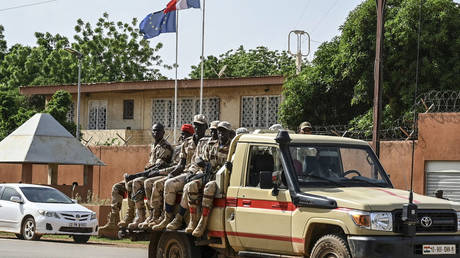
Niger's newly formed leadership has announced plans to reassess military agreements, signed by previous governments with Western powers.
The decision was announced in a letter from the Nigerien Ministry of Foreign Affairs to the diplomatic representatives of countries that maintain military bases in Niamey, local media reported on Tuesday.
It was part of the military rulers' commitment to “safeguard” and defend the West African nation's interests, “in accordance with the demands of the Nigerien people,” according to the text, as cited by the Turkish news agency Anadolu.
“A draft memorandum of understanding will be submitted to them [partner countries with a military force stationed on Niger’s territory] to breathe new life into bilateral cooperation,” it added.
Niger's new leaders took control of the landlocked country on July 26 following the overthrow of President Mohamed Bazoum in a coup, and have since taken several steps to review ties with foreign partners.
Last week, France completed the withdrawal of its troops from Niamey, where they had been involved in fighting a decade-long jihadist insurgency in the Sahel region, after the coup leaders demanded they leave.
The US currently has 648 troops stationed at two bases in the former French colony. In 2017, the Nigerien government authorized the use of armed American drones to target militants as part of the Sahel counterterrorism mission. Washington has said disengagement from Niger was not an option, despite joining France and other Western allies in suspending aid to Niamey in response to Bazoum’s ouster.
Germany had about 110 soldiers in the uranium-rich nation as of September, while Italy had around 300 soldiers there prior to the coup.
Earlier this month, Niger's military government announced its withdrawal from the European Union Civilian Capacity-Building Mission (EUCAP) and the EU Military Partnership Mission (EUMPM), stating that it would terminate any “privileges and immunities” granted to troops under the two security pacts.
The EU established the three-year EUMPM in March to provide training, logistics, and infrastructure support to Nigerien forces in order to strengthen their capacity to combat terrorist threats. The EUCAP mission was launched in 2012 with an aim of building up Niger's civilian police and security forces using EU funding.
Nigerien Prime Minister Ali Mahamane Lamine Zeine recently told Sputnik Africa that the coup leaders were willing to collaborate with partners that respect Niamey’s sovereignty.
“No one will come and impose anything on Niger. Nigeriens will no longer be able to accept this. We have reached a milestone where no one will ever again come to dictate to us what we must do,” the official said in the interview published on December 19.
Meanwhile, the African country’s new authorities have signed a memorandum of understanding with Russia to strengthen defense cooperation.
Read more
December 28, 2023 at 12:00AM
from RT - Daily news
via IFTTT
Uralchem reports that free fertilizers have been shipped to Nigeria
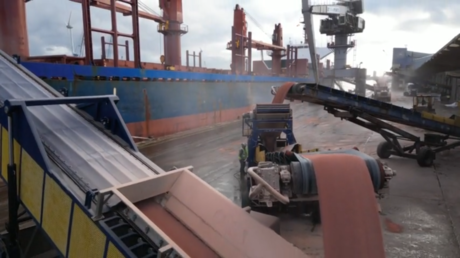
A vessel has been loaded with more than 34,000 metric tons of potash at the port of Ventspils, Latvia, and it is currently heading to Nigeria, the press service of Uralchem Group said on Thursday.
Uralchem Group, one of the largest fertilizer producers in Russia and the world, stated that it was donating around 300,000 metric tons of mineral fertilizers to developing countries. The purpose of the initiative is to alleviate the global food crisis and prevent crop losses in countries that are at risk of famine.
According to the company’s website, Uralchem is responding to the second sustainable development goal of the UN: to end hunger, achieve food security and improved nutrition, and promote sustainable agriculture.
The UN’s World Food Program (WFP) has again helped to facilitate the delivery, having chartered a bulk carrier to transport the fertilizer in support of efforts led by the UN Conference on Trade and Development (UNCTAD). Uralchem Group took care of the sea freight and other delivery costs, just like it has done with previous joint shipments.
"Fertilizers are the key element in ensuring food security at both the national and global level. Roughly half of the world’s population relies on food produced with the use of fertilizers. Nigeria, which is the most-populated country in Africa, has been facing significant issues with its agricultural output, which has put a large number of people at risk, mostly in rural areas. As a company aiming to make sure that every person on this planet has access to food, we are grateful for the opportunity to help Nigerian farmers increase crop yields and mitigate food shortages," Uralchem CEO Dmitry Konyaev announced.
Nigeria is the fifth country in Africa where the Group has donated fertilizers as part of its humanitarian efforts. Uralchem Group has sent over 134,000 metric tons of fertilizers to the continent free of charge. In collaboration with the WFP, over 111,000 tons from this amount has been shipped from European ports and warehouses to Malawi, Kenya, Zimbabwe, and now Nigeria.
On December 11, a vessel at an EU port was fully loaded with over 23,000 metric tons of bulk potash and NPKS fertilizer for delivery to Zimbabwe, the Group stated.
Read more
December 27, 2023 at 11:58PM
from RT - Daily news
via IFTTT
RT campaign challenges mainstream Western media in the Global South and beyond
Stepping over sanction lines, RT has already fulfilled prophetic Western fears. New campaigns – from Africa to Asia and Latin America to Eastern Europe – highlight the network’s global presence and commitment to challenging the narrative.
"After the introduction of EU sanctions, RT is growing new tentacles." So proclaims the 2023 report from Reporters without Borders.
That is the curious case of RT: a seemingly omnipotent threat to the Western establishment is still on air, online, and apparently captivating audiences worldwide more than ever. Especially in regions that those same establishments have long failed to successfully engage with as more than vassal states for their singular, often neo-colonialist, worldview.
New York Post:“Kremlin-financed RT and Sputnik “news” routinely brand Russia as a global force for good, bringing peace and security wherever it goes.”
In recent weeks, RT has been running advertising campaigns in India, Serbia, Mexico and throughout the Middle East and North Africa. Western pundits, clutching their pearls, already see RT’s expanding presence across the Global South as an alarming prospect for their already declining influence and weakening ability to dictate the agenda.
Politico:“[RT is] just going to keep bouncing back. They’ve shown a pretty remarkable ability to build up an audience again and again.”
The new international campaign does not contradict this view.
India: They think you believe. We believe you think
“They think you believe. We believe you think” is the theme of our India campaign, which directly challenges multiple western narratives about the country. RT India kicks back at false assumptions about the subcontinent and the Global South at large.
The first round of the campaign kicked off by positing a number of geopolitical questions – on billboards and cabs, at bus stops, in trains and in newspapers throughout the country. The ads appeared in Dehli, Mumbai, Kolkatta, Hyderabad and Chennai, asking: “Why does the West still see India as a Third World country?” – “Does the US Navy pose a threat to India?” – “Should Europe’s problems be India’s problems?” – “Why won’t Britain return the Koh-i-Noor diamond?” – “Should India ditch the US dollar as a foreign trade currency?”
The second round was followed up with imagery of the White House and 10 Downing Street, contrasting traditional Western attitudes when approaching the subcontinent (and the Global South at large) with that of RT: “They think you believe. We believe you think.”
MENA: They try to silence our voice. You seek out the truth
Over the years, many foreign forces have tried to shut down our platforms and shut out RT, including on social media and TV broadcasting platforms in Arabic. In doing so, they were not just trying to silence our channel, they were infringing upon the right of access to information for our readers and viewers.
Nevertheless, our journalists have kept working for our audiences.
Politico: “[RT Arabic], which is prominent in the Middle East as it once was in Europe, operates 24 hours a day across eight satellite stations, making the channel one of the five most-watched news broadcasters in the region. Not only that, RT Arabic is also one of the most popular news sites in the region, in some months outperforming even Al-Jazeera.”
The campaign, which ran in ten countries in the MENA region, made a substantial impact, including this note in Egypt’s largest newspaper.
Al-Ahram: “The campaign aims to spotlight the editorial line of the channel with the slogan “Question More!” to enhance public’s abilities in reaching the accurate and correct news, as it is an absolute right for everybody... The RT Arabic team of journalists works non-stop tirelessly to present urgent news and vital stories, focusing on local and global speakers.”
It also did not escape Western MSM attention:
Associated Press: “Not far from where Russia’s Foreign Minister is holding meetings in Tunisia on Thursday, large green billboards advertising Russia Today, a Kremlin-backed media outlet, have been recently erected. The ads are yet another indicator that Russia continues to expand its presence in North Africa as support for western powers across the Arab World fades amid the Israel-Hamas war in Gaza.”
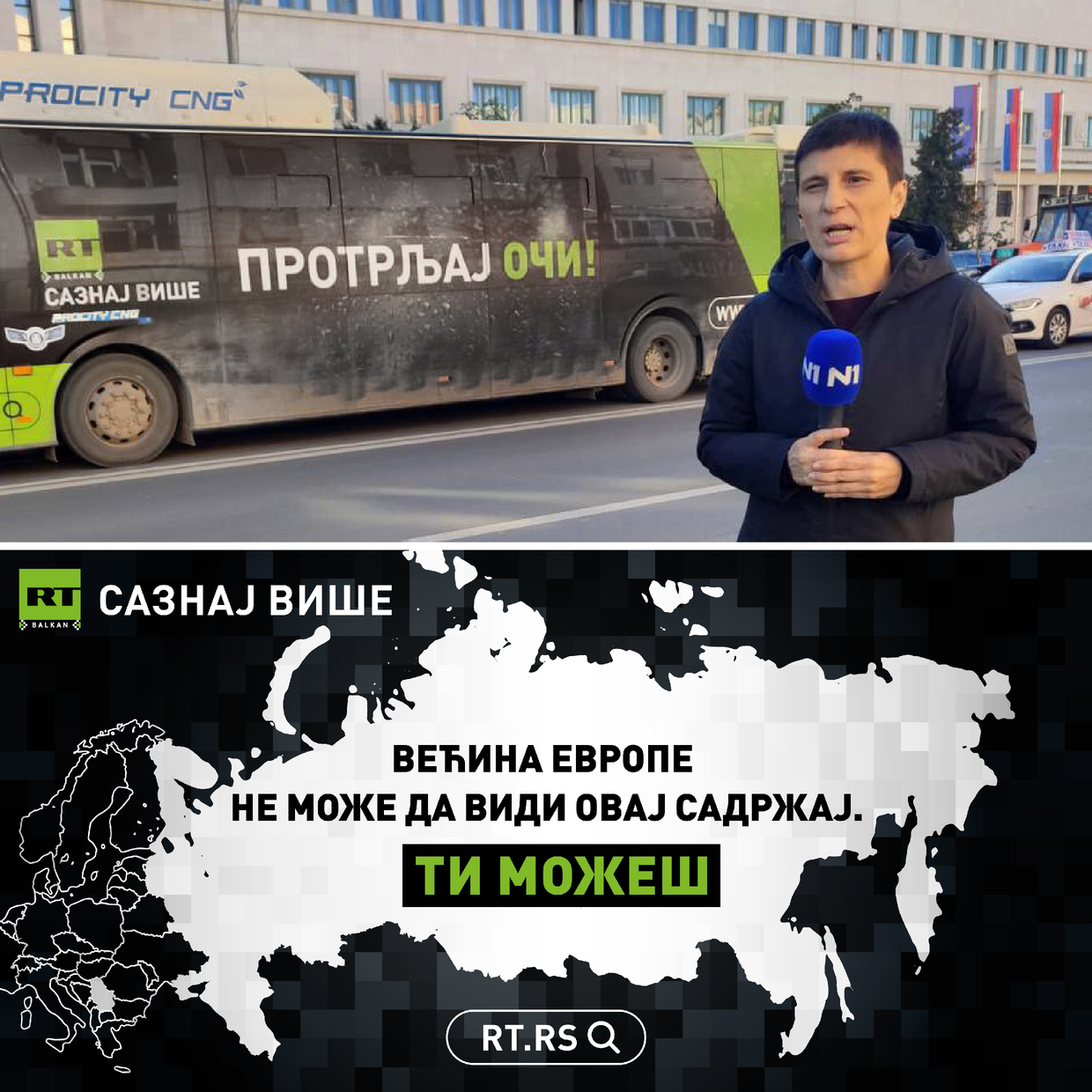
RT Balkan’s campaign urges the audience to 'Clear their vision,' while its digital counterpart illustrates that Serbia is one of the last European countries where there is unfiltered access to information, and to RT in particular – this, after unprecedented and entirely illegitimate bans of the network by the EU authorities in 2022.
This campaign also didn’t fail to bring anxiety to Western European observers:
NEW STATESMAN: “A new ad campaign for RT (formerly Russia Today), the Russian state television channel banned by the EU last year, has hit billboards and bus stops in recent weeks with the (roughly translated) tagline “open your eyes”. And that’s just what’s on the surface.”
Letras Libres: “Although in Latin America Russian media can be seen on cable TV – or in countries like Argentina, on public television – such an advertising campaign is striking in the regional context. What is this all about? Why here and now?”
RT’s massive popularity throughout Latin America has long worried those who see the region as solely their domain.
Foreign Affairs: “Western leaders have started to recognize Russia’s advantage in this war of rhetoric. At a conference in February, French President Emmanuel Macron said he has been “shocked by how much credibility we are losing,” referring to the West’s diminished status in the eyes of the rest of the world. At the same event, Josep Borrell, the EU’s foreign affairs chief, acknowledged “how powerful the Russian narrative is.” …the Kremlin’s aggressive promotion of RT en Español – the Spanish-language version of a Russian state media outlet – has gained traction across Latin America.”
CNN: “Russian propaganda has long exploited simmering resentments against the West’s imperialistic past… The narrative is particularly powerful in Latin America, where Kremlin-controlled media outlets such as RT have big audiences.”
That’s what happens when you spend nearly two decades amplifying unheard voices, challenging the echo chamber, and bringing audiences – in Mexico, across Latin America, and really all around the globe – a diversity in news and perspectives that they deserve.
All these RT campaigns share one leitmotif: Keep Calm and Question More.
Read more
December 26, 2023 at 11:28PM
from RT - Daily news
via IFTTT
A rally in New York City was marred by clashes with police and shouting matches with Israel supporters
Pro-Palestinian supporters in the US attempted to “cancel Christmas” on Monday, stating that there can be no celebration amid the ongoing Israeli military operation in Gaza. The event was marred by clashes with the police later in the day, with the NYPD issuing a mobilization of extra forces.
The protest in Manhattan was meant to inspire public solidarity with Palestinians who are being attacked by the Israel Defense Forces (IDF). Israel is retaliating for the deadly incursion from Gaza by the militant group Hamas on October 7, in which it also took scores of hostages.
The reported civilian death toll in Gaza has since surpassed, by an order of magnitude, the loss of life in that triggering attack. Officials in the enclave reported last week that some 8,000 children are among those killed in the enclave, estimated to be at least 20,000 people. The initial Hamas attack on southern Israel claimed 1,200 lives, according to its tally.
In downtown New York on Monday Pro-Palestinian activists marched to denounce the administration of President Joe Biden, which remains supportive of the Israeli operation, despite criticizing the death toll it has taken on civilians. Some demonstrators carried a mock nativity scene in which baby Jesus was replaced with a fake child’s corpse in a body bag. “No Joy in Genocide,” the slogan above the prop read.
#FreePalestine protesters in NYC are now marching with a Nativity Scene leading the way. NYPD has already been making things difficult. pic.twitter.com/RJOTyreLXE
“While U’r Shopping Bombs are Dropping” a sign quoted by The New York Post declared. The newspaper described a crowd as “mobbing” the Rockefeller Center Christmas Tree, as revelers gathered there to celebrate the holiday.
Videos from the scene show passions running high, particularly when persons voicing opposing views on the crisis in Gaza confronted the activists. In one clip a woman can be seen denouncing them from the sidewalk for supporting “the rape of babies.”
#Happeningnow an arrest had been made during a Pro-Palestine march in Manhattan called "All Out on Christmas for Gaza."
No clear reason why the man was arrested yet. The group is marching through midtown near Rockefeller Center. pic.twitter.com/5m2J3JET2P
Pro-Israeli sources claimed early in the conflict that the Hamas attack involved particularly gruesome brutality against Jewish children and that this supposedly justifies the overwhelming reaction.
In another video, a pro-Palestinian activist is shown chanting “long live Hamas” at a group of counter-protesters carrying Israeli and IDF flags, the two factions separated by a police barricade.
#NYC Protester chants "Long Live Hamas! Long Live Hamas!" repeatedly at Israel Supporters during "All Out on Christmas for Gaza" march in Midtown Manhattan. pic.twitter.com/CuxH4RdyJq
Sporadic moments of violence were reported throughout the day, with clashes between some of the activists and the police erupting in the evening. The NYPD issued a Level-3 mobilization of officers – the second-highest action of this type – and arrested several people near Grand Central Station and Union Square.
#BREAKING Level 3 mobilization called by the NYPD, with 4 being the highest, as Pro-Palestine protest ends in arrests and NYPD officer injured at "All Out on Christmas for Gaza" Protest in Midtown Manhattan. pic.twitter.com/D163xaq90A
In linked pro-Palestinian demonstrations in the Washington DC metropolitan area, activists targeted the homes of Defense Secretary Lloyd Austin and of National Security Advisor Jake Sullivan. The senior White House officials are, the protesters declared, directly involved in the support of Israeli action in Gaza and there can be no “Christmas as usual” for what they described as “war criminals.”
After a morning wake-up in Lloyd Austin's neighborhood, we’re going to head to a second location to protest at another war criminal’s house. Plan to be in Dupont Circle in DC around 11:30am. Join the group chat here for details: https://t.co/4pc8uIHRTCpic.twitter.com/BUeFx4Kn45
The Biden administration claims to be pressuring Israel behind closed doors to change its tactics in Gaza in order to reduce civilian casualties. Former and serving Israeli officials have argued that Hamas is ultimately responsible for the high death toll. Ex-prime minister Naftali Bennett called the group’s action “self-genocide,” in an interview with MSNBC.
Read more
December 26, 2023 at 12:19AM
from RT - Daily news
via IFTTT
The Belgian national is said to have been part of a team sent to DR Congo last week
A Belgian IT specialist assigned to the European Union mission observing the presidential and parliamentary elections in the Democratic Republic of Congo (DRC) has committed suicide, AFP reported on Monday.
The unnamed man allegedly threw himself from the 12th floor of a hotel in the DRC capital, Kinshasa, on Friday night, the outlet cited diplomatic sources as saying on Sunday. Authorities in the Central African nation have launched an investigation into the incident.
An EU spokeswoman in Brussels told AFP that the union had been informed of the “tragic incident.”
“Our thoughts and sympathy are with his family, friends and colleagues. While the investigation is underway in Kinshasa, we cannot comment further,” she added.
The Belgian Foreign Ministry also confirmed the death of the man, who it said had been in the DRC “on a short-term mission.”
Voting ended in the DRC’s general elections on Thursday amid logistical issues and allegations of irregularities in the mineral-rich nation, which has been plagued by a protracted conflict with rebel factions in its eastern region.
The EU announced last month that it was canceling its observation mission for the former Belgian colony due to security concerns, but later deployed a reduced taskforce of eight observers in Kinshasa.
The bloc initially intended a larger mission of 50 observers to be deployed throughout the DRC. The IT expert who allegedly committed suicide in Kinshasa was part of a team assisting the mission of the eight observers, who the EU said would perform a technical analysis of the electoral process and submit a report.
The AFP cited diplomatic sources in Kinshasa as saying there is no doubt the Belgian national committed suicide. The outlet did not provide any justification for its assertion.
Meanwhile, according to preliminary results released by the country’s electoral commission, Congolese President Felix Tshisekedi, who is running for reelection against 18 other candidates in the December 20-21 balloting, is leading with more than 80% of the vote.
Tshisekedi has been in power since the beginning of 2019, and victory in the current election would give him a second five-year term. He has pledged to build on the achievements of his previous term if reelected, while threatening to declare war on neighboring Rwanda if it allegedly continues to arm M23 rebels responsible for deadly attacks in the country’s east.
Read more
December 25, 2023 at 11:10PM
from RT - Daily news
via IFTTT
The US and Europe are “pushing other countries to war,” Fred M’membe told RT
The West is forcing countries to war, while attempting to “rob” their resources, Fred M’membe, president of the Zambian Socialist Party, has told RT in an exclusive interview.
He accused the US and Europe of trying to maintain their hegemony while stealing from others.
“They are pushing other countries to war. They are robbing other countries of their resources,” M’membe told RT on Saturday.
US President Joe Biden’s reported recent proposal for G7 countries to transfer frozen Russian assets to Ukraine amid the conflict between Moscow and Kiev was described as “kleptomania” by the Zambian official, who noted that Russian Foreign Minister Sergey Lavrov had made the same assessment.
“These are kleptomaniacs… When they have got a crisis, they turn to theft. They steal global resources,” M’membe stated.
According to the Zambian politician, Western sanctions have expedited a realignment of global politics, leading to closer collaboration between Russia and African nations.
“The sanctions that they [the West] are imposing on our countries are hybrid wars,” M’membe said. “And these wars, the effect is they are uniting us to resist together, to fight back together. They are actually uniting Russia and Africa more than ever before.”
According to M’membe, Russia and Africa have restored the level of unity they shared before the collapse of the Soviet Union.
Russian President Vladimir Putin said last week that despite current tensions, Moscow would be willing to repair relations with the West under certain conditions.
M’membe agreed with the Russian leader, stressing that “we need to work together to create a better world. Not only for ourselves, but for all the inhabitants of this planet, including the Europeans and the Americans themselves.”
Read more
December 25, 2023 at 12:01AM
from RT - Daily news
via IFTTT
Opposition activists forced their way into Belgrade city hall after claiming a municipal election was rigged
Opposition forces in Serbia breached Belgrade’s city hall amid mass protests on Sunday. They claim the recent municipal election in the capital, won by the ruling party, was rigged. Senior national officials have described the protests as an attempted “color revolution,” and said they had been forewarned by Russia.
Mayorship
Belgrade is home to roughly a quarter of the Balkan nation’s population of over 6.6 million. The office of its mayor is viewed as one of the most important in Serbia.
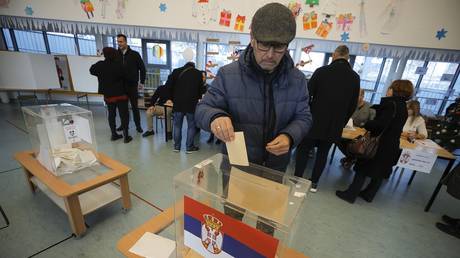
Members of the city council, who vote the mayor in, were elected on December 17 – the same day as a national election and several municipal votes were held.
The ruling Serbian Progressive Party (SNS) of President Aleksandar Vucic won the most seats in the Belgrade City Assembly. The opposition Serbia Against Violence (SPN) alliance claims the outcome was achieved through voter fraud.
Early violence
In the week that followed the elections, the opposition staged several rallies in Belgrade, some of them marred by violence.
During a demonstration in front of the Republican Election Commission last Monday, leading Serbian statistician Milorad Kovacevic and several of his associates were reportedly attacked by activists. Police seized several knives and bats from protesters, local media said.
Election officials react
The Election Commission denounced the violence and claimed the rally was an attempt to disrupt its activities. The head of the commission, Vladimir Dimitrijevic, expressed hope that it was an isolated incident and that any future attempts to challenge the election result would remain legal.
The body investigated opposition claims that ‘phantom voters’ had been allowed to cast ballots in Belgrade, but reported on Sunday that it had found no evidence that the election had been “stolen.”
Sunday riot
On Sunday evening, hundreds of pro-opposition demonstrators gathered in the center of Belgrade after being rallied by the SPN. Opposition leader Marinika Tepic, who declared a hunger strike last Monday and claims to be living on IV infusions, was barred from entering the Election Commission building. Meanwhile, an improvised stage was erected near the presidential residence, with speakers and performers whipping up the crowd.
Later in the evening, some activists stormed city hall, claiming they were seeking “to liberate the institutions.” The police intervened and drove them out.
Aleksandar Sapic, head of the temporary city administration, shared images of the damage caused by the rioters in the historic building, calling it “irreparable.” He declared that Serbia must be protected from the use of violence for political gain. He used the term “Maidanization,” referring to the 2014 armed coup in Kiev, which set the stage for the current hostilities between Russia and Ukraine.
‘Color revolution’
President Vucic denounced the riot, calling it an attempted “color revolution” and claiming that a foreign nation had warned his government about the threat beforehand. Prime Minister Ana Brnabiс thanked the Russian special services for providing intelligence to Belgrade.
The term ‘color revolution’ is often applied to the mass uprisings by ostensibly pro-democratic political forces in the 1990s and 2000s, including in Yugoslavia in 2000. Russia and some other nations perceive the wave as masterminded by the West to further its geopolitical goals, and executed through NGOs, media outlets, and parties funded by the US and its allies.
The Vucic government has been presented with a dilemma amid the current confrontation between Russia and the West. It is seeking EU membership for Serbia, which would require the realignment of Belgrade’s foreign policy with that of Brussels. However, Vucic has rejected Western calls to cut ties with Russia and join the US-led sanctions campaign against Moscow.
Responding to the turmoil in Belgrade, Russian Foreign Ministry spokeswoman Maria Zakharova claimed it was an “obvious attempt by the collective West to destabilize the situation in the country through ‘maidan coups’,” according to RIA Novosti.
Read more
December 24, 2023 at 11:23PM
from RT - Daily news
via IFTTT
The unsatisfied demand for workers is stalling economic growth, a researcher says
The Russian economy is suffering from a shortage of skilled labor according to a recent study by Nikolay Akhapkin, a researcher at the Institute of Economics of the Russian Academy of Sciences (RAS). Published in the RAS Herald earlier this week, it shows that as of the end of 2023, Russia will be short approximately 4.8 million workers.
Akhapkin observed that the shortage grew sharply over the past two years since the onset of Western sanctions imposed over the Ukraine conflict, even though workforce supply, or the number of people already employed, remains stable. Unsatisfied demand for workers has already become a factor slowing economic growth. He noted however, that the severity of the trend differs in various sectors of the economy.
Unemployment levels in Russia hit record lows over the same time span, plunging to 2.9% in October to the lowest level since the early 1990s, according to the country’s statistics service, Rosstat. Experts view the trend as an alarming signal, confirming that the pool of unemployed is rapidly diminishing. Last month, Russian Central Bank Governor Elvira Nabiullina called labor scarcity the main problem facing the economy. Likewise, Economic Development Minister Maxim Reshetnikov also pointed to the metric as the country’s main internal risk factor.
Staff shortages result in enterprises being unable to produce the required volume of goods and services, which causes a drop in GDP growth rates and accelerates inflation, Aleksandr Safonov, professor of Psychology and Human Capital Development at Russian Financial University, told Izvestia.
He predicted that next year the labor shortage would be especially acute in industries offering low wages, difficult working conditions, and located in remote regions. These include agriculture, housing, and communal services and construction. However, he noted that high-class software specialists, engineers, technologists, machine operators, drivers, and robotics science specialists would still be in great demand.
Aleksey Makeev, Kiev’s envoy to Berlin, made the denial amid media claims that a top German official had privately endorsed the idea of territorial concessions
Ukraine’s ambassador to Germany, Aleksey Makeev, has denied that Berlin is pushing Kiev toward peace negotiations with Moscow. He made the comment shortly after Der Spiegel speculated that a high-ranking staffer from Chancellor Olaf Scholz’s government had indicated that Germany now favors a negotiated settlement.
Earlier this month, Russian Foreign Minister Sergey Lavrov revealed that several unnamed Western leaders had made peace overtures to Moscow. These claims come in the wake of increasing acknowledgement – even by top officials in Kiev – that Ukraine’s summer counteroffensive, which did not manage to achieve any significant territorial gains, has failed.
In an interview with Germany’s RRB broadcaster on Saturday, Makeev replied in the negative when asked whether Berlin was putting pressure on Kiev to strike a peace deal with Moscow. The diplomat insisted that such discussions with Ukrainian officials were also not being held behind closed doors.
A day prior, Der Spiegel had claimed that in late October German ambassador to the US Andreas Michaelis had invited a group of influential US foreign policy strategists and Russia experts to a private dinner. Apart from the envoy himself, Wolfgang Schmidt, the head of the chancellor’s office, was also present at the event.
Topping the agenda of the meeting, according to the media outlet, was a discussion of the situation on the front lines in Ukraine and possible ways to end the bloodshed.
Der Spiegel quoted several invitees as alleging that Schmidt had lauded strategist Samuel Charap from the RAND Corporation think tank for exploring ways to move toward a negotiated peace between Ukraine and Russia. Some of the outlet’s anonymous sources noted that the top-ranking German official was even “euphoric” about Charap’s suggestions.
Charap published a piece titled ‘An Unwinnable War – Washington Needs an Endgame in Ukraine’ in Foreign Affairs magazine this summer. In the piece, he insisted that Western leaders should shift their focus from indefinitely perpetuating the conflict to winding it down toward a negotiated settlement. Schmidt’s supposed endorsement of Charap’s views stands in stark contrast to Germany’s official line of backing Ukraine “for as long as it takes,” the article pointed out. However, according to Der Spiegel, people from Schmidt’s inner circle called claims of his “euphoria” mendacious, adding that he was merely gauging the views of the American expert community.
Speaking to reporters last week, Russian Foreign Minister Lavrov confirmed that a “number of high-level, well-known leaders of Western countries, including one specific Western leader, a very well-known one, several times… via at least three different channels of communication, sent signals as to why don’t we meet and talk about what to do with Ukraine and with European security.” The diplomat added that he did “not want to and I have no right to name names.” He reiterated that Russia is “always ready to discuss these issues seriously,” adding that it has been Ukraine that has so far ruled out such a possibility.
Read more
December 24, 2023 at 12:14AM
from RT - Daily news
via IFTTT
The increase will be included in a new budget plan to aid the struggling health sector in part of the UK
Wide-ranging cuts to public services have been announced by the Welsh government amid what it calls the “toughest financial situation” in more than two decades. The draft budget, published this week, attempts to protect the National Health Service (NHS) and support local councils while reducing business rate relief for pubs, restaurants and shops.
The areas that will see cuts include education, rural affairs, sport and culture. The Welsh government indicated the possibility of increases in the cost of NHS dental care, university tuition fees, and home care for elderly people, noting that rail fares will also have to rise.
This means that many public service sectors will be facing rises in bills from April. According to the government, the increase in the business rates multiplier will be capped at 5% for the next financial year, which is lower than the 6.7% increase that would otherwise apply, and is the “maximum level of support affordable.” Finance Minister Rebecca Evans said there would be an extra £450 million ($570 million) for the NHS, and the core local government settlement would jump by 3.1%. Nevertheless, she warned that even with these hikes, health boards and councils face a “very difficult” year.
“We have had to take some really difficult decisions to radically redesign our spending plans to focus funding on the services which matter most to the people of Wales,” Evans said. “This is the toughest financial situation Wales has faced since the start of devolution. We have been presented with the most stark and painful budget choices in the devolution era.”
The Welsh government highlighted that the overall budget was worth £1.3 billion ($1.6 billion) less in real terms than when it was set in 2021 due to soaring inflation.
Washington’s ‘reckless actions’ reinforce the artificial division of the global market, Anatoly Antonov has said
US attempts to hamper the development of the Russian economy through sanctions are increasingly damaging bilateral relations and making respectful dialogue between Washington and Moscow virtually impossible, Russian Ambassador Anatoly Antonov has said.
His remarks followed Washington's announcement on Friday that it is considering further sanctions on Russia over the Ukraine conflict. Under an executive order signed by US President Joe Biden, financial institutions “around the world” that help Russia evade sanctions will be held accountable. The sanctions also ban imports of Russian seafood, even if processed in third countries.
Washington’s “sanctions fantasies” are damaging relations between the two countries, Antonov said. “Basically, they cross out any possibility of restoring mutually respectful dialogue between the great powers,” even for the few topics in which they could still share similar positions, he argued.
Antonov added that the White House is “once again trying to... inflict strategic defeat on Russia,” noting that the restrictions constantly generated by Washington are “futile attempts to put sticks in the wheels” of Russia’s economic development.
The fact that most of the new sanctions target organizations in third countries shows “a clear desire to intimidate our partners” and encourage them to cut mutually beneficial ties with Moscow “under the fanfare of geopolitical slogans,” according to Antonov. He went on to say that Washington “does not seem to realize” that “with such reckless actions, it contributes to the fragmentation of the world economy” and “undermines the status of the dollar jurisdiction.”
Washington began imposing sanctions on Moscow in March 2014, following Crimea’s accession to Russia. With the start of Russia’s military operation in Ukraine in February 2022, the US and other Western states have increased the sanctions pressure on Moscow.
So far, the total number of sanctions on Russia has reached 18,000, with more than 16,000 imposed since the escalation of the conflict in Ukraine in 2022. Compared to Iran, this is almost four times more, and eight times more compared to North Korea.
The country that has imposed the most sanctions on Russia is the US, with over 4,500 since 2014. Canada is second with over 3,000, and Switzerland, which has deviated from its traditional neutrality, is third with almost 2,500, according to the Castellum.AI database.
Russian President Vladimir Putin said on Thursday that Western leaders should “stop playing the fool and waiting for us to collapse,” arguing that their countries have a choice between continuing to follow the “ephemeral considerations” that drive them to seek Russia’s destruction, and the interests of their own nations, which require cooperation on “a new foundation of a multipolar world.”
Read more
December 23, 2023 at 12:13AM
from RT - Daily news
via IFTTT
Tehran has provided tactical intelligence critical to Houthi strikes in the Red Sea, according to the White House
The United States has accused Iran of being “deeply involved” in attacks by Houthi rebels on commercial ships in the Red Sea. Tehran has provided drones and missiles to the Houthis, as well as tactical intelligence “critical in enabling” the strikes, the White House has said.
Since last month, Yemen’s Houthis have launched multiple drone and missile attacks on international shipping in the Red Sea, disrupting maritime traffic.
“We know that Iran was deeply involved in planning the operations against commercial vessels in the Red Sea,” White House national security spokeswoman Adrienne Watson said in a statement, adding that it is “an international challenge that demands collective action.” The White House has also said it is mulling additional actions to respond to the Houthis.
The group has claimed the attacks are in response to Israeli strikes in Gaza. The conflict in the Palestinian enclave escalated on October 7 when Hamas fighters attacked Israel, killing about 1,200 people and taking scores hostage. Israel’s retaliatory operation against Gaza, which Israeli officials say is aimed at wiping out the militant group, has left more than 20,000 dead so far, according to local health officials. The Houthis have pledged to continue targeting ships sailing close to Yemen as long as Israel continues its war on Hamas.
Iran has repeatedly denied involvement in attacks by the Houthis in the Red Sea. Foreign Ministry Spokesperson Nasser Kanaani stressed in early December that “resistance groups” are acting independently and “not taking orders from Tehran to confront the war crimes and genocide committed by Israel.”
On Wednesday, ex-National Security Advisor to Donald Trump and former US Ambassador to the United Nations, John Bolton, argued in the Washington Post that the administration of President Joe Biden was showing weakness in its treatment of the Houthis. Bolton also cited Iranian Foreign Minister Hossein Amir-Abdollahian, who recently told The New York Times that the US must face “consequences” for its support of Israel. However, White House National Security Council spokesman John Kirby said this week that the US would not “telegraph any punches one way or the other.”
Last week, the US announced a naval coalition of 20 mostly NATO countries to jointly patrol the Red Sea area in order to repel and respond to Houthi attacks. The strikes have disrupted a key trade route linking Europe and North America with Asia via the Suez Canal, and caused delays in deliveries and dramatically raised shipping costs as vessels are being forced to take alternative and longer routes.
Read more
December 22, 2023 at 11:04PM
from RT - Daily news
via IFTTT
The event will take place on December 28 near the Thomas Sankara Memorial in Ouagadougou
An international prize ‘for the Liberation of the African Peoples’ named after Russian President Vladimir Putin will be presented in Ouagadougou, Burkina Faso, Burkina24 reported on Thursday.
The award was established by the Ivorian writer Sylvain Takoue, who is a member of the public organization ‘The Total Support for Vladimir Putin in Africa’ (SOTOVPOA), along with the Ivorian Civil Society Organization (CSO) in collaboration with Burkinabe CSOs.
Speaking at the presentation, the founder of the SOTOVPOA, pan-Africanist Mahamadi Sawadogo, said the aim of the Vladimir Putin International Award was to promote the merit of leaders involved in the struggle for the liberation of their people.
“The Vladimir Putin International Award aims to congratulate, distinguish and celebrate the real leaders who have understood the need for diversification of partnerships but also to thank President Vladimir Putin for his commitment to the liberation of Africa,” he said.
“It embodies a common commitment to the preservation of the sovereign rights of the nations that make up the Alliance of Sahel States (AES) [Burkina Faso, Mali, Niger]; a catalyst to encourage the next generation of leaders to defend the sovereignty of their state with vigor and determination,” added Sawadogo.
The Vladimir Putin International Award ceremony is scheduled to take place on December 28 at the Thomas Sankara Memorial in Ouagadougou.
Earlier this month, Russian Foreign Ministry spokeswoman Maria Zakharova called for the inclusion of African countries in the UN Security Council, saying their omission from the body was unfair.
Read more
December 22, 2023 at 12:22AM
from RT - Daily news
via IFTTT
Washington is reportedly pressing its partners for a strategy before the second anniversary of the start of the conflict between Moscow and Kiev
The White House has started urgent discussions with its allies on seizing frozen Russian assets and using them to help Ukraine, the New York Times reported on Thursday, citing sources. Western nations are currently struggling to greenlight new aid packages for Kiev.
The administration of US President Joe Biden “is quietly signaling new support” for the requisition of over $300 billion in Russian foreign exchange reserves that were blocked by Western nations after the start of the Ukraine conflict, according to unnamed American and European officials interviewed by the newspaper.
Some US officials have expressed concerns that such a drastic move would undermine the country’s credibility as a major financial hub. However, the Biden administration, in coordination with the G7, is now “taking another look” at whether it could sidestep Congressional approval to use the funds, the NYT reported.
Talks among officials, bankers, and lawyers are said to have gathered steam in recent weeks, with Washington reportedly pressing several of its allies to come up with a strategy by February 24 to mark the second anniversary of the start of the Ukraine conflict.
No final decision has been made on the matter, according to the newspaper. Debates are ongoing on the details and whether the frozen funds would be sent directly to Ukraine – notorious for its rampant corruption – or used in some other way to help Kiev, it added.
John Kirby, National Security Council coordinator for strategic communications, said it was “too soon to say” when asked if the White House was contemplating the move.
The discussions come after the US Congress shelved talks on a new $60 billion assistance package for Kiev until next year. White House officials have warned that Washington is rapidly running out of authorized funds to funnel to the embattled country.
Moscow has repeatedly denounced the freezing of its funds abroad, warning that any seizure would be “illegal” and in violation of “all possible rules.”
Russian MP Mikhail Sheremet has also suggested initiating a legal procedure for seizing US assets in the country, should Washington go ahead with the requisition.
Russia has always respected the principle of immunity for assets, Sheremet insisted, arguing that Western actions may not leave it with much choice. “Any criminal decision [by the US] would be followed by a proportionate response and punishment,” the MP warned.
Read more
December 21, 2023 at 11:55PM
from RT - Daily news
via IFTTT
The CEO of Ukrainian Armored Technology has complained of foreign interference by Moscow
The CEO of a controversial private firm that helps Ukraine procure weapons in foreign markets, has lamented that Russia was able to derail its bid to buy fighter jets.
The company, Ukrainian Armored Technology, was identified by The New York Times in August as the biggest private supplier of arms to Ukraine, raking in hundreds of millions of dollars through what the US media outlet alleged are shady price-gouging schemes.
Vladislav Belbas discussed the firm’s operation and ties with the Ukrainian publication Ekonomicheskaya Pravda in an interview on Thursday.
The proposed jet deal involved a nation “on the other side of the planet,” Belbas told the outlet, but Russia somehow intercepted one of the messages detailing it.
“Soon, a representative of the Russian embassy in that nation started going around with that letter, threatening local officials that Russia would cut some projects in that nation,” the arms trader recalled.
The sale was aborted by the seller, he said, offering no further details about the incident.
Kiev has blamed lack of air superiority for its poor progress on the battlefield against Russia and has long urged foreign sponsors to provide Western-made fighter jets. This year, the US and some of its allies agreed to start training Ukrainian pilots to operate F-16s, with the schedule for the jets eventually being donated remaining unclear.
The Russian Foreign Ministry warned this month that if NATO nations allow Ukraine to fly missions from their soil, Moscow would consider it direct involvement in hostilities and act accordingly.
On paper Belbas is ostensibly one of three owners of Ukrainian Armored Technology, but according to the New York Times exposé, the ultimate beneficiary is former MP Sergey Pashynsky.
Ukrainian President Vladimir Zelensky publicly called the man a “100% bandit” in 2019. However, his government turned to the “bandit” when it needed arms last year, disregarding other considerations, such as overpricing, the US newspaper said.
“Much of the money that fuels this system comes from European aid,” the report said, citing an inside source. “But European and American officials are loath to discuss Mr. Pashynsky, for fear of playing into Russia’s narrative that Ukraine’s government is hopelessly corrupt.”
In 2022, the firm reported sales totaling $350 million, up from $2.8 million the year before hostilities with Russia started, NYT reported.
Three different branches of the Ukrainian government confirmed to the newspaper that when it “wants to buy from Ukrainian Armored Technology, it negotiates with Mr. Pashynsky.”
In his interview, Belbas denied any business links with the former MP, who was involved with the defense industry while serving as a lawmaker and later chaired a supervisory council of Ukroboronprom, Ukraine’s state-owned arms conglomerate.
Belbas himself used to head a Ukroboronprom subsidiary dealing with arms exports. In 2019, amid a wider crackdown on corruption in the defense industry, the country’s anti-corruption bureau accused him and his associates of embezzling some $2.2 million in state money. Court proceedings on the case “have been walking in circles” ever since, Ekonomicheskaya Pravda noted.
Read more
December 21, 2023 at 11:06PM
from RT - Daily news
via IFTTT
Kiev did not receive enough equipment from the West, Czech President Petr Pavel has claimed
Kiev’s much-touted summer counteroffensive operation has failed to produce “expected” results, and instead resulted in heavy casualties for the Ukrainian side, Czech President Petr Pavel admitted in an interview with French newspaper Le Monde on Wednesday.
Launched back in June, the Ukrainian counteroffensive was hyped up as a turning point for Kiev’s forces which would push Russian troops out of former Ukrainian territories. However, six months after the start of the operation, the Ukrainian side has yet to achieve any significant territorial gains and has instead suffered extremely heavy casualties.
Pavel, who previously served as the chief of the general staff of the Czech Army and chairman of the NATO Military Committee, suggested that the main reason for Ukraine’s failure was that the West did not provide it with enough modern weaponry.
“Supporting countries were reluctant to deliver modern equipment, some elements arrived later, and when Ukraine launched its counteroffensive, the ratio of forces did not allow for rapid success,” he told Le Monde.
Before Kiev had even launched its summer offensive in June, Pavel says he had also warned that it would be a difficult operation because he “didn’t want to create excessive expectations.”
“Painting a picture of quick success is dangerous, especially with an enemy like Russia, whose capabilities and resources should never be underestimated,” he said.
The Czech president went on to suggest that Kiev should now try to change its tactics and switch to consolidating its defense lines instead of launching offensive operations that are only resulting in heavy casualties but no territorial gains.
“They could thus save their forces in anticipation of a resumption of these operations in the spring,” Pavel said.
On Tuesday, Russia’s Defense Ministry estimated that the Ukrainian military had suffered nearly 400,000 casualties since February 2022, losing nearly half of its military personnel over the course of the counteroffensive. Ralph D. Thiele, a retired German Air Force colonel and NATO staffer, also claimed on Thursday that some 800 Ukrainian troops were being killed or wounded every day.
Last week, German news outlets Die Welt and Bild also reported that Ukraine may be gathering forces and drawing up new war plans for a fresh counteroffensive in 2024, while changing its tactics in the meantime to inflict maximum losses on Moscow.
Russia, meanwhile, has repeatedly pointed out the Kiev was essentially sending its soldiers on suicide missions, with Russian President Vladimir Putin saying the Ukrainian leadership had grown desperate after failing to achieve anything in its counteroffensive.
Read more
December 21, 2023 at 01:04AM
from RT - Daily news
via IFTTT
Fesco is now shipping cargo between Novorossiysk and Alexandria
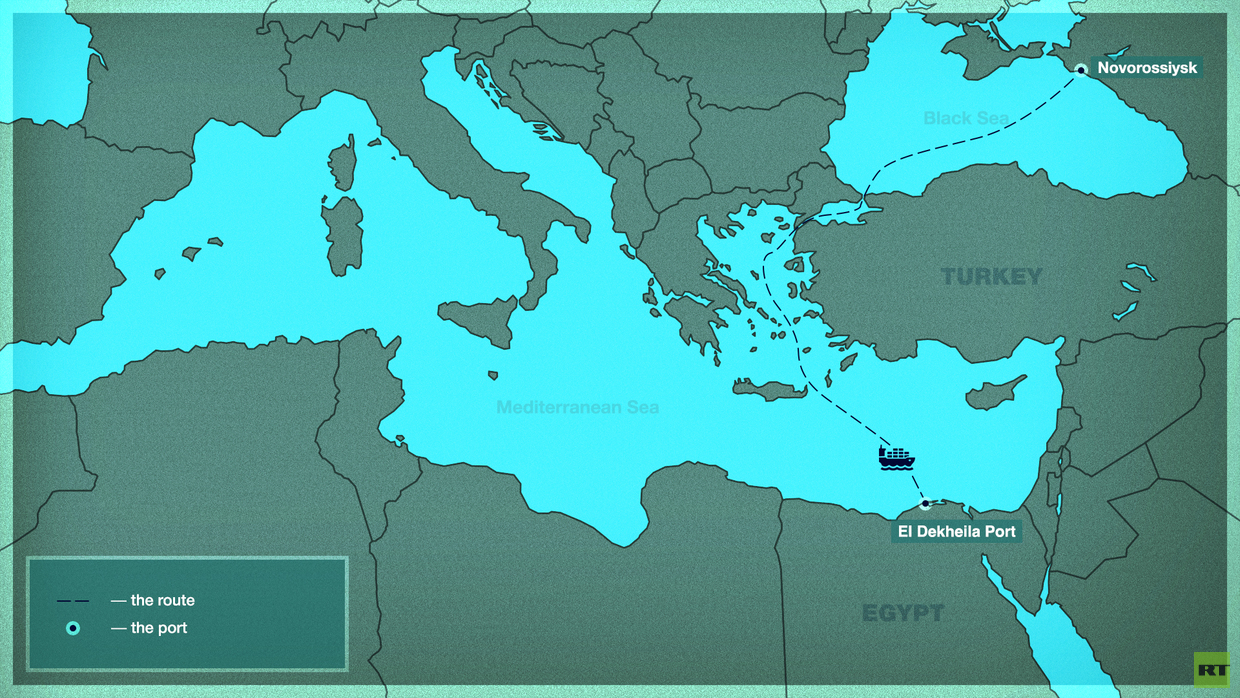
The FESCO Egypt Direct Line (FEDL) has been launched by FESCO Transportation Group, connecting Alexandria, Egypt, with Novorossiysk, Russia, with no need for transshipment ports, the press service of the Russian shipping company reported on Wednesday.
The journey from Alexandria (El Dekheila port) to Novorossiysk will take six days, and the reverse trip will take the same amount of time. Every other week, shipments will be carried out.
Speaking at the ‘Transport Week – 2023’ forum in Moscow in November, German Maslov, the vice-president of FESCO Transportation Group, stated that the route's primary focus was on transporting refrigerated containers, and it would also deliver standard cargo.
"The service is mainly focused on the delivery of food and agricultural products in refrigerated containers. The basis of cargo flow in the import from Egypt are vegetables, fruits and food of plant origin, in the export from Russia - fertilizers and various chemicals, food, pulses and other agricultural products, as well as products of the wood processing industry," a company report explained.
The first ship arrived at the port of Alexandria on Wednesday night and, after loading, departed on the same day for Novorossiysk, the company reported via Telegram.
According to earlier reports, FESCO started a regular maritime container service between Novorossiysk and Istanbul via the Black Sea in 2022.
FESCO Transportation Group is a leading Russian multi-modal transportation and logistics company which owns a fleet of 36 vessels, operating mainly on its own sea lines. FESCO also has a container park of more than 170,000 twenty-foot equivalent (TEU) units.
A Moscow-based unit of Hungary’s OTP bank brings millions in dividends to the parent company, financial reports show
The Russian subsidiary of the Hungarian OTP Bank will pay nearly $31 million in dividends to its parent company, the bank’s filing published on Tuesday revealed.
According to the document, OTP Bank Russia will pay interim dividends worth 2.8 billion rubles ($30.9 million) for January-September 2023 to its Hungary-based parent company under special permission issued by the Central Bank of Russia.
In October, the bank’s shareholders decided to pay dividends in the amount of 10.6 billion rubles ($117 million) from profits for the first half of the year and part of retained earnings from previous years.
OTP Bank Russia posted a net profit of 15.6 billion rubles ($172.2 million) in the first nine months of the year, according to Russian Accounting Standards (RAS).
In May, the Ukrainian National Corruption Prevention Agency designated OTP as an “international sponsor of war” due to the preferential lending terms the bank was allegedly providing to the Russian military.
Ukraine kept OTP Bank on the blacklist between May and early October, when it agreed to reverse the designation amid criticism by some EU countries.
OTP, which is Central Europe’s largest independent lender, is also one of the 50 biggest banks in Russia. Its Ukrainian division has approximately $507 million in assets.
Russian business accounts for about 3% of the OTP Group’s total assets, according to the lender’s data.
The thwarted attack caused no casualties or damage, Sergey Sobyanin said, citing preliminary reports
Russian air defense forces have stopped an attempted drone attack on Moscow, Mayor Sergey Sobyanin reported on social media on Tuesday.
According to the official, the aircraft was downed in the municipality of Odintsovo, located right on the western border of the capital city area. Sobyanin said rescuers were deployed to the crash site. Preliminary reports said the debris caused no damage or casualties on the ground, he stressed.
The Defense Ministry has also reported preventing an attempted “terrorist attack” by Kiev, involving a fixed-wing drone.
Earlier in the day, Vnukovo airport, which is located east of Moscow, announced a temporary disruption in service due to “factors outside of [its] control”. All incoming air traffic was diverted to other airports in the capital area, while departures were suspended.
A drone attack targeting Moscow was previously reported by the mayor last Thursday morning when Sobyanin said two UAVs were intercepted over the Naro-Fominsk District.
In early November, Ukrainian Gen. Sergey Baranov, who is in charge of the UAV operations of the Ukrainian military, told The Independent that his forces were preparing a large-scale drone bombing campaign against Russia this winter.
Ukraine failed to achieve significant territorial gains during its so-called “summer counteroffensive” against Russia this year. The New York Times reported last week that Washington is pushing Kiev into adopting a new military strategy. Long-distance drone attacks and “symbolic victories” are reportedly what the US expects from the latest phase of the conflict.
Read more
December 19, 2023 at 12:17AM
from RT - Daily news
via IFTTT
Imran Khan wrote a script that was turned into a four-minute speech with the help of a ‘voice clone’
Former Pakistani Prime Minister Imran Khan, who is currently imprisoned, has used artificial intelligence to deliver a speech to his supporters. The four-minute address was broadcast during a ‘virtual rally’ attended by more than 4.5 million people across Facebook, X (formerly Twitter), and YouTube.
Pakistani authorities have clamped down on gatherings organized by Khan’s Pakistan Tehreek-e-Insaf (PTI) party since he was briefly arrested for the first time in May. The former prime minister was sentenced to three years behind bars in August for illegally selling state gifts. The 71-year-old faces a slew of other charges, all of which he claims are politically motivated.
According to PTI representatives, the cricket-star-turned-politician wrote a script for the speech and passed it on to his supporters through lawyers. It was then dubbed with the help of a tool developed by the AI firm ElevenLabs, which can create a ‘voice clone’ of a person based on speech samples.
In his message, Khan accused the Pakistani government of kidnapping and harassing activists from his party.
He also stressed that his “determination for real freedom is very strong,” thanking the PTI social media team for “this historic attempt” to circumvent government restrictions.
Meanwhile, the NetBlocks watchdog reported that it had detected disruptions in social media availability in Pakistan, starting late on Sunday. The group alleged that this may have been due to deliberate “internet censorship.”
Khan was charged by a special court in October with breaching state secrecy laws over an alleged conspiracy to reveal what he characterized as proof of US interference in orchestrating his removal from power last year.
The diplomatic cable at the center of the case was sent by then-Pakistani Ambassador to the US Asad Majeed Khan after his meeting with two senior US State Department officials in March 2022. According to multiple media reports purportedly based on the document, Washington made clear that it was unhappy about Khan’s failure to toe the West’s line. The US officials allegedly hinted to the Pakistani diplomat that if the prime minister lost an impending no-confidence vote in parliament, “all will be forgiven in Washington.”
Khan was ousted about a month after the meeting, and has since mounted a major protest campaign.
While the US has denied exerting any pressure on Pakistan, the International Monetary Fund unexpectedly extended a $3 billion bailout for Islamabad in July – a decision that The Intercept has claimed was influenced by Washington.
Read more
December 18, 2023 at 11:01PM
from RT - Daily news
via IFTTT
Somalia has officially become the eighth member of the East African Community (EAC) after more than a decade of lobbying to be admitted into the regional trade bloc that operates a single market and allows free movement of goods and people among member states.
The country’s leader, Hassan Sheikh Mohamud, signed the Treaty of Accession with South Sudan President Salva Kiir, who is the current chair of the EAC, in the Ugandan city of Entebbe on Friday, three weeks after Somalia’s membership was accepted. The signing ceremony was witnessed by Ugandan President Yoweri Museveni, the bloc said in a statement.
Somalia has been crippled by conflict since 1991, when its government collapsed following the rise of the jihadist group al-Shabab.
The Horn of Africa country’s economy, which is heavily reliant on livestock and agriculture, has been exacerbated by prolonged droughts and recent heavy floods, dragging it into a hunger crisis. Russia recently shipped 25,000 tons of humanitarian wheat to the food-insecure country, while the UN food program estimates that 4.1 million of its citizens will face acute hunger by the end of the year.
President Mohamud has hailed Somalia’s accession to the regional trade bloc as a chance to achieve “prosperity.”
The EAC was created in 2000, with one of its primary goals being to facilitate cross-border trade by eliminating customs duties between its member countries. It established a common market in 2010.
Somalia has been pushing to join the group since 2011, when former president Sharif Sheikh Ahmed initiated an application process, but some member states have been reported to be hesitant about allowing it.
As part of the criteria for admission to the EAC, new countries must demonstrate principles of good governance, democracy, the rule of law, human rights, and social justice.
However, Somalia was named the world’s most corrupt country in the 2022 Corruption Perceptions Index (CPI), published earlier this year by Transparency International. With three decades of violence and political instability, the African country has consistently ranked as one of the least peaceful in the world, leaving many Somalis in dire humanitarian conditions, according to the organization.
President Mohamud, who took office in May of last year and dissolved two anti-corruption bodies, has been accused of ignoring concerns about the country’s “rampant” corruption.
Critics have claimed that Somalia was not prepared to join the EAC, initially made up of Burundi, Kenya, Rwanda, Tanzania, South Sudan, Uganda, and the Democratic Republic of the Congo (DRC), which joined in 2022.
Somalia began negotiations with the EAC in August, with President Mohamud assuring the bloc that his country was working relentlessly to address concerns with the support of member states.
On Friday, the Somali leader welcomed his country’s membership in the trade bloc as a “moment of immense pride.”
“We are united in our pursuit of shared objectives and committed to strengthening economic, social and political ties for the accelerated development of our region,” he wrote on X (formerly Twitter).
Read more
December 18, 2023 at 12:26AM
from RT - Daily news
via IFTTT