The country will begin gas exploration, scrapping a year-long freeze on new drillings
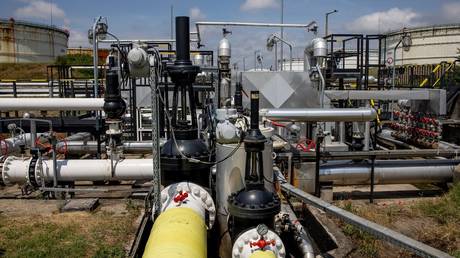
Israel will begin the process of launching a fourth exploration for natural gas in its territorial waters, Energy Minister Karin Elharrar said on Monday, according to The Jerusalem Post. The decision has reportedly come in response to a growing energy crisis in Europe as the continent attempts to cut its dependence on Russia.
The decision also comes despite earlier plans to halt all searches for natural gas in Israel during 2022, in order to focus on renewable energies. Those plans were announced by Elharrar in December.
“The State of Israel is pitching in and helping Europe diversify its energy sources,” the minister said at a press conference, as quoted by the Post. “The global energy crisis provides an opportunity for the State of Israel to export natural gas, along with the honest and real concern for what is going on in Europe.”
Elharrar explained that the ministry aims “to ensure Israel's energy security, the diversity of our energy sources and investment in renewable energies, and the Israeli economy’s gas reserves for the coming decades.”
An Algerian gas facility has been leaking methane into the atmosphere for almost four decades, scientists say
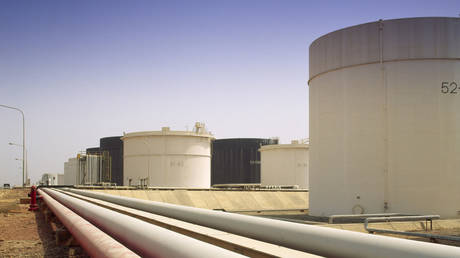
A compressor station at the Hassi R’Mel gas field in Algeria has been leaking large quantities of methane, a powerful greenhouse gas, for nearly four decades, scientists from Valencia Polytechnic University have warned after analyzing satellite data.
The results of the study risk complicating the EU’s climate goals as Algeria is seen by Brussels as a substitute for Russian gas supplies, which the bloc intends to abandon in response to the conflict in Ukraine, Bloomberg reported on Tuesday.
It’s difficult to estimate the total amount of emissions from the facility, but the researchers said that it’s releasing around 4.5 metric tons of methane into the atmosphere every hour.
According to other estimates by Kayrros SAS, a geoanalytics firm, the emissions from the whole Hassi R’Mel gas field spiked by a staggering 67% last year, reaching 939,000 tons of methane, which has 84 times the warming power of CO₂ in the short term.
Experts claim that such an amount delivers the same damage to the environment as 17 million cars.
Algeria currently supplies around 8% of the EU’s gas, but the volumes could grow if the bloc fulfills its plan to give up on Russian supplies.Last week, European Commission President Ursula von der Leyen reiterated that the EU’s goal in the long run was to “get rid of the overall dependency on Russian fossil fuels, all three of them [gas, oil, and coal], and never to go back again.”
However, Brussels has acknowledged that it couldn’t cope without gas from Russia at the moment.The high emission levels could make it hard for the EU to deal with Algeria due to the green policies pursued by the bloc.
Scientists have long known Hassi R’Mel to be a methane hotspot, but, according to Bloomberg, the fresh analysis would put even more pressure on European lawmakers to tighten control for leaks in the North African nation.
However, persuading Algiers to act might be complicated in the current situation, Antoine Vagneur-Jones of the clean energy research group BloombergNEF said. “The danger now is that Algeria holds more of the cards” due to a push by Brussels to cut energy ties with Moscow, he pointed out.
Algerian state oil and gas company Sonatrach, which runs the Hassi R’Mel gas field, claims that its own emission estimates are “much lower than those announced elsewhere.”
Algiers also wasn’t among the 100 capitals that pledged to reduce emissions by 30% by 2030 during the UN Climate Change Conference in Glasgow last year.
Read more
May 30, 2022 at 11:28PM
from RT - Daily news
via IFTTT
A reverse ‘ruble-for-gas’ scheme will be used to cover interest payments, minister says
A scheme similar to the one Russia uses to get foreign payments for its natural gas will be used to service its sovereign debt, Finance Minister Anton Siluanov has explained to a Russian business daily. Debtholders will need to open two accounts in a designated Russian bank to get what is due to them, Vedomosti reported on Sunday.
Russia has long used the Western-controlled financial system for payments related to its debt, but access has been restricted under the sanctions imposed in retaliation for February's attack on Ukraine. Washington previously allowed payments to Russian Eurobond holders – first using its frozen foreign reserves and later proceeds from its foreign trade – but last week the US Treasury announced that the waiver won’t be extended.
Speaking to Vedomosti, the minister said that Russia intends to use a scheme similar to the one introduced for buyers of its natural gas, based in “unfriendly nations,” to circumvent the US ban. The ministry previously said the debt would be paid in rubles.
The gas scheme, which was launched to ensure that payments in foreign currency are not seized by Western nations, requires that customers from "unfriendly" states open two accounts in a Russian bank. The payments are made in euros then converted to the Russian currency.
“The eurobonds payment mechanism will work the same way, but in reverse,” Siluanov said, adding the ministry will soon finalize the arrangement and will be ready to present it to debtholders. The minister previously said Russia will have a mechanism ready to pay eurobond coupons by late July.
The American restrictions are intended to prevent Russia from serving its sovereign debt, potentially resulting in a technical default. But US officials admit that it would be more a symbolic blow against Russia showcasing the country’s supposed status as a pariah on the world stage.
“If Russia [defaulted], I don’t think that really represents a significant change in Russia’s situation. They’re already cut off from global capital markets,” US Treasury Secretary Janet Yellen said. She added the now-expired exemption existed “to allow a period of time for an orderly transition to take place, and for investors to be able to sell securities.”
Moscow has also downplayed the threat, saying that missed payments on sovereign debt orchestrated by the US would be a case of financial sleight-of-hand not reflecting Russia’s real financial state. Unlike the painful default on domestic debt in 1998, it wouldn’t affect the domestic situation in the country, the finance ministry explained.
Read more
May 29, 2022 at 11:14PM
from RT - Daily news
via IFTTT
LNG demand is expected to outstrip supply as the West shifts away from Russia, data shows
The liquefied natural gas (LNG) market could be hit with a potentially historic shortage this winter as the world rushes to secure the super-chilled fuel, Bloomberg reported this week, citing experts.
According to the sources, the EU’s plan to cut imports of piped Russian gas by two-thirds by the end of this year and replace it with LNG from the US and Africa is sharply intensifying competition for the power-plant and heating fuel.
In a normal year, LNG importers stock up on supplies for the peak winter season over the summer. They started replenishing stockpiles earlier this year, people with knowledge of the matter said, noting that the looming supply crunch risks driving up electricity bills and inflation.
“This coming winter has everyone on edge,” James Whistler, the global head of energy derivatives at Simpson Spence Young, told the media outlet. “All things point to tight supply under normal conditions, but additional risks are also present,” he added.
Rystad Energy estimated this month that global demand will hit 436 million tons in 2022, outpacing 410 million tons of available supply.
Meanwhile, traders are diverting LNG shipments away from Asia, and choosing to sell to Europe instead, where prices are more attractive.
“There’s no surplus capacity across the global gas complex, leaving Europe and Asia in a tug-of-war for available supply,” said Michael Stoppard, global gas strategy lead and special advisor at S&P Global Commodity Insights.
Gas prices in Europe have eased from a peak in early March, but are still well above average levels for this time of year. The declines may give the region’s buyers more scope to replenish stockpiles in the next few months, experts say, noting that a lot will depend on how quickly Chinese demand comes back.
Consumption in Asia’s biggest economy, which is still battling the Covid pandemic, still remains subdued, but analysts expect a sharp upsurge in buying later in the year.
“Strong LNG demand in Europe is certain but the wildcard is China, where current demand remains weak given ongoing Covid-19 lockdowns and slowing economic growth,” said Valery Chow, the Asia-Pacific head of gas and LNG research at Wood Mackenzie. “The market will tighten going into winter as European and North Asian buyers compete for volumes,” he said.
The IRNA TV channel runs footage from inside the facility, without disclosing the location
Iran’s state media has offered its viewers a rare glimpse of one of the country’s underground military drone bases, with the footage depicting rows of combat UAVs parked inside the facility.
The video broadcast on Saturday is said to have been shot in the Zagros mountain range, which stretches from Iran’s Gulf coast all the way to its border with Iraq and Turkey in the north-west. No further details regarding the base’s location were disclosed, with the correspondent explaining that it had taken him 45 minutes to reach the base by helicopter from the city of Kermanshah in western Iran. All through the trip, which reportedly took place on Thursday, the journalist was blindfolded, and was only allowed to see his surroundings on arrival.
Chief of Staff of the #Iranian Armed Forces Major-General Mohammad Bagheri visits one of the Army's secret drone bases . He was briefed on the latest capabilities in the field of producing various military, offensive and long-range UAVs. pic.twitter.com/uWysD8j9P5
The footage featured rows of combat drones carrying missiles, parked in a tunnel several hundred meters long, according to the report. Some of the military UAVs were apparently armed with Qaem-9 missiles, an Iranian copy of the US-made air-to-surface Hellfire. One model which was featured in the report, the Kaman-22, is said to be able to cover a distance of at least 2,000 kilometers (1,245 miles).
Video aired on state television also showed Iran’s Armed Forces Chief of Staff General Mohammad Bagheri and army Commander Abdolrahim Mousavi inspecting the underground base.
In the piece, Mousavi stated that there was “no doubt the drones of the Islamic Republic of Iran’s armed forces are the region’s most powerful.” He went on to add that Tehran’s “capability to upgrade drones is unstoppable.”
The military official also revealed that the secret facility was “several hundred meters underground.”
According to the report, “more than 100 combat, reconnaissance and attack drones belonging to the army are kept for operations in this base.” General Bagheri described the fleet of UAVs as “strategic.”
Bagheri pointed out, however, that there was no time for complacency, saying that the Iranian Armed Forces “never underestimate threats, we never assume the enemy is asleep, and we are constantly alert and vigilant.”
Iran first launched its military drone program back in the 1980s, during the war with Iraq.
The US, Israel and Saudi Arabia accuse Tehran of providing its regional allies with combat drones, with Lebanon’s Hezbollah movement, the Syrian government and Yemen’s Houthi rebels named as the alleged recipients.
Washington claims Iranian drones were behind the September 2019 strike on a Saudi oil refinery and the July 2021 attack on a commercial vessel off the coast of Oman that killed two crewmen.
Iran strongly denies any involvement.
In October 2021, the US Department of the Treasury imposed sanctions on Tehran’s drone program.
Read more
May 28, 2022 at 11:58PM
from RT - Daily news
via IFTTT