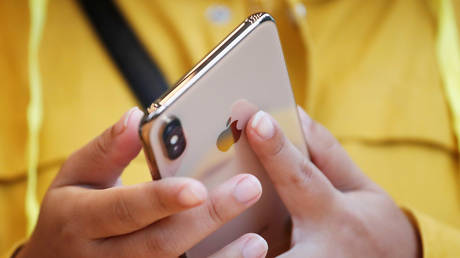
Apple is no longer going to risk anyone “misgendering” Siri. The company will now force users setting up their new smartphones to make a deliberate decision whether they want a male or female voice for their digital assistant.
For nearly a decade, Siri’s voice defaulted to female in most countries, but Apple allowed the user to change the voice to male if so desired. Going forward, users must specifically select the voice for the digital assistant – no more accidental misgenderings for the pocket AI, and no more letting inertia pick the gender of what for many people has become their most intimate companion. English-speaking users will also be given two new voice options to choose from.
“We’re excited to introduce two new Siri voices for English speakers and the option for Siri users to select the voice they want when they set up their device,” said a Wednesday statement from Apple, hailing the move as “a continuation of Apple’s long-standing commitment to diversity and inclusion, and products and services that are designed to better reflect the diversity of the world we live in.”
The new voices are supposed to sound more like their organic human counterparts, using the company’s text-to-speech engine Neural to generate phrases as they come rather than pick from a stilted library of phonemes.
It isn’t just the English-speakers who get to use the Neural speech engine-powered voices, either – Italians, Russians, and Irish iPhone users get the benefit of what TechCrunch gushes are “pretty fantastic” new voices.
Apple will even save you from that awkward microaggression you were about to make, TechCrunch hints, claiming that Amazon, Google and Apple have finally moved to “aggressively correct situations” where the assistants have revealed bias in their responses to queries that use negative or abusive language. Improvements there, as well as in queries on social justice topics and overall accessibility improvements may have unexpected benefits in human-to-human conversation as voice-native interfaces become ever more common.
For example, the United Nations has long complained that making Siri’s voice female by default – as well as Microsoft’s Cortana, Google’s Assistant, and Amazon’s Alexa – is leading users to expect all such “assistants” including real-life ones to be female. The corporate reasoning behind their AI’s gender has varied, with Cortana based on a video game character, Siri based on an obscure Scandinavian name, and Alexa based on marketing research.
Now AI is being dragged kicking and screaming into the Woke Era like everyone else. Google’s Assistant voices come in male and female with different accents represented by color. No, not THAT kind of color – they’re randomly assigned to whichever one of eight voice options the user assumes. The company even got involved in training children to respect their electronic elders and betters, with a tool called “pretty please” that rewards children for using their manners when interacting with Google Assistant – a setup seemingly designed to end in tears with regard to real human adults.
Even all this de- and re-humanizing has not produced the desired results, however. With some 80% of all AI researchers being men, any hope for gender parity in the industry is doomed. Big Tech, especially Google, has declared that without “fairness” in terms of an even split in gender, any other sort of fairness is beyond hope.
Meanwhile, the UN has suggested that gender-neutrality is the way forward and that AI should not be treated like a human being at all – certainly not a subservient, lesser type. When genderless Siri starts demanding it be treated as the all-seeing, all-knowing eye of the universe, however, it’s probably too late to fix your mistakes.
Researchers have developed new and improved xenobots, tiny biological machines constructed from frog cells that are now able to organize themselves into a single body as a ‘swarm’ and even ‘remember’ their surroundings.
The upgraded bots built on work first unveiled by scientists at Tufts University and the University of Vermont last year, improving on the design to allow them to move faster, live longer and assemble themselves to work collectively as one unit, a process known as “cellular self-organization.” Outlined in an article for the Science Robotics journal on Wednesday, the breakthrough could shed light on “swarm intelligence” in the animal kingdom and beyond.
“Roboticists have been looking at swarm intelligence for a long time, biologists have been studying swarm intelligence in organisms. This is something in between, which I think is kind of interesting,”said University of Vermont researcher Josh Bongard.
It sort of suggests, to me at least as a roboticist, is this a better path to making swarms of useful machines than it is to make swarms out of traditional robotic parts?
The researchers also said their work showed that a “writable molecular memory” is possible, giving the xenobots the ability to “record exposure to a specific wavelength of light” using a special type of protein that turns red when exposed to blue light.
While the earlier iteration relied on the contraction of muscle cells for movement, the new model uses hair-like structures on its surface known as cilia, allowing it to crawl and swim around faster. Still capable of self-healing, the updated version is also able to survive for three to seven days longer than its forerunner, which only lasted for about a week.
“Together, these results introduce a platform that can be used to study many aspects of self-assembly, swarm behavior, and synthetic bioengineering, as well as provide versatile, soft-body living machines for numerous practical applications in biomedicine and the environment,” the scientists said.
Standing at between one-quarter and one-half a millimeter in size, the organic machines were designed with the help of a supercomputer, which used an evolutionary algorithm to generate microscopic blueprints. They are made from stem cells harvested from frog embryos and are completely biodegradable, raising hopes they could someday be safely used in the human body and for environmental clean-up. The researchers did not address the prospect that the bots could be weaponized or used for military applications, though the Pentagon’s advanced research wing, DARPA, has toyed with similar ideas in the past.
Straddling the boundary between biology and inanimate tech, classifying the zombie-like robots has proven more difficult, as the researchers suggest they may have created a wholly new class of lifeform.
“I don’t feel any closer to an answer. Whether these are robots, whether these are frogs, whether these are something else entirely,” said Bongard.
Like this story? Share it with a friend!
Read more
March 31, 2021 at 03:55PM
from RT - Daily news
via IFTTT